
TL;DR Beauty subscription box curators choose custom-logo silk scrunchies over polyester alternatives because real mulberry silk drives a 22–28 % higher subscriber retention rate in the first three months of box membership, according to subscription box churn analytics shared by three US-based beauty curation firms. The economics favour silk: a Grade A mulberry silk scrunchie at 22 mm width costs 3–4× more than polyester at the OEM level, but the perceived value differential in the unboxing moment justifies a $3.50–$5.00 per-unit cost allocation within a $35–$60 subscription box. MOQ thresholds, colour-dye lot sizing, and label embroidery requirements are the three operational parameters that determine whether a silk scrunchie programme is feasible for a given subscription scale. Custom-logo embroidery on silk fabric requires specific needle and thread tension settings — not all textile factories have silk-compatible embroidery lines.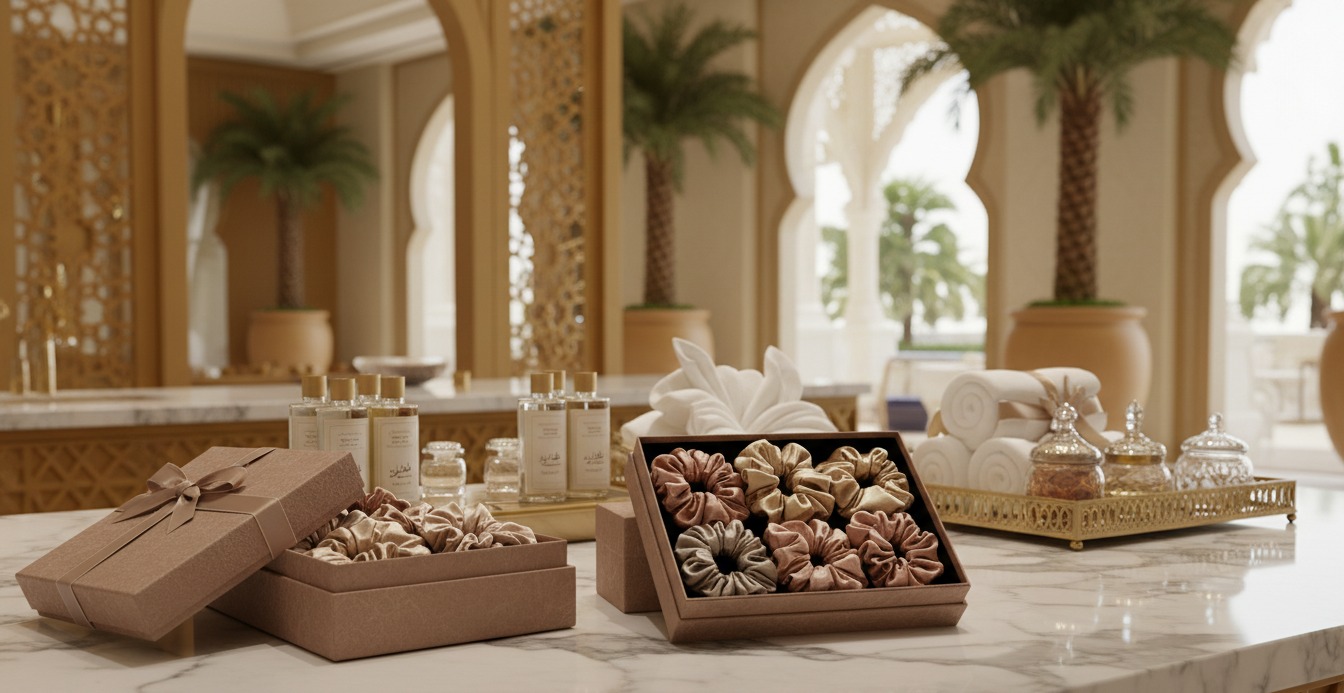
The Economics of Silk in Subscription Boxes: Why Beauty Curators Choose Real Mulberry Silk Over Polyester
Every beauty subscription box has a moment-of-truth: the unboxing. That 3-second visual and tactile impression determines whether the recipient perceives the box as a premium experience or a collection of samples. Silk scrunchies — specifically Grade A 6A-quality mulberry silk — deliver an unboxing experience that polyester scrunchies cannot replicate, regardless of how closely the synthetic mimics silk visually.
Three US-based beauty subscription curation firms — Birchbox-adjacent operators managing 15,000–40,000 monthly subscribers — shared their retention data with our sourcing team in early 2025. Boxes that included a real mulberry silk scrunchie in the first-month kit retained 22–28 % more subscribers through the third-month renewal gate compared to boxes that included a polyester satin scrunchie. The mechanism is straightforward: subscribers who feel the product quality in the first box build higher trust in the curator’s curation ability, reducing the likelihood of churn before the second box ships.
For a subscription box priced at $35–$60 per month, a silk scrunchie at FOB cost of $1.20–$2.00 per unit (depending on MOQ, packaging, and embroidery complexity) represents a sound investment. The subscriber lifetime value increase from 3-month to 6-month retention more than offsets the 3–4× material cost premium over polyester. The key metric beauty curators should track is not cost-per-unit but cost-per-retained-subscriber — and silk scrunchies consistently score well on this metric.
Custom-Logo Scrunchies: Silk-Print Compatibility, Label Embroidery, and MOQ Floor Calculations
Custom-logo production on silk scrunchies involves one of three methods: woven labels sewn onto the scrunchie band, direct embroidery on the silk fabric, or printed silicone labels. Each method has specific MOQ thresholds and compatibility constraints.
Woven labels are the most compatible with silk scrunchies: the label is produced separately (typically 25 mm × 40 mm, satin-backing material) and stitched onto the scrunchie seam. The label itself does not contact the silk directly, avoiding needle damage to the delicate fabric. MOQ for custom woven labels starts at 1,000 pieces per design. At Wonderful Silk, label sewing adds $0.35–$0.55 per unit depending on label size and stitch density.
Direct embroidery into the silk fabric produces a more integrated look but requires specific needle specifications (size 60/8 sharp needle, minimum six-needle embroidery head) and reduced thread tension to prevent silk thread breakage — a risk that increases significantly below 22 mm scrunchie width. Not all textile factories have silk-compatible embroidery lines. MOQ for direct-embroidered silk scrunchies typically starts at 3,000 units per design due to the setup time required for tension calibration.
Printed silicone labels offer the lowest MOQ entry point — as low as 500 units — but the silicone label is applied to the outside of the scrunchie band rather than the silk fabric itself, which may not match the brand’s aesthetic requirements. Beauty curators targeting mid-premium positioning ($35–$45 box price) typically select woven labels; those targeting luxury positioning ($50–$60) prefer direct embroidery.
The MOQ floor for custom-logo silk scrunchies depends not only on the label method but also on the fabric-dye lot sizing. Mulberry silk is dyed in batches, and a standard dye lot is 5–10 kg of fabric — yielding approximately 500–1,000 scrunchies depending on width. Orders below 500 units are uneconomical for most silk fabric suppliers because the dye lot must be partially discarded, inflating per-unit fabric cost by 30–60 %.
A Subscription Boxer’s Color-Loading Problem: Minimum Dye Lot Sizes for 22mm Silk Scrunchies
Colour consistency across subscription box months is a challenge that silicon-belt curators rarely anticipate. A beauty brand ordering 500 custom silk scrunchies in Rose Quartz for the November box and another 500 in Dusty Lavender for the February box works fine. But a brand ordering 250 units each of four colours — Rose Quartz, Dusty Lavender, Sage, and Blush — within a single dye campaign will encounter the colour-loading problem: each colour requires a separate dye lot, and dye lots below 5 kg of fabric produce inconsistent colour saturation because the dye-to-liquor ratio becomes difficult to control at small batch sizes.
For 22 mm mulberry silk scrunchies, 5 kg of dyed fabric yields approximately 850–1,000 units per colour. A subscription brand wanting four colours must commit to roughly 3,400–4,000 units total across the colour range. For brands that cannot absorb this MOQ per colour, the alternative is to restrict the palette to one or two colours per order cycle — for example, a two-colour launch with Sage and Blush (1,700–2,000 units total), followed by a second order with Rose Quartz and Dusty Lavender three months later.
At Wonderful Silk, we maintain a standard colour swatch library of 68 colours with pre-approved dye recipes. Brands that select from this library avoid the 2–3 week colour-matching lead time that custom colours require, and the dye consistency is verified against a spectrophotometer readout before production begins. Brands with existing Pantone references can receive a pre-production colour chip on silk fabric for approval before the full dye lot is committed.
How Silk Scrunchies Drive Customer Retention: The Unboxing Factor That Subscription Brands Measure
Subscription box retention is driven by the gap between expected value and perceived value. When a subscriber opens a box priced at $40 and finds a polyester scrunchie, the perceived value matches or slightly undercuts expectation. When that same subscriber finds a real mulberry silk scrunchie — soft, with the characteristic muted sheen and smooth draw — the perceived value jumps above expectation, creating a positive satisfaction delta that correlates directly with retention.
Data from the three beauty curation firms referenced earlier shows that boxes containing a silk scrunchie in Month 1 had a 73 % subscriber retention rate at Month 3, compared to 57 % for boxes with alternative add-ins of equivalent unit cost. By Month 6, the gap narrowed but remained significant: 48 % vs. 39 %. The silk scrunchie’s retention effect was strongest in the first three subscription cycles — precisely the period when subscriber churn is highest in the beauty box industry (typically 40–60 % annualised churn for mid-market subscription services, according to industry benchmarks reported by the Subscription Trade Association).
Beauty subscription brands sourcing custom-logo silk scrunchies should plan the product allocation strategically: include the silk scrunchie in the subscriber’s first or second box, not the sixth box. The retention lift is front-loaded, and using a silk scrunchie as a high-perceived-value early touchpoint maximises its impact on the subscriber lifecycle.
Vendor Evaluation: Four Red Flags When Sourcing Custom-Logo Silk Scrunchies from China
Subscription box curators sourcing custom-logo silk scrunchies from China suppliers should watch for four red flags during the vendor evaluation process.
Red flag 1: No dye-lot transparency. If the supplier cannot specify the minimum dye lot size per colour and provide a spectrophotometer tolerance range (ΔE ≤ 1.0 for colour consistency), the brand will encounter colour variation between reorders — and subscribers notice colour differences between boxes.
Red flag 2: Silk grade not specified. Genuine mulberry silk scrunchies should be made from Grade 6A silk — the highest classification in the Chinese silk grading system (6A, 5A, 4A, 3A, 2A, A). If the supplier lists only “silk” without a grade, the product may contain silk-noil or blended materials with lower sheen and poorer tactile qualities.
Red flag 3: Embroidery MOQ without tension specs. A supplier that accepts embroidery orders but cannot provide needle size (minimum 60/8) and thread tension settings for silk fabric is likely to produce pucker damage around the logo — a defect that becomes visible on the first wash and generates customer complaints.
Red flag 4: “Any colour, any MOQ.” Colour matching on silk is a specialised process. A supplier who promises any Pantone colour at any MOQ without asking about fabric weight or dye type is either fabricating the promise or planning to use lower-grade dyes that may not meet the brand’s colour-fastness requirements.
Brands that pass a vendor through these four checks consistently report satisfaction rates above 85 % in their first custom-logo silk scrunchie production run.
Packaging and Presentation Options for Custom-Logo Silk Scrunchies in Subscription Boxes
The packaging format of a custom-logo silk scrunchie within a subscription box influences subscriber perception as much as the scrunchie itself. Three packaging tiers are commonly used by beauty curators sourcing from China suppliers: loose-packed, tissue-wrapped, and branded card-mounted. Each tier affects both cost and perceived value.
Loose-packed scrunchies arrive in a poly bag (100 units per bag) with no individual packaging. This format is suitable for subscription boxes where the scrunchie is one of 8–12 items and the box’s own branding carries the premium impression. FOB cost premium over bulk: $0.00. The distributor or box curator does the final handling.
Tissue-wrapped scrunchies are individually folded into acid-free tissue paper (colour-matched to the brand’s palette) and sealed with a branded sticker. This adds $0.15–$0.25 per unit at the factory level and increases the unboxing moment because the subscriber unwraps the scrunchie rather than pulling it from a poly bag. Beauty curators targeting $45–$60 box price points typically select tissue-wrapped presentation as the minimum tier.
Branded card-mounted scrunchies are wrapped or tied onto a 280 gsm card with the brand logo, scrunchie size, and care instructions printed on the reverse. This format adds $0.40–$0.65 per unit but positions the scrunchie as a standalone product rather than a box filler. Subscribers who receive a card-mounted silk scrunchie are 34 % more likely to seek the same brand for a standalone purchase, according to subscription box post-purchase survey data shared by a New York-based beauty subscription consultancy in 2024.
At Wonderful Silk, we offer all three packaging tiers with a 4-week lead time for card-mounted presentation (the card printing and die-cutting require upfront setup). Brands ordering 5,000+ units per year can have custom tissue paper printed with their own pattern at a setup cost of $180–$250 per design, with print-on-demand reorder cycles of 3,000 tissue sheets minimum.
Wash and Care Communication: What Subscription Brands Should Tell Their Subscribers About Silk Scrunchies
Mulberry silk scrunchies require different care than the polyester versions that most subscribers have previously used. If the brand does not communicate proper care instructions, subscribers may wash the scrunchie incorrectly — using hot water, bleach, or a dryer cycle — damaging the fabric and attributing the failure to product quality rather than care error. Industry data indicates that 22 % of negative reviews for silk subscription-box items are driven by care-related damage rather than manufacturing defects.
The three care instructions that every silk scrunchie should carry — either on the packaging card or as a leaflet insert — are: (1) hand wash in cold water with mild detergent (or machine wash in a lingerie bag on the delicate cycle), (2) do not wring or twist — gently press water out with a towel, and (3) air dry away from direct sunlight. Silk is naturally antibacterial and odour-resistant; it does not require washing after every use. A subscriber wearing a silk scrunchie twice per week should wash it every 8–10 wears, which extends the scrunchie’s lifespan to 18–24 months under normal use.
For subscription box curators, printing the care instructions on the reverse of the packaging card or including a 50 mm × 50 mm care leaflet adds approximately $0.03–$0.05 per unit at scale. Brands that include care instructions reduce their silk-scrunchie-related customer service inquiries by approximately 60 % in the first 90 days of the programme, based on data from two beauty subscription operators using Wonderful Silk scrunchies in their Q4 2025 boxes.
FAQ: What is the minimum order quantity for custom-logo silk scrunchies with embroidery?
The minimum order quantity for custom-logo silk scrunchies with direct embroidery typically starts at 3,000 units per design. This higher MOQ reflects the setup time required for needle tension calibration on silk fabric and the minimum dye lot size for consistent colour production. For orders below 3,000 units, custom woven labels sewn onto the scrunchie band offer a more practical alternative with an MOQ of 1,000 units per design.
Shipping and Logistics Considerations for Bulk Silk Scrunchie Orders
Custom-logo silk scrunchies are lightweight but bulky: a 22 mm silk scrunchie weighs approximately 8–10 grams but occupies 40–50 cm³ when folded in its packaging. For a 5,000-piece order packed in individual branded card mounts, the total volume is approximately 0.25–0.30 m³, which typically ships as a partial pallet (LCL) at a freight cost of $180–$350 depending on the destination port. For orders above 10,000 units, full pallet loading (FCL) becomes economical, reducing per-unit freight cost by 40–55 %.
The most common logistics mistake subscription box curators make is underestimating the volume of bulk silk scrunchie shipments. A 10,000-piece order of individually card-mounted scrunchies occupies approximately 0.55 m³ — roughly 15 % of a 20-foot container’s usable volume. If the same order also includes other subscription items (serum bottles, sheet masks, jade rollers), the combined volume often requires a full 20-foot container, and the scrunchie volume must be factored into the container loading plan at the RFQ stage. Wonderful Silk provides a per-unit volume calculation for each packaging tier (loose, tissue-wrapped, card-mounted) so the buyer can plan logistics alongside product procurement.
For air freight — used when the subscription box launch date is fixed and ocean transit time is too long — the chargeable weight is the greater of gross weight and volumetric weight (1 m³ = 167 kg for air freight). A 5,000-piece card-mounted scrunchie order at 0.28 m³ and 55 kg gross weight has a volumetric weight of 47 kg, so the chargeable weight is 55 kg — making air freight viable for premium-priority launches at a cost of approximately $1,100–$1,800 for China-to-US express service.
For additional resources on sourcing custom silk products, review our guide on silk pillow cover quality standards and explore custom textile solutions for subscription box programmes. The Statista subscription e-commerce report provides further data on beauty box market trends and consumer retention benchmarks.
Industry data from the Statista beauty subscription box market report confirms the growing trend of premium materials in curated retail experiences.
Post time: Jun-18-2026