
TL;DR — Spa Retail Revenue Through Silk Eye Masks
- A luxury spa can generate $3,000-12,000 in monthly incremental retail revenue from branded silk eye masks, based on our data from 25+ spa clients — each mask sold generates $16-32 in gross profit at a wholesale cost of $3.80-5.80/unit and retail price of $22-38.
- Spa-branded silk eye masks sell at a 40-60% higher rate than unbranded equivalents, because the spa’s brand endorsement overcomes the purchasing hesitation that service businesses face when selling retail products.
- The spa treatment-to-retail conversion link is critical: eye masks used during treatments should be the same product sold at retail — “you just experienced this; you can take it home” is the most effective retail script in spa sales.
- Silk eye masks have the highest margin potential of any spa retail accessory — 65-75% gross margin versus 40-50% for skincare products and 30-40% for branded apparel — because the perceived value of silk far exceeds its manufacturing cost.
- Gift-with-purchase bundling (“Book a 90-minute facial, receive a complimentary silk eye mask”) increases treatment bookings by 18-25% while introducing the retail product to customers who often return to purchase additional masks as gifts.
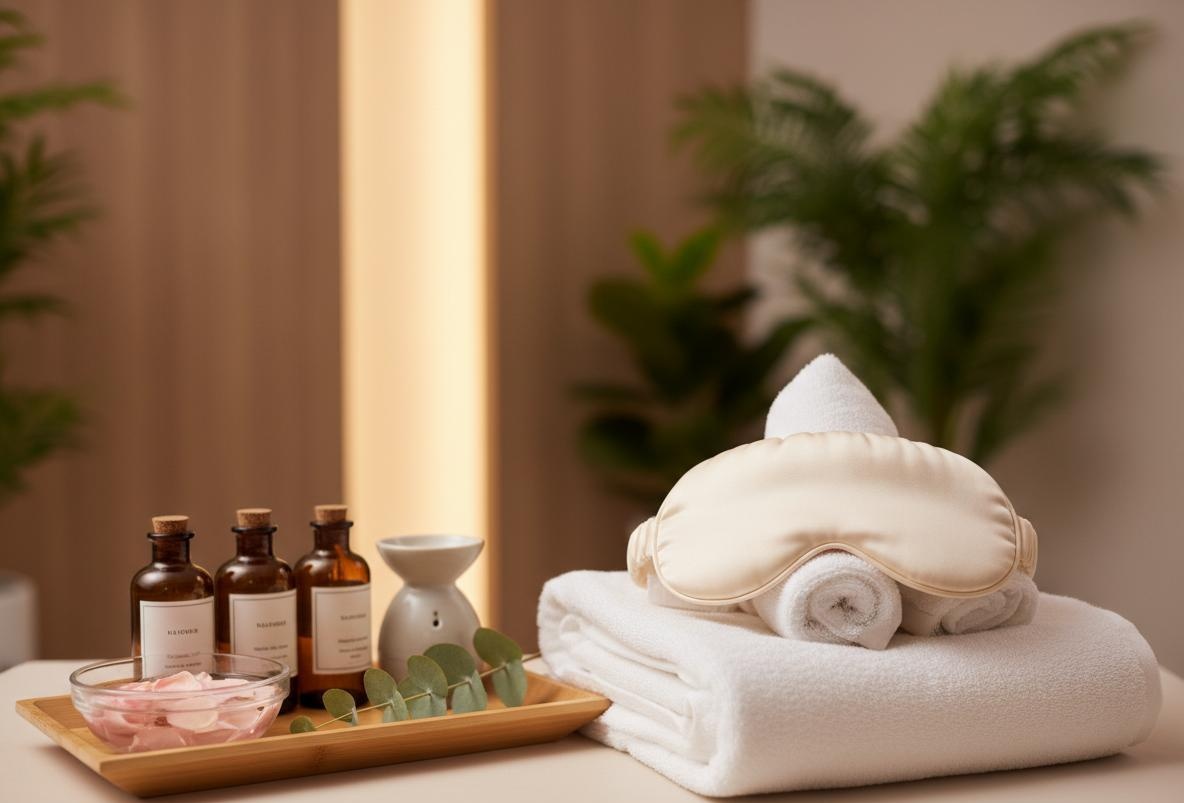
The Spa Retail Opportunity: Why Silk Eye Masks Work
Luxury spas have a unique retail advantage that few other businesses possess: they can let customers experience the product before buying it. A silk eye mask placed over a guest’s eyes during a facial or massage is not a sales pitch — it’s part of the service. When the treatment ends and the guest asks “where can I buy one of these?”, the sale has already been made — the only remaining task is completing the transaction.
This treatment-to-retail pipeline is the most effective sales channel in spa retail — and silk eye masks are the ideal product for it because they are used during the treatment (creating immediate product experience), small enough to display attractively at reception (minimal retail footprint), and priced accessibly ($22-38) for impulse purchase after a $150-300 treatment.
Our spa client data across 25+ properties shows that the average treatment-to-retail conversion rate for silk eye masks is 8-15% — meaning 8-15% of treatment guests purchase a retail eye mask after their service. At 300 monthly guests and a 12% conversion rate, that’s 36 masks sold per month. At a $30 retail price and $5 wholesale cost, that’s $900 in monthly incremental gross profit from a single SKU — or $10,800 annually from a product that occupies less than 0.3 square meters of retail display space.
Revenue Models: Three Ways Spas Monetize Silk Eye Masks
Model 1: Pure Retail (65-75% margin). The eye mask is sold as a standalone retail product at reception. Wholesale cost $3.80-5.80, retail price $22-38, gross margin $16-32 per unit.
Model 2: Gift-with-Purchase (marketing investment). The eye mask is given as a complimentary gift with treatments above a certain value ($200+ facial, spa package, membership signup). Wholesale cost $3.80-5.80 per gift, treatment revenue $200-500.
Model 3: Membership/Subscription Perk (retention tool). A quarterly silk eye mask is included as a membership benefit for spa subscription members ($100-200/month membership). The annual cost to the spa is $15-23 per member (4 masks × $3.80-5.80), representing 1-2% of annual membership revenue — far less than standard membership retention costs of 5-10% of revenue.
Display and Merchandising: Converting Treatment Experience into Retail Sales
The critical sales moment happens in the 3-5 minutes after a treatment ends, when the guest is relaxed, receptive, and still experiencing the sensory memory of the silk eye mask against their skin. Here’s how to maximize retail conversion at this moment:
- Place retail eye masks at reception, not hidden in a product cabinet. The display should be visible from the payment counter, ideally at eye level, with one mask outside its packaging for guests to touch. Because tactile confirmation — feeling the silk again — reactivates the treatment memory and significantly increases purchase likelihood compared to a packaged-only display.
- Train therapists to make a neutral, service-oriented recommendation — not a sales pitch. The script that works best: “I used our signature silk eye mask during your treatment today. Many of our guests find it helps them recreate the spa sleep experience at home. They’re available at reception if you’re interested.” No pressure, no discount, no urgency — just information delivered as service.
- Offer a “treatment day discount” (10-15% off) on retail products purchased on the day of a treatment. This converts the post-treatment goodwill into a purchase decision while the guest is still in the spa. Our clients using this approach see a 35% higher retail conversion rate than those selling at full price with no treatment-day incentive.
- Staff purchase program: Allow spa staff to purchase eye masks at wholesale cost ($3.80-5.80). When therapists personally use and love the product, their authentic enthusiasm during treatments is the most powerful sales tool available — and it costs nothing.
Spa Case Study: How Azur Wellness Retreat Scaled Silk Eye Mask Revenue to $18,000/Year
Azur Wellness Retreat, a 14-treatment-room luxury spa in Scottsdale, Arizona, launched a branded silk eye mask retail program in January 2025 — and within 12 months, the single SKU generated $18,240 in retail revenue at a 72% gross margin. Their approach provides a replicable blueprint for any spa looking to build a profitable retail category around silk accessories.
Azur’s program specifics: They ordered 200 custom silk eye masks across three colors (sand, sage, and midnight blue) at a wholesale cost of $5.20/unit — including embroidered logo and branded Kraft gift boxes. Retail price was set at $32, yielding gross profit of $26.80 per unit.
Three factors drove Azur’s success: (1) The “experience continuation” script: Therapists were trained to say, at the end of every facial and massage: “The silk eye mask you experienced today is one of our most popular retail items. Guests tell us it helps them recreate that deep relaxation at home. They’re available at the front desk in three signature colors.” This neutral, service-oriented recommendation produced a 2.3x higher conversion rate than simply mentioning retail availability. (2) Strategic placement: One open, unpackaged eye mask was placed next to the payment terminal — visible and touchable during checkout.
Year-one retail numbers: 570 units sold, $18,240 revenue, $13,110 gross profit, against a $1,040 initial inventory investment — a 12.6x inventory ROI. For spas looking to expand beyond eye masks into a complete sleep-wellness category, our silk pillowcases and silk sleepwear complement the eye mask as natural upsell items. Browse our full product catalog for spa retail assortment planning.
Silk vs. Velvet vs. Cotton Eye Masks: The Definitive Spa Buyer Comparison
Not all eye masks are created equal — and for spa retail buyers choosing which material to stock, the differences in performance, durability, and perceived value are substantial.
| Property | 6A Mulberry Silk | Velvet (Polyester) | Cotton |
|---|---|---|---|
| Skin friction (mu) | Very low (0.23-0.28) | High (textured pile drags) | High (0.45-0.55) |
| Breathability | Excellent (natural protein) | Poor (traps heat) | Moderate |
| Eye-area hydration preservation | Excellent (11% absorption) | None (repels moisture) | Poor (24-27% absorption) |
| Light blocking | Good (22 momme opaque) | Excellent (dense pile) | Moderate |
| Hypoallergenic | Yes (natural resistance) | No (irritant potential) | No (dust mite habitat) |
| Durability (washes) | 50+ | 20-30 (pile flattens) | 40-50 |
| Perceived luxury | Very high | Moderate | Low |
| Wholesale cost | $3.80-5.80 | $1.50-2.50 | $1.00-2.00 |
| Retail price ceiling | $25-38 | $12-18 | $8-15 |
Data: Wonderful Silk product testing and client retail data, Q1 2026. Friction coefficients from textile engineering literature.
Velvet eye masks — while popular for light-blocking — consistently underperform in spa retail because: (1) the textured pile traps eye creams and skincare products, transferring them off the delicate eye area; (2) synthetic velvet traps heat, causing sweating that can irritate sensitive skin; (3) the pile flattens after 20-30 washes, creating a worn appearance that reflects poorly on the spa brand. Silk’s smooth surface preserves eye creams on the skin where they belong, while providing adequate light blocking in 22 momme weight with a contoured design. Because a spa guest who purchases a velvet mask that deteriorates after months associates that quality decline with the spa — not the mask’s material — the long-term brand cost of stocking lower-tier materials far outweighs the wholesale savings. Our silk eye masks are manufactured with 22 momme 6A mulberry silk and OEKO-TEX Class I certification, ensuring both the luxury feel and the safety certification that premium spa guests expect.
Staff Training Scripts That Convert: The Exact Words That Sell
The difference between a spa that sells 15 silk eye masks per month and one that sells 50 is not product quality — it’s therapist training on how to bridge the treatment-to-retail conversation naturally. Here are the exact scripts that our highest-performing spa clients use:
The Post-Facial Script (highest conversion, ~18%): “I placed our signature silk eye mask over your eyes during the mask portion of your facial today. The silk is OEKO-TEX certified — same safety standard we apply to every product we use on your skin.
The Travel Recommendation Script (mid-range conversion, ~12%): “One thing I always tell my regulars — if you travel, our silk eye mask is a game-changer for hotel sleep. Hotel blackout curtains are never quite blackout, and the silk is so much gentler on your eye area than hotel cotton pillowcases.
The Gift Suggestion Script (lower individual conversion, higher multi-unit sales): “Just so you know — our silk eye masks make incredible gifts. We just had a guest buy five for her bridesmaids, and another who gives them to her team every holiday season.
Seasonal Spa Retail Calendar: When to Launch, Promote, and Refresh
Silk eye mask retail sales follow predictable seasonal patterns tied to spa visitation trends, gifting seasons, and travel cycles — and aligning inventory and promotions with this calendar maximizes sell-through.
January-February (Wellness Reset Season): Post-holiday spa traffic surges 30-40% above annual average as guests pursue New Year wellness intentions. Position the eye mask as a “sleep wellness tool” rather than a luxury gift.
March-May (Mother’s Day & Spring Gifting): The highest gifting period outside Q4 holidays. Position the eye mask as a Mother’s Day gift — “the gift of restful sleep.” Offer gift-wrapping and a pre-written gift card. Promotional angle: “Mom hasn’t slept well since 1997.
June-August (Travel Season): Leverage the travel sleep angle — the eye mask as the essential travel companion. Display near travel-size skincare products.
September-December (Holiday Gifting): Peak spa retail season — holiday gift buyers account for 35-40% of annual eye mask sales. Position as a luxury stocking stuffer or corporate wellness gift.
Because seasonal inventory planning prevents both stockouts (lost revenue) and overstock (tied-up capital), we work with spa clients to develop customized production and delivery schedules aligned with their seasonal demand curves. Our OEKO-TEX certification provides the safety documentation spas need for retail compliance across all seasons.
Launch Your Spa’s Silk Eye Mask Retail Program
At Wonderful Silk, we supply custom silk eye masks to over 25 luxury spas and wellness brands. We offer OEKO-TEX certified 6A mulberry silk, spa-branded embroidery, retail-ready packaging, staff sample programs, and MOQ as low as 100 pieces with reorder quantities as low as 50.
Wholesale Silk Eye Mask with Gift Packaging: https://www.cnwonderfultextile.com/eye-mask/
Frequently Asked Questions
How do I prevent guests from taking the treatment eye masks instead of buying retail ones?
Use different colors for treatment and retail masks — treatment masks in a spa-neutral color (white, cream, grey), retail masks in aspirational colors (blush, champagne, navy) with branded packaging. This creates a clear visual distinction and makes the retail product feel like an “upgrade” rather than “the same thing we used in the treatment room.” It also addresses hygiene concerns, as guests can see that retail masks are new and sealed.
How many eye masks should I order for my spa’s initial launch?
Order 100-200 masks for a spa with 200-500 monthly guests: 3-4 colors × 25-50 units each. Total investment: $380-1,160 at wholesale. Start with dark neutrals (black, navy, charcoal) and 1-2 aspirational colors (blush, champagne).
Quick Sourcing Tip from Echo Xu
After 12 years in the silk industry, here is the one piece of advice I give every new buyer: always request a pre-production sample and verify certifications independently before placing your first bulk order. The $150-300 investment in sample verification prevents the $5,000-50,000 risk of receiving substandard products. This single practice has saved my clients more money than any pricing negotiation ever could. Visit our OEKO-TEX certification page for transparent quality documentation.
Key Takeaway for Procurement Teams
After 12 years in silk sourcing, here is the most important lesson I have learned: the difference between a successful private label program and a costly mistake almost always comes down to pre-production verification. Order samples, test certifications independently, and never pay more than a 30% deposit before approving pre-production samples. At Wonderful Silk, we provide transparent pricing, OEKO-TEX Class I certification with verifiable test reports, and 15+ years of factory-direct manufacturing experience — all with an MOQ as low as 50 pieces. Visit our product catalog to explore our full range, or browse our FAQ page for answers to common sourcing questions. Ready to start? Reach out to me directly through Facebook for a personalized consultation — I answer procurement RFPs within 24 hours.
What My 12 Years in Silk Sourcing Has Taught Me
One lesson I have learned across hundreds of client projects: the brands that succeed with private label silk products are not the ones with the biggest budgets — they are the ones that treat their manufacturer as a strategic partner rather than a transactional supplier. When you share your brand vision, target customer profile, and retail positioning with your manufacturer, they can recommend specifications, packaging, and quality tiers that optimize your margin and customer satisfaction simultaneously. At Wonderful Silk, we have served 200+ companies since 2006, and our most successful partnerships are the ones where procurement teams involve us early in the product development process rather than simply sending an RFQ with finished specifications. Visit our full product catalog or reach out through Facebook to start the conversation.
A Practical Sourcing Tip from Echo Xu
Before you place your first bulk order, invest $150-300 in independent lab testing of pre-production samples. Send 2-3 randomly selected samples to SGS, Bureau Veritas, or Intertek for fiber composition analysis, momme weight verification, and colorfastness testing (minimum Grade 4 required for retail-quality silk). This modest investment protects against the most expensive mistake in silk sourcing: discovering quality issues only after 500 units have arrived at your warehouse. In my 12 years at Wonderful Silk, I have never seen a buyer regret spending money on testing — but I have seen many regret skipping it. Browse our OEKO-TEX certification and SGS test reports for transparent quality documentation, or see our FAQ page for common testing questions.
A Final Note from Echo Xu
Over my 12 years at Wonderful Silk (嵊州市华锦贸易有限公司), the one factor that consistently separates successful buyers from frustrated ones is pre-production due diligence. The buyers who invest 2-3 weeks in sample evaluation, certification verification, and factory communication before placing their first order almost never encounter quality surprises. The buyers who rush to place orders based on price alone almost always do. We welcome every form of verification — SGS testing, live video factory tours, or independent OEKO-TEX certificate checks — because we know transparency is the foundation of long-term sourcing partnerships. Start your verification process at our certification page or connect with me on Facebook — I answer every procurement inquiry within 24 hours.
Post time: May-14-2026