
Introduction
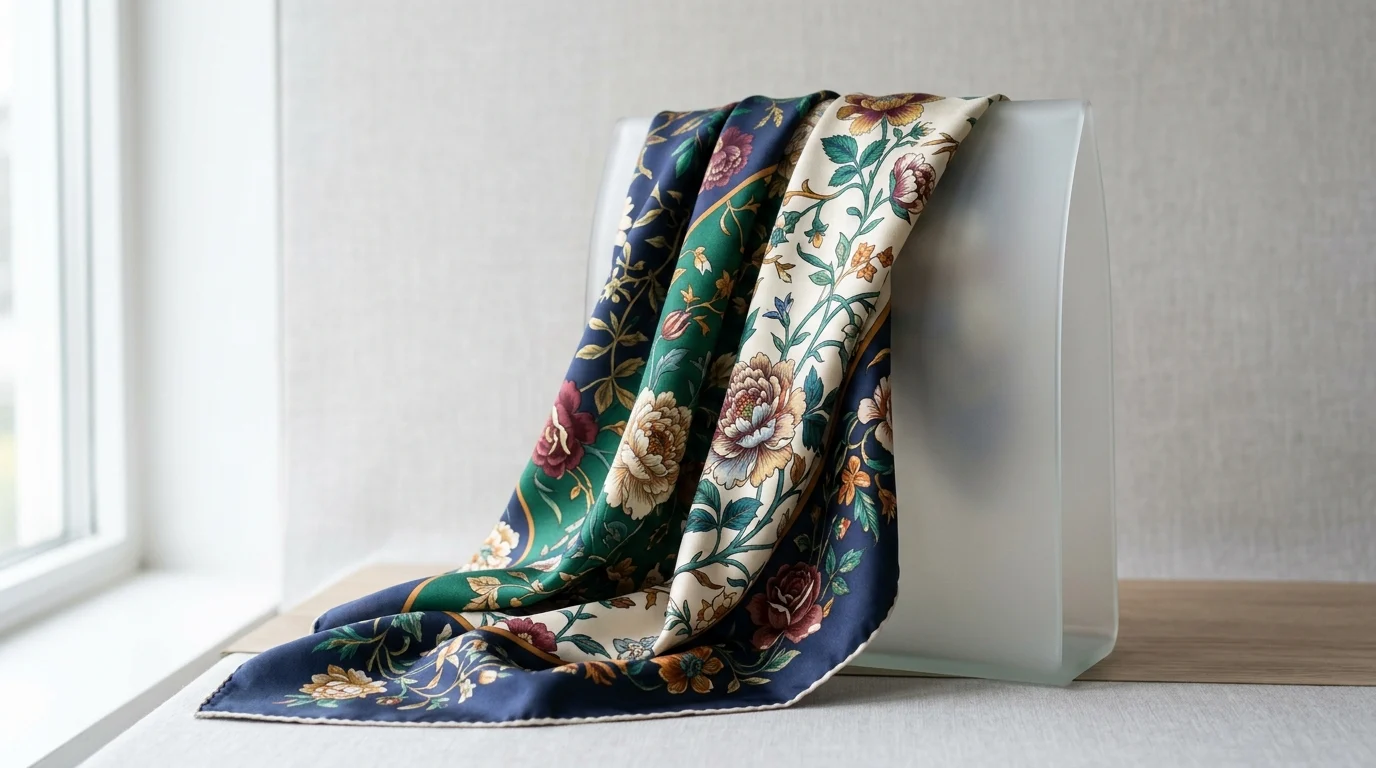
Selecting an OEM partner for silk print scarves affects far more than unit cost: it shapes print accuracy, fabric quality, delivery consistency, and ultimately your brand’s credibility. China offers deep manufacturing capacity, but suppliers differ widely in silk expertise, customization ability, quality control, and communication standards. This article explains how to assess a manufacturer beyond price alone, including production capability, sampling, certification, defect management, and order-fit for your business model. By the end, you will know what signals to look for, which questions to ask, and how to reduce sourcing risk before committing to a factory.
Why Choosing the Right Silk Print Scarf Manufacturer Matters
I have spent years navigating the complex world of textile sourcing, and if there is one truth I have learned, it is this: finding a reliable factory in China is the absolute foundation of your brand’s success. When you are dealing with a premium product like silk, the stakes are incredibly high. A poorly printed or defect-ridden batch does not just cost you money; it costs you your reputation.
Choosing the right manufacturing partner is about much more than just scrolling through Alibaba and picking the lowest price. It requires a strategic approach to ensure the factory’s capabilities match your specific market demands, quality standards, and growth trajectory. Let’s dive into why making the right choice from day one is so critical for your silk scarf business.
How to align a supplier with your business needs
When I first started consulting for fashion brands, I noticed a common mistake: buyers would approach a massive, high-volume factory for a boutique, small-batch order. To align a supplier with your business needs, you first have to understand your own scale and market positioning. Are you a fast-fashion brand needing 10,000 units of a basic 12 momme (mm) silk scarf, or are you a luxury boutique requiring 200 units of a premium 16mm or 19mm heavy silk twill?
Your chosen factory must have an operational model that fits your needs. Some factories excel at massive runs with strict cost controls, offering rock-bottom prices but demanding Minimum Order Quantities (MOQs) of 1,000 pieces per design. Others specialize in high-mix, low-volume production, perfect for emerging designers who need to test 10 different patterns at 50 pieces each.
You also need to align on communication and workflow. If you require constant updates, rapid prototyping, and English-speaking account managers, you need a factory that invests in its B2B service infrastructure, not just its production lines. A true partner acts as an extension of your own team, offering suggestions on fabric yields and printing techniques rather than just blindly following a tech pack.
What business risks the right manufacturer helps avoid
The business risks of partnering with the wrong manufacturer are steep, and I have seen them derail promising brands. The most common risk is ‘quality fade.’ This happens when your first sample is a flawless, vibrant 14mm silk masterpiece, but by the third bulk production run, the factory quietly downgrades to a 12mm fabric or rushes the digital printing process, resulting in a defect rate jumping from an acceptable 1% to a disastrous 15%.
Another major risk is intellectual property (IP) theft. When you hand over your proprietary, high-resolution artwork to an unverified supplier, you risk seeing your exact designs being sold on fast-fashion marketplaces a month later. A reliable manufacturer will readily sign a Non-Disclosure Agreement (NDA) and have strict internal controls over digital file management.
Finally, there is the risk of catastrophic delays. In the fashion industry, missing a seasonal launch window by 30 days means you are left holding dead inventory. A dependable factory provides realistic lead times—typically 25 to 35 days for bulk—and builds in buffer time for unexpected supply chain hiccups.
Section Summary & Key Data Points: Aligning with the right factory prevents critical business failures. Key data to monitor includes matching your fabric weight (12mm for mass market vs 16mm+ for luxury), keeping defect rates strictly below 2%, and ensuring realistic 25-35 day lead times to avoid seasonal inventory loss.
How to Evaluate an OEM Silk Print Scarf Manufacturer
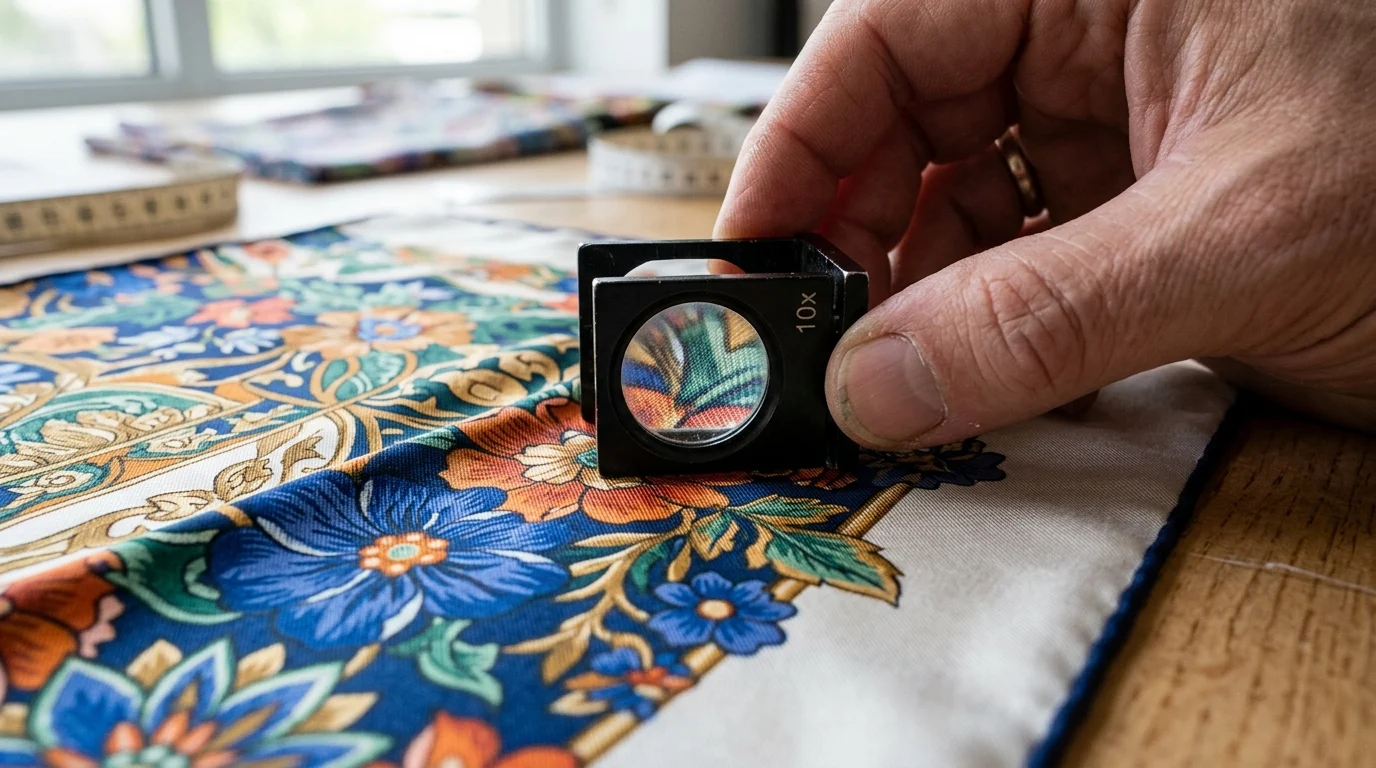
Once you understand the strategic importance of your supplier, the next step is rolling up your sleeves and evaluating their technical capabilities. Evaluating a manufacturer means looking past their glossy showroom and examining the raw specifications and production methods they offer.
Not all silk is created equal, and not all printing machines yield the same results. To guarantee you are getting what you pay for, you need to know exactly which specs drive up costs and how different production methods impact the final look and feel of the scarf.
Which product specifications most affect quality and cost
In the world of silk, specifications dictate everything from drape to durability to your bottom line. The most critical spec is the ‘momme’ (mm) weight, which measures the density of the silk. A standard 12mm silk habotai is lightweight, slightly sheer, and relatively inexpensive, making it great for promotional items. However, if you are aiming for a luxury feel, you will want a 14mm or 16mm silk twill or satin. Moving from a 12mm to a 16mm fabric can increase your raw material costs by 25% to 35%, but it drastically improves the product’s lifespan and premium feel.
Dimensions also play a massive role in cost, primarily due to fabric yield and wastage. The standard luxury square is 90x90cm (approx. 35×35 inches). If you decide to make a 95x95cm scarf, you might inadvertently push the dimensions beyond the standard fabric roll width (often 114cm or 140cm), resulting in significant wasted fabric that you still have to pay for. A knowledgeable Custom Silk Scarf Production partner will advise you on the most cost-effective dimensions to maximize fabric yield.
Finally, consider the silk grade. The global standard grades silk from A to F, with numbers indicating quality. You should always look for factories that source 6A grade mulberry silk. This grade guarantees the longest, most uniform silk threads, resulting in fewer fabric flaws and a smoother canvas for printing.
How to compare printing methods, silk grades, and finishing
Comparing printing methods is where you will see the biggest visual differences in your samples. Today, digital printing dominates the market for its flexibility. It uses inkjet technology to print millions of colors directly onto the fabric, perfect for intricate, photographic designs. Traditional screen printing, on the other hand, pushes ink through a stencil one color at a time. It offers unmatched color penetration (so the back of the scarf looks almost as vibrant as the front) but requires expensive setup costs per color.
Finishing is the final touch that defines a scarf’s value. Machine hemming is fast, precise, and costs pennies per unit. Hand-rolled edges, where a skilled worker meticulously rolls the silk and stitches it by hand, is the hallmark of a luxury scarf. This manual process can add $1.50 to $2.50 to the cost of each scarf and limits daily production capacity, but it allows you to retail the scarf at a significantly higher price point.
| Feature | Digital Printing | Screen Printing |
|---|---|---|
| Setup Cost | Low to None | High ($30-$50 per color screen) |
| Color Limit | Unlimited | Usually max 10-12 colors |
| MOQ | Low (Often 20-50 pcs/design) | High (Often 300-500 pcs/design) |
| Penetration (Back side) | Good (70-80%) | Excellent (90-100%) |
| Best For | Complex, multi-color art, small batches | Solid blocks of color, high volume |
Section Summary & Key Data Points: Product specs directly control your margins. Upgrading from 12mm to 16mm silk increases raw costs by up to 35%. Hand-rolled hems add $1.50-$2.50 per unit but elevate the retail value. Always specify 6A grade mulberry silk for the best printing canvas, and choose digital printing for low-MOQ (50 pcs) complex designs.
How to Verify Factory Reliability and Quality Control
Trust is good, but verification is better. It is incredibly easy for a trading company to masquerade as a direct factory online. If you are serious about building a long-term supply chain, you must rigorously verify the manufacturer’s reliability and internal quality control (QC) processes.
I always tell my clients that a factory’s true colors are not shown during the sales pitch; they are revealed during the sampling phase and the compliance audit. Here is how you can effectively stress-test a potential supplier before committing to a massive bulk order.
Which audit points and compliance documents to check
Before transferring any funds, you need to request and verify compliance documents. In the textile industry, the gold standard for chemical safety is the OEKO-TEX Standard 100 certification. This guarantees that the silk and the printing dyes are free from harmful substances and are safe for direct skin contact. If a factory cannot produce a valid, up-to-date OEKO-TEX certificate, it is a massive red flag.
You should also look for ISO 9001 certification, which indicates the factory has a standardized quality management system in place. When auditing a factory (either in person or via a third-party service like SGS or Intertek), pay attention to their raw material inspection process. Do they use a 4-point inspection system to check the unprinted silk rolls for snags and variations? How do they handle wastewater from the printing process? Environmental compliance is increasingly strictly enforced in China, and a factory that violates local environmental laws could be shut down mid-production.
A reputable China Silk Scarf Manufacturer will transparently share their audit reports and welcome third-party inspections before shipment. They know that compliance is a selling point, not a burden.
How sampling and communication reveal supplier capability
The sampling process is your best window into a supplier’s true capability. When you request a ‘strike-off’ (a small printed sample to verify colors), pay close attention to the timeline and the communication. A well-organized factory will typically produce a digital print strike-off in 7 to 10 days. If it takes three weeks and constant follow-ups, expect the same chaotic delays during bulk production.
When the sample arrives, do not just look at the design. Test it. Measure the dimensions to ensure they account for the 2-3% shrinkage that naturally occurs during the steaming and washing phases of silk production. Check the color penetration on the reverse side; you want at least 70% to 80% visibility on the back for digital prints. Wash the sample in cold water to check for color bleeding. If the colors run, their post-print steaming and washing process is flawed.
Communication during this phase is equally telling. When you point out a flaw—say, a color matching issue—how do they react? A bad supplier will make excuses. A capable supplier will explain the technical limitation (e.g., ‘CMYK digital printers struggle with neon orange’) and offer a concrete solution, such as adjusting the digital file or offering a screen-printed alternative.
What company strengths indicate a reliable partner
When evaluating potential partners, you should look for specific company strengths that align with seamless production. For instance, our own manufacturing ecosystem is built on a foundation of over two decades of textile expertise. We integrate the entire process—from sourcing premium 6A raw silk to utilizing state-of-the-art digital printing and meticulous hand-hemming—entirely in-house.
This integrated approach is a massive indicator of a reliable partner. Factories that outsource their printing or hemming to subcontractors often lose control over quality and timelines. By keeping everything under one roof, we can enforce strict QC at every bottleneck, allowing us to confidently offer highly flexible MOQs and rapid turnaround times without sacrificing an ounce of quality.
Furthermore, a strong partner will have an in-house design and pre-press team. They don’t just hit ‘print’; they review your files, adjust color profiles for the specific silk weight, and ensure the artwork translates perfectly from screen to fabric.
Section Summary & Key Data Points: Verify reliability through hard evidence: demand OEKO-TEX 100 certificates and look for ISO 9001 compliance. Use the 7-10 day sampling phase to test for 70-80% color penetration and 2-3% shrinkage tolerances. Integrated factories with in-house QC and design teams drastically reduce defect rates and delays.
How Pricing, MOQ, Lead Time, and Shipping Affect Your Order
Even if a factory produces beautiful samples and passes every compliance check, the partnership will not work if the economics and logistics do not make sense for your business model. Pricing, minimum order quantities (MOQ), lead times, and shipping mechanics are the four pillars of your production contract.
Understanding how these elements interact allows you to negotiate better terms, plan your cash flow accurately, and ensure your products hit the retail shelves exactly when your marketing campaigns go live.
Which cost drivers shape OEM scarf quotations
When you receive a quotation for an OEM scarf, it is vital to understand the underlying cost drivers so you know exactly what you are paying for. The largest chunk of the cost is the raw silk itself. Silk is a globally traded commodity, and its price fluctuates based on agricultural yields and market demand. Generally, raw silk accounts for 50% to 60% of your total unit cost.
The next major driver is the printing technique and ink volume. Heavy, dark designs that require full ink coverage will cost slightly more in digital printing than light, minimalist designs. Additionally, post-processing treatments—like specialized silicone washes to make the silk feel even softer—add marginal costs but significantly boost the perceived value.
Labor is the final major cost component, heavily influenced by your finishing choices. As mentioned earlier, hand-rolled hems are labor-intensive. In a typical quotation, a standard machine hem might cost $0.30 per piece, while a meticulous hand-rolled edge will cost upwards of $2.00 per piece. If you are ordering a Bulk Silk Print Scarf run of 5,000 units, that finishing choice alone swings your invoice by over $8,500.
How MOQ, capacity, packaging, and logistics impact planning
MOQ and production capacity dictate your inventory risk. Many premium Chinese factories have lowered their MOQs for digital printing to support independent brands, often requiring just 50 pieces per design. However, if you want custom-dyed solid color scarves or screen printing, expect MOQs to jump to 300-500 pieces per color due to the massive setup involved.
Lead times must be factored into your cash flow. A standard timeline looks like this: 7-10 days for samples, followed by 25-35 days for bulk production after sample approval and deposit payment. If you require custom packaging—like rigid magnetic gift boxes with gold foil stamping—this can add an extra 15 days to your timeline, as packaging is often coordinated with secondary suppliers.
Finally, logistics will heavily impact your final landed cost. Silk scarves are lightweight and high-value, making them excellent candidates for air freight.
| Shipping Method | Typical Transit Time | Cost Estimate (Per KG) | Best Use Case |
|---|---|---|---|
| Air Express (DHL/FedEx) | 5 – 7 Days | $8.00 – $12.00 | Urgent launches, small batches under 100kg |
| Standard Air Freight | 10 – 15 Days | $5.00 – $8.00 | Mid-sized orders, balanced speed and cost |
| Sea Freight (LCL) | 25 – 40 Days | $1.00 – $3.00 | High-volume bulk orders where time is flexible |
Section Summary & Key Data Points: Raw silk drives 50-60% of your unit cost. Plan your cash flow around standard timelines: 7-10 days for samples and 25-35 days for bulk. For shipping, lightweight silk favors Air Express (5-7 days at $8-$12/kg) for smaller runs, while large bulk orders should utilize sea freight to cut logistics costs by up to 80%.
How to Make the Final Supplier Decision
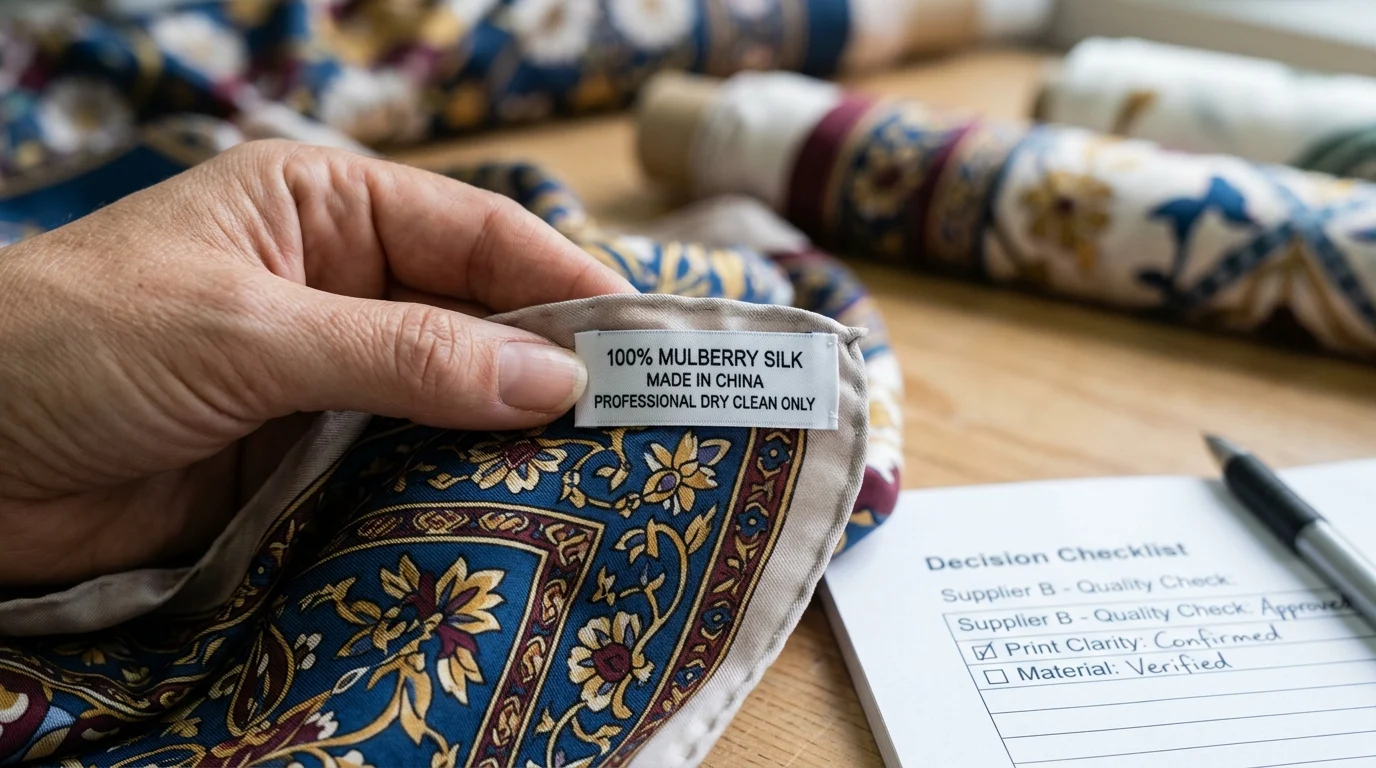
You have done the research, evaluated the specs, audited the factories, and analyzed the costs. Now comes the critical moment: making the final supplier decision. This is where you transition from a researcher to a buyer.
Selecting the final manufacturer is rarely about finding the absolute lowest price; it is about identifying the partner who offers the best overall value, communication, and alignment with your brand’s long-term vision. Here is how I recommend finalizing your choice.
What selection process helps shortlist and test suppliers
I always advise against putting all your eggs in one basket too early. The best selection process involves shortlisting two or three top contenders and running a parallel test. Order 3 to 5 identical samples from each factory using the exact same tech pack and artwork. Yes, you will pay multiple sample fees (usually $50 to $100 each), but this is the cheapest insurance policy you can buy.
When the competing samples arrive, conduct blind tests. Assess the hand-feel, the vibrancy of the print, and the neatness of the stitching. Crucially, run a rub test (crocking test) to check colorfastness. Vigorously rub a white cotton cloth against the printed silk, both dry and wet. You are looking for a colorfastness rating of at least 4 out of 5. If a factory’s sample leaves heavy dye streaks on the cloth, discard them from your shortlist immediately.
Also, evaluate the ‘soft factors.’ Which factory communicated proactively? Which one flagged a potential issue with your hem allowance before printing? The supplier that acts as a consultant during the sample phase is the one you want for bulk production.
How to balance quality, customization, and market fit
Making the final decision requires balancing quality, customization, and your market fit. You must reverse-engineer your choice based on your retail price point. If you are selling a scarf for $40, you cannot afford 16mm silk with hand-rolled edges, and you should choose a factory that excels in efficient, high-quality 12mm machine-hemmed production. If your retail price is $150, your customers will expect flawless 14-16mm silk, perfect color penetration, and artisan finishing.
Consider the supplier’s willingness to grow with you. A great B2B Silk Apparel Supplier understands that your first order of 100 pieces is a stepping stone. Look for partners who offer scalable pricing tiers and are willing to negotiate terms as your volume increases over the years.
Ultimately, choose the manufacturer that gives you peace of mind. When you find a factory that combines transparent pricing, strict 4-point QC inspections, and clear English communication, you have found a partner that will help elevate your brand in the competitive fashion market.
Section Summary & Key Data Points: Finalize your choice by testing 3-5 parallel samples from shortlisted factories.
Key Takeaways
- The most important conclusions and rationale for Silk Print Scarf
- Specs, compliance, and risk checks worth validating before you commit
- Practical next steps and caveats readers can apply immediately
Frequently Asked Questions
What silk specs matter most when choosing a scarf manufacturer?
Focus on silk type, momme weight, print clarity, colorfastness, and hem finishing. For premium scarves, ask for 16–19 momme options and clear QC standards before sampling.
How can I verify a Chinese OEM silk print scarf factory is reliable?
Request recent samples, audit photos or video, test reports, and a clear production timeline. A reliable factory should explain MOQ, defect control, and lead times transparently.
What is a reasonable lead time for custom silk print scarves?
For most OEM orders, bulk production usually takes about 25–35 days after sample approval. Confirm timeline buffers for printing, hemming, and shipping before placing the order.
How do I reduce quality risks on custom silk scarf orders?
Approve a pre-production sample, lock fabric specs in writing, and define acceptable defect rates below 2%. Ask for in-line inspections and final QC photos before shipment.
Can cnwonderfultextile.com support low-volume or custom silk scarf orders?
Ask their team about MOQ by fabric, print method, and design count. Many OEM scarf suppliers can support custom runs, but exact minimums depend on scarf size and material.
Post time: May-20-2026