
TL;DR
- At the 100-piece MOQ we run on this line, roughly a third of the quoted unit price is freight and packing rather than fabric, so negotiating the satin first is optimising the smallest line on a small order.
- A 51 × 76 cm poly satin pillowcase consumes about 0.83 m² of 90 g/m² fabric, which is roughly 75 g per piece and 75 kg per 1,000 pieces before trims.
- What is genuinely testable on poly satin is fabric weight, colour fastness, shrinkage and seam strength, while claims about wrinkles and dust mites are positioning rather than specification.
- Colour fastness is the clause that decides whether a cheap line stays cheap, because a case that shifts shade in a hotel laundry turns into a re-order instead of a saving.
A poly satin pillowcase wholesale bulk order is priced by three things, and only one of them is the satin: the fabric mass in the piece, the make-and-trim labour, and the freight and packing volume. At a 100-piece minimum, which is the MOQ we run on this line, fabric is not even the largest share — so a buyer who spends a week arguing over the fabric price can still miss the line that would move the total.
The arithmetic to hold onto is simple. A 51 × 76 cm case with an envelope back takes about 0.83 m² of 90 g/m² satin, or roughly 75 g of fabric. At 1,000 pieces that is 75 kg of satin before a single label goes on. Everything else in the quotation is labour, packaging, or movement.
I sell mulberry silk for a living, and this is the line I put in front of buyers who cannot justify silk. Poly satin is a legitimate budget line and it is not silk, so the useful thing I can do here is tell you where the cheap line is genuinely cheap and where it quietly costs you more.
What Does a Budget Line Mean at 100 Pieces?
It means the order is small enough that preparation, not material, sets the price. Our line runs a minimum of 100 pieces per colour, with sample proofing inside 3 days of artwork confirmation, and 7 to 25 days for bulk depending on customisation and quantity. At that scale you are paying for a cutting run, a sewing changeover, labels and cartons far more than for the polyester itself.
That is not a complaint about small orders — it is the reason a budget line can exist at all with no tooling and no minimum yardage. A 100-piece order is a validation instrument rather than a sourcing strategy, and it should be priced and judged that way.
Where Does the Money Sit in a Wholesale Pillowcase Order?
In three buckets, and their shares change as the order grows, which is the single most useful thing to understand before you negotiate. The figures below are the approximate split of the unit price we quote at each tier, not a market average.
| Order tier | Fabric | Make and trim | Freight and packing |
|---|---|---|---|
| 100 pieces, one colour | 30% | 35% | 35% |
| 1,000 pieces | 38% | 40% | 22% |
| 5,000 pieces and above | 42% | 42% | 16% |
Read the last column first. At 100 pieces, more than a third of what you pay is cartons, poly bags and movement, and that share is the one that compresses fastest with volume — faster than any fabric concession you will win. The practical conclusion is unglamorous: on a first order, consolidate colours into one shipment instead of splitting them, and put your negotiating energy into the freight basis rather than into the satin.
The Fabric Arithmetic You Can Check Before You Order
You can verify the material side of a quotation with a kitchen scale and a tape measure, which is worth doing because fabric weight is the specification most often left vague. The build-up below is for our standard 51 × 76 cm envelope-back case.
| Item | Value | Basis |
|---|---|---|
| Finished size | 51 × 76 cm | Standard size; queen and king run longer. |
| Cut size per panel | 53 × 78 cm | Finished size plus 1 cm seam allowance per side. |
| Panels per case | 2 plus overlap | Front and back, with the envelope return. |
| Fabric area per case | 0.83 m² | Two panels plus the envelope overlap allowance. |
| Fabric weight | 90 g/m² | Typical satin in this price band; 75 g/m² feels thin. |
| Fabric mass per case | about 75 g | Area multiplied by fabric weight. |
| Fabric mass per 1,000 cases | about 75 kg | The figure to sanity-check against a quote. |
Why this matters commercially: a supplier quoting a lighter fabric than the sample implied has not necessarily lied, because “poly satin” is a weave and a finish rather than a weight. Ask for grams per square metre in writing, then weigh ten pieces from the bulk delivery and divide — a 15 g/m² shortfall on 5,000 pieces is several hundred kilograms of polyester you paid for and did not receive.
What Can You Actually Specify and Test on Poly Satin?
Four properties, and they are the four that survive contact with a laundry. Fabric weight in grams per square metre, colour fastness under a named wash test, dimensional change after washing, and seam strength including stitch density. Everything else on a typical listing is marketing.
Colour fastness to washing is measured by ISO 105-C06:2010, which specifies domestic laundering tests for colour fastness and rates the change against a grey scale. Dimensional change should be assessed after a wash cycle carried out to ISO 6330:2012, the standard that defines domestic washing and drying procedures for textile testing, so that “pre-shrunk” means a measured result rather than an assurance.
If the product touches a sleeper’s skin every night, specify a harmful-substance certification as well, and specify the right class — OEKO-TEX Standard 100 places bed linen in Product Class 2 and tests against a list of over 1,000 harmful substances. That single line replaces a paragraph of vague reassurance about chemicals.
Why Is Colour Fastness the Clause That Matters Most?
Because it is the failure that costs you the account rather than the piece. A poly satin case that shifts shade after ten washes, or bleeds onto a white sheet in the same load, is not a budget item any more — it is a complaint, a replacement and a conversation with a hotel’s housekeeping manager.
The risk is concentrated in the shades buyers love on this line: black, deep navy, and saturated pinks and greens. We test for this and the test reports are available on request, which is the minimum bar. Ask for colour fastness results on the specific shade you are ordering rather than on the line in general, because a lab report for a pale grey tells you almost nothing about the black.
Then go one step further and specify the wash regime your customer actually uses. A domestic 40 °C cycle and an industrial hotel laundry are different ordeals, and a rating that passes the first can fail the second. If your buyer is a hotel group, name the temperature and the detergent type in the specification.
What Does a 100-Piece MOQ Really Buy You?
It buys one colour, one size and one construction, made properly, with the artwork and packing work done for you. On our line that includes mockups of your logo, label and packaging, embroidery, printed labels, custom tags and custom cartons — and the MOQ applies per colour, not per order, which is the detail that decides whether a 100-piece minimum is workable for you.
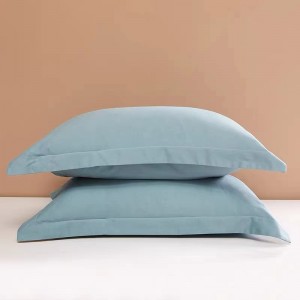
Five colours at 100 pieces each is a 500-piece order, so a palette decision is a volume decision, and it should be made before you ask for a price rather than after. For Amazon sellers the line also covers FBA preparation — UPC printing, labelling and product photography — which is genuinely useful at this size and rarely offered at the low end.
Where Poly Satin Is the Wrong Line to Buy
Four situations, and I would rather lose the order than have a buyer discover them later. If your brand story is silk, do not substitute this and rename it, because the fibre is polyester and the market eventually notices. If your property is positioned on skin sensitivity or on premium bedding, silk is the honest answer and poly satin is the compromise.
If your laundry runs hot with heavy bleaching, expect the shade and the hand to age faster than the piece wears out. And if breathability is the requirement, polyester is the wrong fibre by definition, because it moves moisture away rather than absorbing it — which some sleepers like and others do not.
How Should You Structure a First Bulk Order?
Five steps, in the order that keeps a first order small without making it useless.
- Order samples across the exact shades you intend to sell, because screen colour and dyed satin rarely agree.
- Cut the palette to two or three colours for the first run, since the MOQ is per colour and freight rewards consolidation.
- Put fabric weight in grams per square metre, the colour fastness method and the shrinkage test into the purchase order in writing.
- Validate with one 100-piece colour, then scale the proven colour rather than scaling the whole palette.
- Confirm the packing format and carton marks before production, because repacking after the fact is the most expensive mistake on a small order.
Sourcing the Cheap Line Without Buying the Wrong Line
Poly satin earns its place when the job is a washable, presentable, replaceable pillowcase at a volume that makes sense — hotel housekeeping stock, retail entry price points, Amazon programmes, promotional sets. It stops earning its place when the buyer needs the case to behave like silk, or needs the laundry to be gentle, or needs the fibre story to be true.
If you are sizing a first order, send us the sizes, the shades and the destination, and we will tell you what the packing and freight will do to the unit price before you commit — including the cases where a slightly larger run of two colours beats a small run of five. You can also see the full poly pillow case range for the constructions and sizes we hold, or read the polyester pillowcase specification page for the detail behind this line.
Frequently Asked Questions
What is the minimum order for poly satin pillowcases?
On our line the minimum is 100 pieces per colour, which is low enough that a buyer can validate a shade before committing to a full run. The important qualifier is per colour rather than per order, because a five-colour first order is a 500-piece order and the freight and packing share behaves very differently at that size.
How much fabric is in one pillowcase?
A 51 × 76 cm envelope-back case takes about 0.83 m² of fabric, which at 90 g/m² is roughly 75 g per piece and about 75 kg per 1,000 pieces. Weighing ten finished pieces from a delivery is a quick check on whether the fabric weight you specified is the fabric weight you received.
Is poly satin the same as silk satin?
No, and the difference is the fibre rather than the finish: satin describes a weave with a glossy face, and it can be woven from polyester or from mulberry silk. Poly satin is cheaper, machine washable and more durable in a laundry, while silk has a different hand and a different price, and the two should not be sold under the same description.
How do I stop the colour fading in a hotel laundry?
Specify colour fastness to a named wash test on the exact shade you are ordering, and state the wash temperature and detergent type your laundry uses. Dark shades are the ones that move first, so a report covering a pale colour is not evidence about a black case, and an industrial wash is a harsher test than a domestic cycle.
Can I get custom labels and packaging at the minimum quantity?
Yes, and on our line that includes mockups of your logo, woven or printed labels, custom tags and custom cartons at the 100-piece minimum, with sample proofing inside 3 days of artwork confirmation. Confirm the packing format and carton marks before production starts, because repacking a small order afterwards undoes the saving.
How long does a bulk order take?
Standard designs can ship in as little as 7 days, and customised regular orders under 1,000 pieces typically complete within 25 days of order confirmation. Sampling adds roughly 3 days after artwork approval, so the artwork stage is usually what decides whether your delivery date is realistic.
About the Author
Echo Xu — International Business Director, Wonderful Silk, Shengzhou, Zhejiang.
Echo Xu is the International Business Director at Wonderful Silk, based in Shengzhou, Zhejiang — the heart of China’s mulberry silk industry. With 12 years of experience in silk trade and B2B procurement, she has managed supply partnerships with hospitality chains, retail brands and distributors across 30+ countries, and specialises in helping hotel procurement teams navigate silk specifications, quality certification and factory-direct pricing structures. When she is not on the factory floor overseeing QC, she answers procurement RFPs — usually within 24 hours.
Post time: Nov-10-2026