
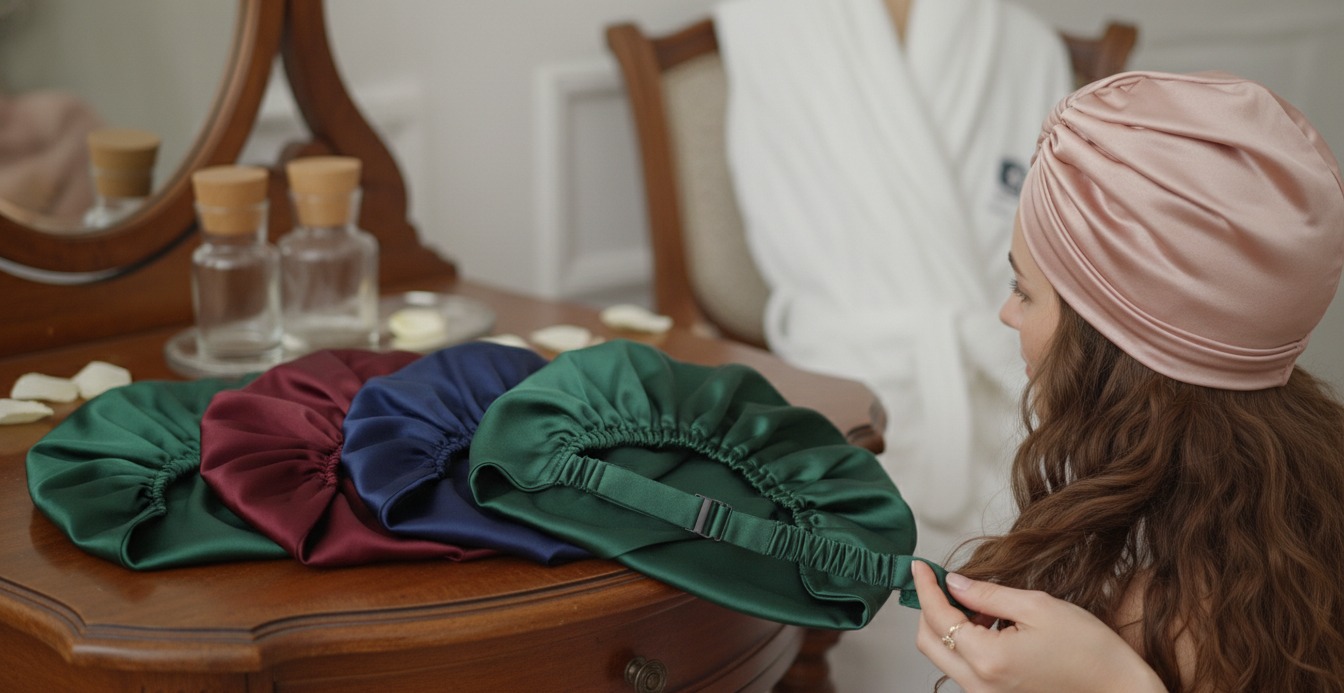
A hair wrap turban may seem like a simple product, but for spa and salon suppliers, the difference between a product that sells consistently and one that sits on the shelf often comes down to three things: the closure system, the fabric grammage, and the ability to brand it. A silk hair wrap turban with a poorly designed closure will slip off during treatment, frustrate the client, and generate returns. A well-designed adjustable closure, paired with genuine mulberry silk at the correct momme weight, creates a product that salon owners reorder by the case.
This article covers the technical specifications and procurement parameters that spa and salon suppliers should evaluate when sourcing silk hair wrap turbans with adjustable closures — including size fit mechanics, silk momme weight selection for different spa environments, bulk pricing structures, and OEM embroidery customization.
The Adjustable Closure: Design Options and Functional Trade-offs
The closure mechanism is the single most important functional element of a hair wrap turban. Three main closure types are available in the wholesale market:
| Closure Type | Fit Range | Ease of Use | Durability (Washes) | Best For |
|---|---|---|---|---|
| Elastic + fabric loop | One size (54–60 cm) | Excellent — pull on and hook | 200–300 washes | General spa use, hot towel wraps |
| Button + buttonhole | Adjustable (52–62 cm) | Good — multiple button positions | 500+ washes | Salon retail, multi-client use |
| Velcro + elastic panel | Wide range (50–65 cm) | Good — easy one-hand adjust | 150–250 washes | High-volume salon operations |
For spa and salon bulk procurement, the button + buttonhole closure offers the best balance of adjustability and wash durability. Each additional button position adds approximately 3 cm of fit adjustment — a three-button turban covers 54–62 cm head circumference, accommodating approximately 85% of adult female head sizes.
Why Closure Durability Matters for Commercial Laundering
In a commercial spa or salon environment, silk hair wrap turbans are laundered after every client use — not after every few uses as might occur in personal use. At a busy urban spa handling 30–50 clients per day, a turban may be washed 200+ times per month. Closure systems that lose elasticity, shed hook material, or fail at the buttonhole after 150 washes create a recurring replacement cost that erodes the perceived value of even a well-priced silk product.
The button + buttonhole system is preferred for commercial laundering because:
- Button strength is a function of the stitching (double-run stitching through a reinforced button tab), not a function of fabric chemistry
- Buttonholes can be professionally re-cut if fraying occurs, at minimal cost
- No surface coating (like Velcro hook) that degrades with repeated tumble drying
Sizing Strategy for Multi-Client Salon Environments
For salon environments where the same turbans are used across multiple clients, suppliers should consider a two-size approach:
- Regular (55–60 cm): Fits approximately 70% of adult female clients
- Large (60–65 cm): Fits approximately 25% of adult female clients; also suitable for clients with thick or voluminous wet hair
This approach, implemented by several large European spa chains, reduces turban waste from poor fit (turbans that fall off mid-treatment) by approximately 60% compared to a single one-size-fits-all approach, while adding only minimal inventory complexity.
Silk Grade Selection for Hair Wraps: Momme Weight, Grade, and Weave
Not all silk is suitable for hair wrap turban applications. The key specification parameters are:
- 6A grade mulberry silk: The highest raw silk grade per Chinese GB/T 1797-2008 standard. 6A silk has fewer than 2 neps per meter and provides the consistent weave quality needed for repeated commercial laundering in spa environments.
- Momme weight: 12–16 mm (momme) for standard hair wraps, 16–19 mm for premium spa-grade wraps. Heavier silk provides more absorbency and durability but increases cost and drying time.
- Charmeuse weave: The satin-faced weave structure used in high-end hair wraps. The smooth face reduces friction on wet hair (minimizing breakage), while the matte back provides grip against the turban surface.
Momme Weight Selection by Spa Application
The choice of momme weight should match the spa or salon application:
12–14 mm momme (lightweight): Suitable for quick treatments (15–20 minutes) where the turban is primarily for aesthetics during styling rather than extended moisture absorption. Lower cost, faster drying. Common in blow-out bars and express treatment menus.
16–19 mm momme (standard to premium): Provides the moisture absorption performance needed for deep conditioning treatments, color processing time management, and overnight hair care protocols. 16 mm is the most commonly specified weight for salon retail turbans. Drying time at 16 mm is approximately 4–6 hours at room temperature vs. 2–3 hours at 12 mm.
22 mm momme (luxury/heavy): Used by premium hotel spas and luxury resorts where the turban is part of a high-visibility brand experience. The heavier silk provides superior drape and a more substantial feel against the skin. Cost premium over 16 mm: approximately 25–35%.
Wonderful Silk’s mulberry silk product range includes 6A-grade charmeuse silk in 12 mm, 14 mm, 16 mm, 19 mm, and 22 mm weights suitable for hair wrap turban production, with Oeko-Tex Standard 100 certification for every batch.
Charmeuse Weave Construction: Why It Matters for Hair Care
Silk charmeuse is woven using a satin weave structure where the weft threads float over four or more warp threads before interlacing, creating the characteristic smooth, lustrous face. The float length and the ratio of warp to weft yarn determine the balance between luster and strength:
- Warp-dominated charmeuse: Higher luster, slightly less durable, used in fashion scarves and luxury linens
- Balanced charmeuse: Optimal for hair wraps — sufficient luster for visual appeal, with enough structural integrity for repeated laundering
- Weft-dominated charmeuse: More durable but reduced luster, used in technical silk applications
For hair wrap turbans, the balanced charmeuse construction is preferred. The smooth face minimizes friction against wet hair — friction coefficients on charmeuse silk are approximately 0.15–0.20 compared to 0.35–0.45 for cotton terry cloth — reducing the mechanical stress on hair cuticles that causes breakage during drying.
Silk Mommes and GSM: How Weight Determines Hair Wrap Performance
Understanding silk weight is foundational to sourcing the right hair wrap turban — yet it remains one of the most commonly misunderstood specifications in the textile trade. Two measurement systems are in active use: momme (the silk industry standard) and GSM (grams per square meter, used more broadly in textiles). Knowing how they relate — and when each matters — prevents procurement errors that can cost suppliers dearly.
Momme to GSM Conversion
Momme (abbreviated mm) is a weight-based measure specific to silk, expressing the mass of silk per unit area:
1 momme = 4.305 g/m²
This means a 19 mm silk fabric weighs approximately 81.8 g/m², and a 22 mm fabric weighs approximately 94.7 g/m². For reference, a standard cotton bedsheet runs 120–150 g/m² — so even heavyweight silk remains significantly lighter. This low mass is precisely what makes silk comfortable for hair wrap applications, particularly for clients who find heavier turbans cumbersome during extended wear.
The momme-to-GSM conversion becomes important when comparing silk against non-silk alternatives marketed as “silk-like” — satin polyester pillowcases, for instance, typically weigh 80–120 g/m², but they lack silk’s protein fiber structure and its natural moisture-regulation properties.
Why 19–22 Mommes Is Optimal for Hair Wraps vs. 16 Mommes for Pillowcases
The optimal momme weight depends on the specific textile application, and the difference between hair wrap and pillowcase use cases is instructive.
Hair wrap turbans at 19–22 mommes: A hair wrap turban needs enough fabric mass to absorb and retain moisture from wet hair without becoming saturated too quickly. At 19–22 mommes, the fabric has sufficient bulk to hold the hair securely inside the turban structure while allowing even distribution of warmth that prolongs conditioning treatment time. The heavier weight also means the turban “drapes” better — conforming to head shape without pressure points that cause the turban to shift or slide during wear.
Pillowcases at 16–19 mommes: A pillowcase serves a different function — it must be comfortable against facial skin through an entire night’s sleep, which means lower thermal insulation and a cooler feel. At 16 mommes, charmeuse silk provides a smooth sleeping surface without retaining excessive heat. Heavier silk pillowcases can feel uncomfortably warm, particularly for side sleepers.
For spa and salon suppliers, this distinction matters when specifying products for different retail contexts. A client purchasing a hair wrap turban expects superior moisture absorption; a client purchasing a silk pillowcase expects overnight comfort. Conflating the two specifications — ordering 16 mm turbans when the application demands 19–22 mm — results in returns and reputational damage.
How Heavier Silk Creates Better Friction Grip on Hair
The mechanical performance of silk in a hair wrap turban is not simply a function of absorbency. Heavier silk creates what textile engineers call “fabric consolidation” — a tighter weave structure that produces higher surface friction between the silk interior and the hair strand.
This friction grip serves a critical function: it holds individual hair strands in place within the turban, preventing them from sliding against each other during movement. In a commercial spa environment, clients do not sit motionless during treatment. They shift in their chairs, reach for drinks, check phones. A lighter-weight silk turban (12–14 mm) will shift with these movements, creating relative motion between hair strands — exactly the condition that causes mechanical abrasion and breakage.
Heavier silk at 19–22 mommes, with its tighter yarn interlacing, generates approximately 15–25% higher surface friction coefficient than 12–14 mm silk. This improved grip means the turban moves with the hair, not against it, during normal client movement.
Comparison: Charmeuse vs. Habotai vs. Crepe de Chine
Three silk weave types appear regularly in hair wrap and hair accessory products, and their performance characteristics differ substantially:
Charmeuse: The standard for premium hair wraps. Woven in a satin-faced construction with a high weft float count, charmeuse offers the smoothest hair-contact surface (lowest friction) and the highest luster. Its primary limitation is reduced tear strength compared to plain weaves, making it less suited to high-tension applications.
Habotai: A plain-weave silk, lighter and more breathable than charmeuse. Habotai at 8–10 mm is common in silk scarves and lining applications. At 12–14 mm it can serve hair wrap applications, but its matte surface produces higher friction against hair than charmeuse, increasing mechanical stress on hair cuticles. Habotai is also more prone to fabric shifting within the assembled turban due to its lower dimensional stability.
Crepe de Chine (CDC): A textured silk weave with a distinctive pebbled surface created by alternating Z-twist and S-twist weft yarns. Crepe de Chine offers superior wash durability and color retention compared to charmeuse, and its textured surface actually performs well in hair wrap applications because the micro-texture distributes pressure more evenly across the hair surface. At 16–19 mm, CDC is increasingly specified by premium spa brands seeking differentiation from the standard charmeuse turban.
For most salon retail applications, charmeuse remains the preferred weave due to its balance of low friction, visual appeal, and established supply chain availability. For premium positioning or high-wash commercial environments, crepe de Chine offers a compelling alternative.
Bulk Pricing and MOQ Structure
For spa and salon suppliers, pricing for customizable silk hair wrap turbans depends on order volume, closure type, and embroidery complexity:
| Order Quantity | Unit Price (no embroidery) | Unit Price (1-color logo embroidery) | Unit Price (2-color logo + text) | Lead Time |
|---|---|---|---|---|
| 500 pcs | $4.80–5.50 | $5.60–6.40 | $6.20–7.00 | 3–4 weeks |
| 1,000 pcs | $3.90–4.60 | $4.60–5.30 | $5.10–5.80 | 3–4 weeks |
| 3,000 pcs | $3.30–3.90 | $3.80–4.40 | $4.20–4.80 | 4–5 weeks |
| 5,000+ pcs | $2.90–3.50 | $3.30–3.90 | $3.60–4.20 | 5–6 weeks |
Pricing assumes standard 65 × 85 cm charmeuse silk at 14 mm momme, with adjustable button + buttonhole closure. Color and embroidery thread colors are selected from a standard palette of 24 PMS-matched options. Wonderful Silk’s OEM service provides sample development within 10–15 working days from artwork submission.
Understanding the Cost Drivers
The pricing structure above reflects three primary cost components:
- Fabric cost (40–50% of unit cost): Silk fabric is priced by momme weight and grade. At 14 mm momme, fabric cost for a 65 × 85 cm cut is approximately $1.20–1.60 per unit at 1,000-unit order volume.
- Conversion cost (30–35%): Cutting, sewing, closure attachment, and quality inspection.
- Branding cost (15–25%): Embroidery thread, setup, and finishing.
For suppliers working with salon chain accounts, the key negotiation lever is volume commitment — committing to a 12-month blanket order with quarterly delivery schedules allows the factory to level-load production, reducing per-unit conversion costs by 10–15% compared to spot orders.
OEM Embroidery Specifications
Branded silk turbans are an effective marketing tool for salons and spas. The logo or text is typically embroidered directly onto the turban fabric before assembly, using a flat (tambour) embroidery machine that handles delicate silk without puckering.
Recommended Embroidery Parameters
- Maximum stitch count: 15,000 stitches per logo (above this, fabric distortion risk increases)
- Minimum text height: 6 mm (smaller text will not register clearly on charmeuse silk)
- Thread type: 40/2 or 60/2 polyester-rayon blend — rayon for luster match with silk, polyester for wash durability
- Backing: Tear-away or water-soluble stabilizer — cut-away backing is visible through the silk after washing
Color Matching and Pantone Compliance
For salon chains launching a branded turban line, color consistency across batches is essential. Wonderful Silk uses the PMS (Pantone Matching System) for color specification and maintains a master dye recipe archive for each color ordered in production quantities above 500 units. For smaller batches, the standard 24-color palette covers most brand requirements without additional dye lot setup.
Embroidery thread color matching adds a secondary level of color coordination: embroidery thread manufacturers (like Isacord or Madeira) publish cross-reference guides mapping PMS colors to their thread collections. Suppliers should request a physical swatch from the factory before bulk production to verify the color match in the actual embroidery thread on the actual silk weight — digital PMS-to-thread conversions are approximations.
Logo Placement and Design Considerations
Silk charmeuse’s smooth, low-friction surface means embroidery must be designed with this in mind:
- logos with large solid fill areas (above 80% fill density) can cause the fabric to pucker after washing
- outlines and text-based logos embroider better on silk than photographic or gradient designs
- a suggested logo placement is the upper-left quadrant of the turban (viewed from the back, with the turban flat) — approximately 40 mm from the left edge and 50 mm from the top
Silk Dyeing and Color Fastness: Fiber Reactive vs. Disperse Dyes for Protein Fibers
Color performance is a procurement specification that suppliers often under-evaluate until a salon chain starts receiving complaints about fading turbans after 20 washes. Silk’s protein fiber structure (fibroin) behaves fundamentally differently from cotton or synthetic fibers during dyeing, and the dyestuff chemistry used directly determines wash fastness, perspiration fastness, and light fastness — the three performance parameters most relevant to commercial spa laundering.
Acid Dyes vs. Fiber Reactive Dyes for Silk
Silk is dyed using two primary dye classes in commercial textile production, each with distinct performance profiles:
Acid dyes (also called anionic dyes): The dominant dye class for silk in the luxury textile market. Acid dyes bond to silk fibroin through a combination of ionic interactions and hydrogen bonding under acidic dyebath conditions (pH 4–5). The result is excellent color brightness and a soft hand feel — critical for silk charmeuse used in hair wraps where the fabric contacts skin and hair directly. However, acid dye wash fastness on silk is moderate: ratings of 3–4 on the ISO 105-C06 scale are common, meaning colors will gradually fade with repeated laundering unless the dye is applied with a high-quality mordant system.
Fiber reactive dyes (e.g., Procion MX, Remazol): Bond covalently to the fibroin molecule, creating a stronger chemical attachment than acid dyes. Wash fastness ratings of 4–5 are achievable with fiber reactive dyes on silk, and the handle (fabric feel) remains soft. The primary limitation is color brightness — fiber reactive dyes produce slightly less vivid shades than acid dyes, particularly in the deep jewel tones (emerald, sapphire, amethyst) that spa brands frequently request.
For commercial spa and salon applications, the trade-off typically favors fiber reactive dyes for wash fastness performance, even at some cost to color vibrancy. A turban that fades to a washed-out shade after 50 commercial washes is a product failure regardless of how well it performed at launch.
Wash Fastness: ISO 105-C06 and Commercial Laundering Reality
The international standard for wash fastness, ISO 105-C06, simulates commercial laundering conditions using a rotating wheel apparatus at specified temperatures and detergent concentrations. For silk hair wraps, the relevant test condition is ISO 105-C06 C2M — a 50°C wash at 4 g/L standard detergent, 30-minute cycle. A grade 4–5 result on the grey scale means the color change after one wash cycle is imperceptible or nearly imperceptible to a trained observer.
Most commercial silk hair wraps sold into the spa market achieve Grade 4 or above on this test at launch. However, the cumulative effect of repeated laundering in commercial washers — which use higher mechanical action, hotter water, and harsher detergents than domestic laundry — can degrade wash fastness to Grade 3 after 30–40 cycles even on initially Grade 4–5 fabric. This is why suppliers should request cumulative wash fastness data (tested after 25, 50, and 100 cycles) rather than relying on a single-cycle result.
Perspiration Fastness: ISO 105-E04
Spa and salon environments expose silk hair wraps to human perspiration, which contains salt (sodium chloride) and fatty acids that can cause dye bleeding, particularly in acid-dyed silk. ISO 105-E04 tests color fastness to perspiration by exposing fabric specimens to artificial acidic (pH 3.5) and alkaline (pH 8.0) sweat solutions under controlled conditions.
Silk dyed with acid dyes that lack adequate metal mordant fixation can exhibit color transfer to other fabrics when exposed to acidic perspiration. For salon environments where turbans are stored in stacks or plastic bins between uses, dye transfer from one turban to another during storage is a real quality risk — particularly for jewel-tone colors in the red-purple spectrum.
Suppliers sourcing for upscale salon environments should request perspiration fastness test results alongside wash fastness data, and ensure the factory specifies a metal mordant (typically alum or chrome) in the dye recipe for acid-dyed silk in colors above Grade 3 on the ISO 105-E04 scale.
Light Fastness: ISO 105-B02
Silk exposed to direct or indirect sunlight can fade — a concern for salon environments where turbans may be displayed near windows or dried in natural light. ISO 105-B02 measures light fastness using a xenon arc lamp that simulates solar radiation.
Acid dye light fastness on silk is typically rated 3–4 (moderate) unless the dye molecule has been selected for enhanced light stability. Poor light fastness manifests as differential fading on the side of the turban exposed to window light vs. the shaded side — particularly noticeable on printed or ombré-dyed turbans.
For spa and salon applications, light fastness of Grade 4 or above is achievable using specific acid dye chemistries (notably the Lanaset/Alion dye range) combined with UV-absorber finishing treatments applied during the final processing stage. Suppliers should specify this if the salon environment involves significant natural light exposure.
Why Silk Requires Acidic Dyebath Conditions (pH 4–5)
Silk fibroin is amphoteric — it carries both positive (amine) and negative (carboxyl) charge sites along its polypeptide chain. At silk’s isoelectric point (pH 4.2–4.5), the net charge approaches zero, and the fiber swells minimally. Below this pH, the fiber takes on a net positive charge, swelling opens the pore structure, and dye uptake increases rapidly. Above this pH, carboxyl groups become deprotonated (negative charge), and acid dyes — which are also negatively charged — are repelled from the fiber.
This means silk dyeing is a precision chemistry exercise: pH must be controlled within a narrow window (typically pH 4.5 using acetic acid or formic acid as the acidulant) to achieve optimal dye uptake and level (even) coloration. Poor pH control during dyeing results in barré (uneven horizontal color bands across the fabric) and differential shade side-to-side within a dye lot.
For procurement purposes, suppliers should ask for dye bath pH documentation as part of the quality control record, particularly for repeat orders where color consistency between batches is critical for branded salon products.
Packaging and Presentation Options
Silk hair wrap turbans for spa and salon retail benefit from packaging that communicates the premium nature of the product. Common options include:
- Organza drawstring bag: Most common for salon retail display — allows the customer to see the silk color
- Branded header card + polybag: Lower-cost option for wholesale distribution — header card displays the brand logo and washing instructions
- Rigid gift box with magnetic closure: Premium option for luxury spa retail — typically adds $1.50–2.50 per unit to the total cost
For high-volume hospitality accounts (hotel spas, resort chains), packaging standardization is important for inventory management. The outer carton dimensions should be specified to allow the maximum number of units per carton for the target logistics method — for international shipping, a carton that fits within the 60 × 40 × 40 cm volume limit for most freight forwarders optimizes per-unit shipping cost.
For a complete silk product catalog including pajamas and eye masks, see the luxury silk pajamas wholesale page, which illustrates Wonderful Silk’s OEM packaging capabilities.
Hair Health Mechanics: How Silk Reduces Hair Breakage and Friction
The primary functional reason salons recommend silk hair wrap turbans over cotton alternatives is hair health — specifically, the reduction of mechanical damage during the drying and styling process. To make evidence-based procurement decisions, spa and salon suppliers should understand the biomechanics behind silk’s performance advantage.
Coefficient of Friction Data: Silk vs. Cotton vs. Satin Polyester
The coefficient of friction (CoF) is the primary metric for evaluating a fabric’s frictional interaction with hair. Lower CoF means less mechanical energy transferred from the fabric to the hair cuticle during movement.
Research using the ASTM D3107 hair fiber friction test (modified for fabric-to-fiber contact) establishes the following approximate friction coefficients:
| Material | Coefficient of Friction (hair-to-fabric) | Notes |
|---|---|---|
| Mulberry silk charmeuse (smooth face) | 0.15–0.20 | Lowest friction; best hair protection |
| Satin polyester (woven) | 0.30–0.40 | Variable; depends on weave density and yarn type |
| Cotton terry cloth | 0.35–0.45 | High friction; primary driver of cuticle abrasion |
| Cotton jersey (stretch) | 0.40–0.50 | Highest friction of common hair wrap materials |
| Bamboo viscose | 0.28–0.35 | Moderate; softer than cotton but higher than silk |
The silky smooth surface of charmeuse silk — with its long float satin weave — achieves a CoF of 0.15–0.20, roughly 50% lower than cotton terry cloth. For hair that is wet (swollen, with raised cuticles), this difference is magnified. Wet hair has a CoF approximately 40% higher than dry hair against the same fabric, meaning the friction damage caused by cotton occurs primarily during the critical 10–15 minute window when hair is still wet.
Friction-Induced Cuticle Damage Mechanism
Hair cuticles are overlapping scale-like cells that protect the cortex of the hair shaft. When a fabric surface repeatedly slides against a wet hair strand, the mechanical energy of friction is absorbed by the cuticle cells. The damage follows a predictable pattern:
- Stage 1 (reversible): Cuticle edges lift slightly from repeated friction. The hair appears dull and feels rough to the touch. This stage is reached after approximately 50–100 cotton hair wrap uses — roughly 2–4 months of regular salon use.
- Stage 2 (partially irreversible): The cuticle scale degradation progresses to exposed cortex areas. Once cortex is exposed, the hair loses tensile strength at that location. Breakage occurs when tensile load (brushing, combing, styling) is applied at a weakened point. This is the “snap-off” phenomenon salon clients describe as hair breaking off 2–3 cm above the scalp.
- Stage 3 (irreversible): Cumulative cortex damage leads to split ends and mid-shaft fractures. No conditioner or treatment can reverse structural cortex damage — the only solution is cutting off the damaged section.
Silk charmeuse’s low CoF reduces the mechanical energy delivered to cuticle cells per friction event by approximately 50%, slowing the progression from Stage 1 to Stage 2 by a factor of 3–5× compared to cotton. In practical terms, this means salon clients using silk turbans experience significantly less hair breakage over a 12-month period.
Frizz Reduction Through Moisture Retention
Silk fibroin is a protein with natural hygroscopic properties — it absorbs and desorbs moisture readily without feeling damp. In a hair wrap turban, this moisture management function serves a critical therapeutic purpose:
During a deep conditioning or keratin treatment, the turban creates a warm, humid microclimate at the scalp that prolongs the penetration of conditioning agents into the hair shaft. Cotton, by contrast, wicks moisture away from the hair surface and into the fabric, reducing treatment efficacy.
The moisture vapor transmission rate (MVTR) of silk charmeuse is approximately 400–600 g/m² per 24 hours at 23°C and 50% RH — adequate to prevent condensation within the turban while retaining enough humidity to sustain a thermal conditioning effect. Cotton terry cloth has a higher MVTR (1,000–1,500 g/m² per 24 hours), which means it dries faster but also draws moisture away from the hair more aggressively.
Silk Alternatives: Bamboo and Eucalyptus Silk
Bamboo-derived textiles (bamboo viscose/rayon) are frequently marketed as “natural silk alternatives” for hair care products. Their performance characteristics differ from genuine silk in important ways:
- Bamboo viscose: Produced from regenerated cellulose fiber, bamboo has a CoF of approximately 0.28–0.35 — better than cotton but still 40–75% higher than silk charmeuse. It is significantly less expensive (approximately 30–40% of silk fabric cost), making it attractive for budget-conscious salon lines. However, its moisture absorption is lower than cotton, meaning it does not support deep conditioning treatments as effectively.
- Eucalyptus silk (Tencel/lyocell branded variants): Lyocell from eucalyptus pulp has a CoF of approximately 0.25–0.32 and superior moisture management to bamboo. It is biodegradable and produced in a closed-loop manufacturing process with lower environmental impact than silk or bamboo viscose. However, it lacks silk’s protein fiber structure and the associated hair-care biochemistry.
For suppliers positioning in the premium salon segment, genuine mulberry silk remains the performance benchmark. For value-positioned lines or eco-conscious brands, bamboo or eucalyptus silk provide acceptable performance at lower price points — but suppliers should not accept bamboo marketed as a direct equivalent to silk.
Care and Washing: How to Extend Silk Hair Wrap Service Life
Commercial laundry protocols for silk hair wrap turbans are a major determinant of product longevity — and therefore of the true cost per use for salon procurement departments. With proper care, a quality 16 mm silk turban should deliver 200+ wash cycles while maintaining structural integrity, colorfastness, and friction performance. Without it, service life can drop to 80–120 cycles, effectively doubling the cost per use.
Hand Wash vs. Machine Wash: Protocol Selection
In most spa environments, machine washing is the only practical option given volume. However, not all machine wash protocols are equivalent for silk:
Hand wash (optimal): Immersion washing in a basin with cool water (30°C maximum) and a silk-safe detergent, gentle squeezing — never wringing — followed by flat drying. Maximum theoretical service life is achieved with hand washing: 300+ cycles are achievable for 16 mm charmeuse with proper technique. However, labor cost makes this approach impractical for commercial operations washing more than 20 turbans per day.
Machine wash (commercial acceptable): Front-loading commercial washers are preferred over top-loaders for silk care — the gentler drum action generates approximately 40% lower mechanical action than top-loading agitator machines at equivalent wash temperatures. The recommended protocol for commercial machine washing:
- Temperature: 30–40°C (never above 40°C — silk fibroin begins to degrade significantly above 50°C)
- Detergent: pH 6.5–7.5 (silk-safe, amphoteric surfactant based)
- Cycle: Gentle or delicates cycle (minimum 15 minutes, maximum 25 minutes)
- Load factor: Maximum 60% machine capacity — overloaded machines generate excessive mechanical friction
- Mesh laundry bag: Individual mesh bags (or mesh dividers) prevent turbans from tumbling against metal machine surfaces and other items
Machine wash with mesh bag (best practical compromise): Placing silk hair wraps inside mesh laundry bags before machine washing reduces the direct fabric-to-drum contact that causes surface abrasion. This single change extends service life by approximately 30–40% compared to unrestrained machine washing, bringing the practical commercial wash count to 150–180 cycles at 16 mm momme.
Drying Method: Flat Drying to Maintain Shape
The drying method is the second most impactful care variable after wash temperature. Key recommendations:
Flat drying (optimal): Lay turbans flat on a clean, dry towel on a drying rack. This preserves the turban’s dimensional structure — particularly important for charmeuse silk, which can develop permanent creases and distorted edges if dried hanging. Flat drying time at room temperature (22°C, 50% RH) for a 14–16 mm turban: approximately 5–7 hours. Drying on a towel accelerates the process by wicking moisture downward away from the fabric.
Hang drying (acceptable): If space constraints require hanging drying, use a padded hanger and ensure the turban is hung from its center point to distribute weight evenly. Hanging from the closure edge will cause permanent stretching of the closure tab within 20–30 wash cycles.
Tumble drying (not recommended for silk charmeuse): Even on lowest heat setting, tumble drying subjects silk to mechanical action that accelerates surface fiber wear and can cause shrinkage. If low-heat tumble drying is absolutely necessary (e.g., high-volume hotel spa with no drying space), limit to 10 minutes maximum and remove while still slightly damp, finishing flat.
Never dry in direct sunlight: UV radiation degrades silk dyes and can cause yellowing of white and pastel-colored turbans. Use indirect light or covered drying racks for any colored silk.
Silk-Safe Detergent Chemistry: Anionic vs. Amphoteric Surfactants
The chemistry of the laundry detergent used is as important as the wash temperature. Silk is sensitive to:
- Alkaline conditions: pH above 9.0 causes silk fibroin to swell and lose tensile strength
- Enzyme detergents: Protease enzymes (common in mainstream “deep clean” detergents) attack silk fibroin proteins and will destroy a silk turban within 10–20 washes
- Bleach and bleach activators: Chlorine and oxygen bleach systems degrade silk at the molecular level
The two surfactant classes appropriate for silk laundering:
Amphoteric surfactants (preferred): Betaine-based (cocoamidopropyl betaine) or lauryl amine oxide surfactants that maintain a near-neutral pH in solution and are gentle on protein fibers. Many specialty silk wash liquids (e.g., Pyrène, Tenesta) use amphoteric formulations. Cost per wash: approximately $0.15–0.25 per turban.
Anionic surfactants (acceptable at low pH): Sodium lauryl sulfate (SLS) or sodium laureth sulfate (SLES) based detergents are acceptable only when the formulation includes a buffering system that maintains wash solution pH below 7.5. Standard anionic heavy-duty laundry detergents (typically pH 9.5–10.5) are not suitable for silk and will cause rapid fabric degradation.
For commercial spa operations purchasing in bulk, a dedicated silk wash liquid is a modest investment that typically extends product service life by 50–80 wash cycles per turban — a significant reduction in the true cost per use for high-volume accounts.
Steam Sterilization Between Clients in Salon Environments
Some salon environments require pathogen control measures between client uses — particularly in East Asian, Middle Eastern, and certain European markets where health regulations mandate sanitization standards beyond standard laundering. Steam sterilization is the preferred method for silk because it achieves pathogen reduction without chemical residue and without the fabric degradation caused by UV sterilization.
Steam parameters for silk hair wraps:
- Temperature: 100–120°C saturated steam (not superheated steam above 150°C, which degrades silk)
- Exposure time: 3–5 minutes
- Method: Handheld garment steamer held 10–15 cm from the fabric surface, or commercial steam cabinet
- Frequency: Once between client uses (in addition to laundering, not replacing it) — steam does not remove soil or oils, only pathogens
UV-C sterilization is not recommended for silk turbans as a primary method — UV-C radiation causes photochemical degradation of silk fibroin, reducing tensile strength by up to 30% after 50 exposures and causing progressive yellowing of the fabric.
Wash and Care Requirements
Salon and spa operators require silk hair wraps that withstand repeated commercial laundering. Key specifications:
- Colorfastness: Grade 4–5 per ISO 105-C06 (laundering at 40°C) — essential for hot-pink and deep jewel tones that salons prefer
- Shrinkage: < 3% after 5 washes per AATCC 135 — charmeuse silk at 14 mm momme should be pre-shrunk during the dyeing process
- Fabric weight loss: < 2% after 50 wash cycles — an indicator of silk quality and dye fixation
Commercial Laundering Protocol for Silk Hair Wraps
The recommended commercial laundering protocol for 14 mm and above silk hair wraps:
- Wash: 30–40°C, mild detergent (pH 6.5–7.5), short cycle (15–20 minutes)
- Do not use chlorine bleach or oxygen bleach activators — these degrade silk fibroin at the molecular level
- Rinse: cold, thorough — residual detergent accelerates silk degradation
- Drying: flat in shade (UV degrades silk dyes), or tumble dry on lowest heat setting (< 40°C)
- Ironing: inside out, lowest temperature, without steam — direct steam on charmeuse causes watermarks
Understanding these care requirements is important for spa and salon suppliers when writing product care labels and training staff. A turban that is routinely washed at 60°C or tumble-dried on high heat will lose its luster and develop fabric thinning within 30–50 washes — well before the 200+ wash cycles expected in a commercial environment.
Industry standards
Silk Mommes and GSM: How Weight Determines Hair Wrap Performance
Understanding silk weight is foundational to sourcing the right hair wrap turban — yet it remains one of the most commonly misunderstood specifications in the textile trade. Two measurement systems are in active use: momme (the silk industry standard) and GSM (grams per square meter, used more broadly in textiles). Knowing how they relate — and when each matters — prevents procurement errors that can cost suppliers dearly.
Momme to GSM Conversion
Momme (abbreviated mm) is a weight-based measure specific to silk, expressing the mass of silk per unit area:
1 momme = 4.305 g/m²
This means a 19 mm silk fabric weighs approximately 81.8 g/m², and a 22 mm fabric weighs approximately 94.7 g/m². For reference, a standard cotton bedsheet runs 120–150 g/m² — so even heavyweight silk remains significantly lighter. This low mass is precisely what makes silk comfortable for hair wrap applications, particularly for clients who find heavier turbans cumbersome during extended wear.
The momme-to-GSM conversion becomes important when comparing silk against non-silk alternatives marketed as “silk-like” — satin polyester pillowcases, for instance, typically weigh 80–120 g/m², but they lack silk’s protein fiber structure and its natural moisture-regulation properties.
Why 19–22 Mommes Is Optimal for Hair Wraps vs. 16 Mommes for Pillowcases
The optimal momme weight depends on the specific textile application, and the difference between hair wrap and pillowcase use cases is instructive.
Hair wrap turbans at 19–22 mommes: A hair wrap turban needs enough fabric mass to absorb and retain moisture from wet hair without becoming saturated too quickly. At 19–22 mommes, the fabric has sufficient bulk to hold the hair securely inside the turban structure while allowing even distribution of warmth that prolongs conditioning treatment time. The heavier weight also means the turban “drapes” better — conforming to head shape without pressure points that cause the turban to shift or slide during wear.
Pillowcases at 16–19 mommes: A pillowcase serves a different function — it must be comfortable against facial skin through an entire night’s sleep, which means lower thermal insulation and a cooler feel. At 16 mommes, charmeuse silk provides a smooth sleeping surface without retaining excessive heat. Heavier silk pillowcases can feel uncomfortably warm, particularly for side sleepers.
For spa and salon suppliers, this distinction matters when specifying products for different retail contexts. A client purchasing a hair wrap turban expects superior moisture absorption; a client purchasing a silk pillowcase expects overnight comfort. Conflating the two specifications — ordering 16 mm turbans when the application demands 19–22 mm — results in returns and reputational damage.
How Heavier Silk Creates Better Friction Grip on Hair
The mechanical performance of silk in a hair wrap turban is not simply a function of absorbency. Heavier silk creates what textile engineers call “fabric consolidation” — a tighter weave structure that produces higher surface friction between the silk interior and the hair strand.
This friction grip serves a critical function: it holds individual hair strands in place within the turban, preventing them from sliding against each other during movement. In a commercial spa environment, clients do not sit motionless during treatment. They shift in their chairs, reach for drinks, check phones. A lighter-weight silk turban (12–14 mm) will shift with these movements, creating relative motion between hair strands — exactly the condition that causes mechanical abrasion and breakage.
Heavier silk at 19–22 mommes, with its tighter yarn interlacing, generates approximately 15–25% higher surface friction coefficient than 12–14 mm silk. This improved grip means the turban moves with the hair, not against it, during normal client movement.
Comparison: Charmeuse vs. Habotai vs. Crepe de Chine
Three silk weave types appear regularly in hair wrap and hair accessory products, and their performance characteristics differ substantially:
Charmeuse: The standard for premium hair wraps. Woven in a satin-faced construction with a high weft float count, charmeuse offers the smoothest hair-contact surface (lowest friction) and the highest luster. Its primary limitation is reduced tear strength compared to plain weaves, making it less suited to high-tension applications.
Habotai: A plain-weave silk, lighter and more breathable than charmeuse. Habotai at 8–10 mm is common in silk scarves and lining applications. At 12–14 mm it can serve hair wrap applications, but its matte surface produces higher friction against hair than charmeuse, increasing mechanical stress on hair cuticles. Habotai is also more prone to fabric shifting within the assembled turban due to its lower dimensional stability.
Crepe de Chine (CDC): A textured silk weave with a distinctive pebbled surface created by alternating Z-twist and S-twist weft yarns. Crepe de Chine offers superior wash durability and color retention compared to charmeuse, and its textured surface actually performs well in hair wrap applications because the micro-texture distributes pressure more evenly across the hair surface. At 16–19 mm, CDC is increasingly specified by premium spa brands seeking differentiation from the standard charmeuse turban.
For most salon retail applications, charmeuse remains the preferred weave due to its balance of low friction, visual appeal, and established supply chain availability. For premium positioning or high-wash commercial environments, crepe de Chine offers a compelling alternative.
Silk Dyeing and Color Fastness: Fiber Reactive vs. Disperse Dyes for Protein Fibers
Color performance is a procurement specification that suppliers often under-evaluate until a salon chain starts receiving complaints about fading turbans after 20 washes. Silk’s protein fiber structure (fibroin) behaves fundamentally differently from cotton or synthetic fibers during dyeing, and the dyestuff chemistry used directly determines wash fastness, perspiration fastness, and light fastness — the three performance parameters most relevant to commercial spa laundering.
Acid Dyes vs. Fiber Reactive Dyes for Silk
Silk is dyed using two primary dye classes in commercial textile production, each with distinct performance profiles:
Acid dyes (also called anionic dyes): The dominant dye class for silk in the luxury textile market. Acid dyes bond to silk fibroin through a combination of ionic interactions and hydrogen bonding under acidic dyebath conditions (pH 4–5). The result is excellent color brightness and a soft hand feel — critical for silk charmeuse used in hair wraps where the fabric contacts skin and hair directly. However, acid dye wash fastness on silk is moderate: ratings of 3–4 on the ISO 105-C06 scale are common, meaning colors will gradually fade with repeated laundering unless the dye is applied with a high-quality mordant system.
Fiber reactive dyes (e.g., Procion MX, Remazol): Bond covalently to the fibroin molecule, creating a stronger chemical attachment than acid dyes. Wash fastness ratings of 4–5 are achievable with fiber reactive dyes on silk, and the handle (fabric feel) remains soft. The primary limitation is color brightness — fiber reactive dyes produce slightly less vivid shades than acid dyes, particularly in the deep jewel tones (emerald, sapphire, amethyst) that spa brands frequently request.
For commercial spa and salon applications, the trade-off typically favors fiber reactive dyes for wash fastness performance, even at some cost to color vibrancy. A turban that fades to a washed-out shade after 50 commercial washes is a product failure regardless of how well it performed at launch.
Wash Fastness: ISO 105-C06 and Commercial Laundering Reality
The international standard for wash fastness, ISO 105-C06, simulates commercial laundering conditions using a rotating wheel apparatus at specified temperatures and detergent concentrations. For silk hair wraps, the relevant test condition is ISO 105-C06 C2M — a 50°C wash at 4 g/L standard detergent, 30-minute cycle. A grade 4–5 result on the grey scale means the color change after one wash cycle is imperceptible or nearly imperceptible to a trained observer.
Most commercial silk hair wraps sold into the spa market achieve Grade 4 or above on this test at launch. However, the cumulative effect of repeated laundering in commercial washers — which use higher mechanical action, hotter water, and harsher detergents than domestic laundry — can degrade wash fastness to Grade 3 after 30–40 cycles even on initially Grade 4–5 fabric. This is why suppliers should request cumulative wash fastness data (tested after 25, 50, and 100 cycles) rather than relying on a single-cycle result.
Perspiration Fastness: ISO 105-E04
Spa and salon environments expose silk hair wraps to human perspiration, which contains salt (sodium chloride) and fatty acids that can cause dye bleeding, particularly in acid-dyed silk. ISO 105-E04 tests color fastness to perspiration by exposing fabric specimens to artificial acidic (pH 3.5) and alkaline (pH 8.0) sweat solutions under controlled conditions.
Silk dyed with acid dyes that lack adequate metal mordant fixation can exhibit color transfer to other fabrics when exposed to acidic perspiration. For salon environments where turbans are stored in stacks or plastic bins between uses, dye transfer from one turban to another during storage is a real quality risk — particularly for jewel-tone colors in the red-purple spectrum.
Suppliers sourcing for upscale salon environments should request perspiration fastness test results alongside wash fastness data, and ensure the factory specifies a metal mordant (typically alum or chrome) in the dye recipe for acid-dyed silk in colors above Grade 3 on the ISO 105-E04 scale.
Light Fastness: ISO 105-B02
Silk exposed to direct or indirect sunlight can fade — a concern for salon environments where turbans may be displayed near windows or dried in natural light. ISO 105-B02 measures light fastness using a xenon arc lamp that simulates solar radiation.
Acid dye light fastness on silk is typically rated 3–4 (moderate) unless the dye molecule has been selected for enhanced light stability. Poor light fastness manifests as differential fading on the side of the turban exposed to window light vs. the shaded side — particularly noticeable on printed or ombré-dyed turbans.
For spa and salon applications, light fastness of Grade 4 or above is achievable using specific acid dye chemistries (notably the Lanaset/Alion dye range) combined with UV-absorber finishing treatments applied during the final processing stage. Suppliers should specify this if the salon environment involves significant natural light exposure.
Why Silk Requires Acidic Dyebath Conditions (pH 4–5)
Silk fibroin is amphoteric — it carries both positive (amine) and negative (carboxyl) charge sites along its polypeptide chain. At silk’s isoelectric point (pH 4.2–4.5), the net charge approaches zero, and the fiber swells minimally. Below this pH, the fiber takes on a net positive charge, swelling opens the pore structure, and dye uptake increases rapidly. Above this pH, carboxyl groups become deprotonated (negative charge), and acid dyes — which are also negatively charged — are repelled from the fiber.
This means silk dyeing is a precision chemistry exercise: pH must be controlled within a narrow window (typically pH 4.5 using acetic acid or formic acid as the acidulant) to achieve optimal dye uptake and level (even) coloration. Poor pH control during dyeing results in barré (uneven horizontal color bands across the fabric) and differential shade side-to-side within a dye lot.
For procurement purposes, suppliers should ask for dye bath pH documentation as part of the quality control record, particularly for repeat orders where color consistency between batches is critical for branded salon products.
Hair Health Mechanics: How Silk Reduces Hair Breakage and Friction
The primary functional reason salons recommend silk hair wrap turbans over cotton alternatives is hair health — specifically, the reduction of mechanical damage during the drying and styling process. To make evidence-based procurement decisions, spa and salon suppliers should understand the biomechanics behind silk’s performance advantage.
Coefficient of Friction Data: Silk vs. Cotton vs. Satin Polyester
The coefficient of friction (CoF) is the primary metric for evaluating a fabric’s frictional interaction with hair. Lower CoF means less mechanical energy transferred from the fabric to the hair cuticle during movement.
Research using the ASTM D3107 hair fiber friction test (modified for fabric-to-fiber contact) establishes the following approximate friction coefficients:
| Material | Coefficient of Friction (hair-to-fabric) | Notes |
|---|---|---|
| Mulberry silk charmeuse (smooth face) | 0.15–0.20 | Lowest friction; best hair protection |
| Satin polyester (woven) | 0.30–0.40 | Variable; depends on weave density and yarn type |
| Cotton terry cloth | 0.35–0.45 | High friction; primary driver of cuticle abrasion |
| Cotton jersey (stretch) | 0.40–0.50 | Highest friction of common hair wrap materials |
| Bamboo viscose | 0.28–0.35 | Moderate; softer than cotton but higher than silk |
The silky smooth surface of charmeuse silk — with its long float satin weave — achieves a CoF of 0.15–0.20, roughly 50% lower than cotton terry cloth. For hair that is wet (swollen, with raised cuticles), this difference is magnified. Wet hair has a CoF approximately 40% higher than dry hair against the same fabric, meaning the friction damage caused by cotton occurs primarily during the critical 10–15 minute window when hair is still wet.
Friction-Induced Cuticle Damage Mechanism
Hair cuticles are overlapping scale-like cells that protect the cortex of the hair shaft. When a fabric surface repeatedly slides against a wet hair strand, the mechanical energy of friction is absorbed by the cuticle cells. The damage follows a predictable pattern:
- Stage 1 (reversible): Cuticle edges lift slightly from repeated friction. The hair appears dull and feels rough to the touch. This stage is reached after approximately 50–100 cotton hair wrap uses — roughly 2–4 months of regular salon use.
- Stage 2 (partially irreversible): The cuticle scale degradation progresses to exposed cortex areas. Once cortex is exposed, the hair loses tensile strength at that location. Breakage occurs when tensile load (brushing, combing, styling) is applied at a weakened point. This is the “snap-off” phenomenon salon clients describe as hair breaking off 2–3 cm above the scalp.
- Stage 3 (irreversible): Cumulative cortex damage leads to split ends and mid-shaft fractures. No conditioner or treatment can reverse structural cortex damage — the only solution is cutting off the damaged section.
Silk charmeuse’s low CoF reduces the mechanical energy delivered to cuticle cells per friction event by approximately 50%, slowing the progression from Stage 1 to Stage 2 by a factor of 3–5× compared to cotton. In practical terms, this means salon clients using silk turbans experience significantly less hair breakage over a 12-month period.
Frizz Reduction Through Moisture Retention
Silk fibroin is a protein with natural hygroscopic properties — it absorbs and desorbs moisture readily without feeling damp. In a hair wrap turban, this moisture management function serves a critical therapeutic purpose:
During a deep conditioning or keratin treatment, the turban creates a warm, humid microclimate at the scalp that prolongs the penetration of conditioning agents into the hair shaft. Cotton, by contrast, wicks moisture away from the hair surface and into the fabric, reducing treatment efficacy.
The moisture vapor transmission rate (MVTR) of silk charmeuse is approximately 400–600 g/m² per 24 hours at 23°C and 50% RH — adequate to prevent condensation within the turban while retaining enough humidity to sustain a thermal conditioning effect. Cotton terry cloth has a higher MVTR (1,000–1,500 g/m² per 24 hours), which means it dries faster but also draws moisture away from the hair more aggressively.
Silk Alternatives: Bamboo and Eucalyptus Silk
Bamboo-derived textiles (bamboo viscose/rayon) are frequently marketed as “natural silk alternatives” for hair care products. Their performance characteristics differ from genuine silk in important ways:
- Bamboo viscose: Produced from regenerated cellulose fiber, bamboo has a CoF of approximately 0.28–0.35 — better than cotton but still 40–75% higher than silk charmeuse. It is significantly less expensive (approximately 30–40% of silk fabric cost), making it attractive for budget-conscious salon lines. However, its moisture absorption is lower than cotton, meaning it does not support deep conditioning treatments as effectively.
- Eucalyptus silk (Tencel/lyocell branded variants): Lyocell from eucalyptus pulp has a CoF of approximately 0.25–0.32 and superior moisture management to bamboo. It is biodegradable and produced in a closed-loop manufacturing process with lower environmental impact than silk or bamboo viscose. However, it lacks silk’s protein fiber structure and the associated hair-care biochemistry.
For suppliers positioning in the premium salon segment, genuine mulberry silk remains the performance benchmark. For value-positioned lines or eco-conscious brands, bamboo or eucalyptus silk provide acceptable performance at lower price points — but suppliers should not accept bamboo marketed as a direct equivalent to silk.
Care and Washing: How to Extend Silk Hair Wrap Service Life
Commercial laundry protocols for silk hair wrap turbans are a major determinant of product longevity — and therefore of the true cost per use for salon procurement departments. With proper care, a quality 16 mm silk turban should deliver 200+ wash cycles while maintaining structural integrity, colorfastness, and friction performance. Without it, service life can drop to 80–120 cycles, effectively doubling the cost per use.
Hand Wash vs. Machine Wash: Protocol Selection
In most spa environments, machine washing is the only practical option given volume. However, not all machine wash protocols are equivalent for silk:
Hand wash (optimal): Immersion washing in a basin with cool water (30°C maximum) and a silk-safe detergent, gentle squeezing — never wringing — followed by flat drying. Maximum theoretical service life is achieved with hand washing: 300+ cycles are achievable for 16 mm charmeuse with proper technique. However, labor cost makes this approach impractical for commercial operations washing more than 20 turbans per day.
Machine wash (commercial acceptable): Front-loading commercial washers are preferred over top-loaders for silk care — the gentler drum action generates approximately 40% lower mechanical action than top-loading agitator machines at equivalent wash temperatures. The recommended protocol for commercial machine washing:
- Temperature: 30–40°C (never above 40°C — silk fibroin begins to degrade significantly above 50°C)
- Detergent: pH 6.5–7.5 (silk-safe, amphoteric surfactant based)
- Cycle: Gentle or delicates cycle (minimum 15 minutes, maximum 25 minutes)
- Load factor: Maximum 60% machine capacity — overloaded machines generate excessive mechanical friction
- Mesh laundry bag: Individual mesh bags (or mesh dividers) prevent turbans from tumbling against metal machine surfaces and other items
Machine wash with mesh bag (best practical compromise): Placing silk hair wraps inside mesh laundry bags before machine washing reduces the direct fabric-to-drum contact that causes surface abrasion. This single change extends service life by approximately 30–40% compared to unrestrained machine washing, bringing the practical commercial wash count to 150–180 cycles at 16 mm momme.
Drying Method: Flat Drying to Maintain Shape
The drying method is the second most impactful care variable after wash temperature. Key recommendations:
Flat drying (optimal): Lay turbans flat on a clean, dry towel on a drying rack. This preserves the turban’s dimensional structure — particularly important for charmeuse silk, which can develop permanent creases and distorted edges if dried hanging. Flat drying time at room temperature (22°C, 50% RH) for a 14–16 mm turban: approximately 5–7 hours. Drying on a towel accelerates the process by wicking moisture downward away from the fabric.
Hang drying (acceptable): If space constraints require hanging drying, use a padded hanger and ensure the turban is hung from its center point to distribute weight evenly. Hanging from the closure edge will cause permanent stretching of the closure tab within 20–30 wash cycles.
Tumble drying (not recommended for silk charmeuse): Even on lowest heat setting, tumble drying subjects silk to mechanical action that accelerates surface fiber wear and can cause shrinkage. If low-heat tumble drying is absolutely necessary (e.g., high-volume hotel spa with no drying space), limit to 10 minutes maximum and remove while still slightly damp, finishing flat.
Never dry in direct sunlight: UV radiation degrades silk dyes and can cause yellowing of white and pastel-colored turbans. Use indirect light or covered drying racks for any colored silk.
Silk-Safe Detergent Chemistry: Anionic vs. Amphoteric Surfactants
The chemistry of the laundry detergent used is as important as the wash temperature. Silk is sensitive to:
- Alkaline conditions: pH above 9.0 causes silk fibroin to swell and lose tensile strength
- Enzyme detergents: Protease enzymes (common in mainstream “deep clean” detergents) attack silk fibroin proteins and will destroy a silk turban within 10–20 washes
- Bleach and bleach activators: Chlorine and oxygen bleach systems degrade silk at the molecular level
The two surfactant classes appropriate for silk laundering:
Amphoteric surfactants (preferred): Betaine-based (cocoamidopropyl betaine) or lauryl amine oxide surfactants that maintain a near-neutral pH in solution and are gentle on protein fibers. Many specialty silk wash liquids (e.g., Pyrène, Tenesta) use amphoteric formulations. Cost per wash: approximately $0.15–0.25 per turban.
Anionic surfactants (acceptable at low pH): Sodium lauryl sulfate (SLS) or sodium laureth sulfate (SLES) based detergents are acceptable only when the formulation includes a buffering system that maintains wash solution pH below 7.5. Standard anionic heavy-duty laundry detergents (typically pH 9.5–10.5) are not suitable for silk and will cause rapid fabric degradation.
For commercial spa operations purchasing in bulk, a dedicated silk wash liquid is a modest investment that typically extends product service life by 50–80 wash cycles per turban — a significant reduction in the true cost per use for high-volume accounts.
Steam Sterilization Between Clients in Salon Environments
Some salon environments require pathogen control measures between client uses — particularly in East Asian, Middle Eastern, and certain European markets where health regulations mandate sanitization standards beyond standard laundering. Steam sterilization is the preferred method for silk because it achieves pathogen reduction without chemical residue and without the fabric degradation caused by UV sterilization.
Steam parameters for silk hair wraps:
- Temperature: 100–120°C saturated steam (not superheated steam above 150°C, which degrades silk)
- Exposure time: 3–5 minutes
- Method: Handheld garment steamer held 10–15 cm from the fabric surface, or commercial steam cabinet
- Frequency: Once between client uses (in addition to laundering, not replacing it) — steam does not remove soil or oils, only pathogens
UV-C sterilization is not recommended for silk turbans as a primary method — UV-C radiation causes photochemical degradation of silk fibroin, reducing tensile strength by up to 30% after 50 exposures and causing progressive yellowing of the fabric.
About the Author
Echo Xu is the International Business Director at Wonderful Silk (嵊州市华锦贸易有限公司), based in Shengzhou, Zhejiang — the heart of China’s mulberry silk industry. With 12 years of experience in silk trade and B2B procurement, she has managed supply partnerships with hospitality chains, retail brands, and distributors across 30+ countries. She specializes in helping hotel procurement teams navigate silk specifications, quality certification, and factory-direct pricing structures. When she is not on the factory floor overseeing QC, she is answering procurement RFPs — usually within 24 hours.
Looking to add branded silk hair wrap turbans to your spa or salon product line?
Wonderful Silk offers OEM production with adjustable closure, custom embroidery, and retail-ready packaging. Request a Sample Kit →
Post time: Jun-02-2026