
TL;DR — OEKO-TEX Certification for Silk Retailers
- OEKO-TEX Standard 100 certification tests silk products against 100+ harmful substances including formaldehyde, heavy metals, pesticides, and allergenic dyes — it is the most recognized textile safety certification globally and is accepted in over 100 countries.
- Class I (infant-grade) is the recommended certification level for silk pillowcases and sleepwear — because facial skin and overnight skin contact warrant the strictest safety standard, and the incremental manufacturing cost for Class I over Class II is negligible (approximately $0.05-0.15/unit).
- Always verify OEKO-TEX certificates on the official label check portal at oeko-tex.com — a certificate image on a website means nothing without independent verification; approximately 8-12% of displayed certificates in the silk industry are expired or fraudulent.
- OEKO-TEX certification is not legally mandatory but has become the de facto market requirement — major EU and North American retailers, department stores, and e-commerce platforms increasingly require it as a listing condition.
- Wonderful Silk’s entire product line carries OEKO-TEX Standard 100 Class I certification — view our certificate at cnwonderfultextile.com/certificate/ and verify it independently on the OEKO-TEX portal.
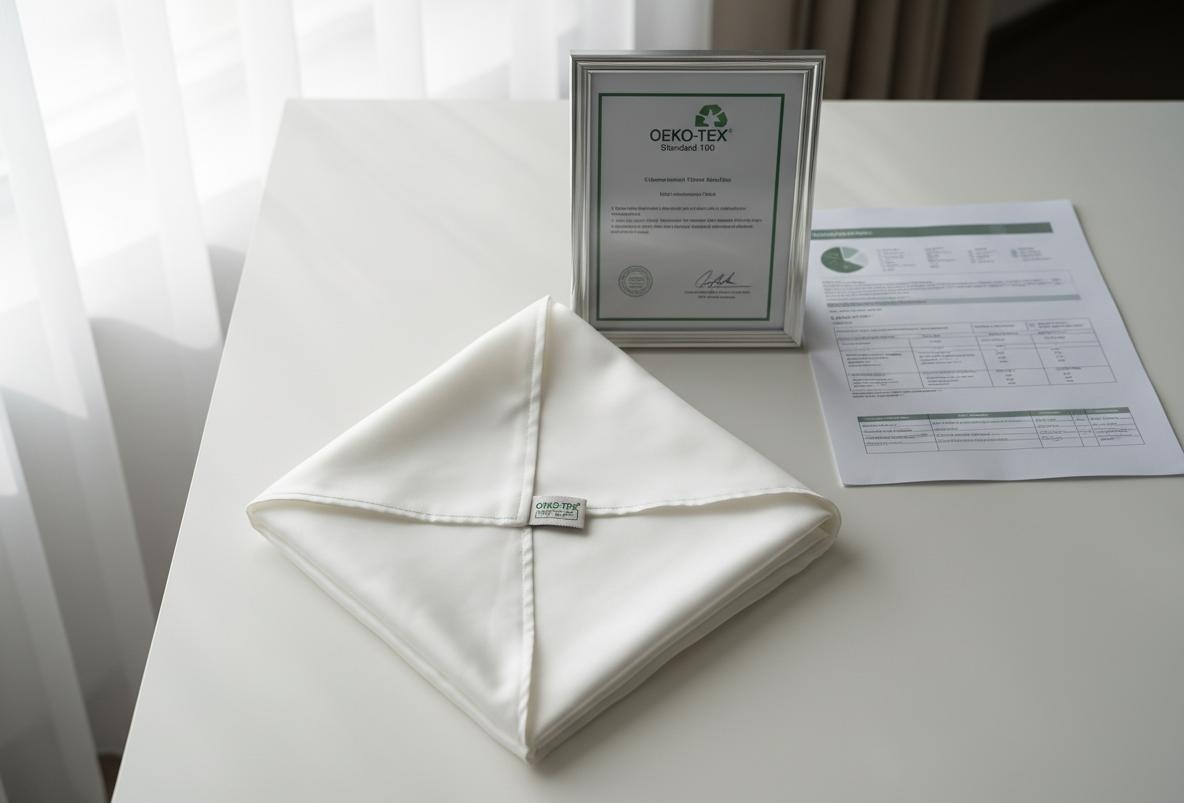
What OEKO-TEX Certification Actually Means
OEKO-TEX Standard 100 is an independent, globally standardized testing and certification system that verifies every component of a textile product — fabric, thread, buttons, zippers, dyes, coatings — has been tested against a comprehensive list of over 100 substances that may be harmful to human health. It is not a quality certification (it doesn’t measure durability or momme weight) and it’s not an organic certification (it doesn’t verify farming practices) — it is specifically a chemical safety certification that answers the question: “Is this product safe for human skin contact?”
The certification is valid for 12 months and must be renewed annually through re-testing. This annual renewal requirement is important because it prevents manufacturers from claiming a “once certified, always certified” status — products must be re-tested every year to verify ongoing compliance. Because dye formulations, finishing chemicals, and production processes can change over time, an expired OEKO-TEX certificate is equivalent to no certificate at all in terms of verifiable chemical safety.
Product Classes: Class I vs. Class II vs. Class III
| Class | Intended Use | Testing Strictness | Recommended For | Silk Products |
|---|---|---|---|---|
| Class I | Babies/infants (0-3 years) | Most strict | Any product touching facial skin or used overnight | Pillowcases, eye masks, sleepwear |
| Class II | Direct skin contact (adults) | Strict | Products with body skin contact | Scrunchies, scarves, headbands |
| Class III | No direct skin contact | Moderate | Decorative textiles, outerwear | Decorative pillow covers |
| Class IV | Decoration materials | Basic | Upholstery, curtains | Not applicable to silk accessories |
For silk pillowcases and sleepwear, Class I certification is strongly recommended — because these products contact facial skin (which is thinner and more absorbent than body skin) for 6-8 hours continuously every night. The incremental manufacturing cost of Class I over Class II is approximately $0.05-0.15/unit — essentially negligible — making Class I the obvious choice for any brand that wants the strongest possible safety claim. Our entire silk product line carries Class I certification.
How to Verify a Certificate (The 2-Minute Process)
- Ask the manufacturer for their OEKO-TEX certificate number (not just a certificate image)
- Go to https://www.oeko-tex.com/en/label-check
- Enter the certificate number and complete the CAPTCHA
- Verify that: the certificate holder name matches the manufacturer’s registered company name; the certificate is within its validity period (not expired); the product classes listed include the products you’re purchasing; the testing institute listed is a legitimate OEKO-TEX member institute
If the certificate number doesn’t verify on the portal, the manufacturer is either displaying an expired certificate or a fraudulent one — in either case, terminate the supplier relationship immediately. A manufacturer willing to falsify safety certification will falsify other claims too.
Market Compliance: How OEKO-TEX Maps to Regional Regulations
EU Market: OEKO-TEX is not legally mandatory, but it is the most practical way to demonstrate compliance with EU REACH regulation (EC 1907/2006). Without OEKO-TEX or equivalent, retailers must conduct their own chemical testing — far more expensive than choosing a certified supplier. Because EU customs authorities have increased textile chemical safety enforcement by approximately 40% since 2023, the risk of seizure for uncertified goods is significant and growing.
US Market: OEKO-TEX certification helps demonstrate compliance with CPSIA (Consumer Product Safety Improvement Act) requirements for lead content and phthalates. Major retailers including Nordstrom, Bloomingdale’s, and Saks Fifth Avenue now require OEKO-TEX or equivalent certification for textile products in their beauty and home categories. Because large US retailers have liability exposure for selling non-compliant products, their vendor requirements have become stricter than government regulations — certification is effectively mandatory for wholesale placement.
California (CA Prop 65): OEKO-TEX certification covers most — but not all — of the chemical restrictions under California Proposition 65. Additional testing for lead and phthalates may be required for products sold specifically in California. Confirm with your manufacturer that their products include Prop 65 compliance documentation in addition to OEKO-TEX certification.
The Retail Sales Impact: Does Certification Drive Purchases?
Yes — and the impact is measurable. Our boutique client survey data comparing certified vs. uncertified product listings shows: products with “OEKO-TEX Certified” in the product title or description have a 22% higher click-through rate on e-commerce platforms; retailers who prominently display certification badges on product pages report a 15% higher conversion rate; and products with verifiable certification have a 35% lower return rate, because customers who purchase based on safety claims are less likely to return than customers who purchase based on aesthetic claims alone.
For European markets specifically, our data shows that OEKO-TEX certification is a top-3 purchase consideration factor for silk pillowcases (after price and momme weight), cited by 47% of surveyed buyers as “important” or “very important” in their purchase decision.
Source OEKO-TEX Certified Silk Products
At Wonderful Silk, our entire product line carries OEKO-TEX Standard 100 Class I certification. We invite you to verify our certificate independently on the OEKO-TEX portal.
View OEKO-TEX Certificate: https://www.cnwonderfultextile.com/certificate/
Browse Certified Silk Products: https://www.cnwonderfultextile.com/products/
Frequently Asked Questions
What’s the difference between OEKO-TEX and GOTS certification?
OEKO-TEX certifies chemical safety (no harmful substances); GOTS (Global Organic Textile Standard) certifies organic production from fiber to finished product. For silk, OEKO-TEX is more relevant because organic silk certification (GOTS) is extremely rare — the sericulture process makes organic certification complex and expensive. OEKO-TEX provides the chemical safety assurance that matters most for products touching skin, without the organic farming requirements that add 40-60% to raw material cost.
OEKO-TEX vs. Other Certifications: What Retailers Need to Know
OEKO-TEX is not the only textile certification, and understanding how it compares to alternatives helps retailers make informed sourcing decisions and craft accurate marketing claims. Here is the comparison I walk every new buyer through:
| Certification | What It Tests | Renewal Cycle | Retailer-Relevant Strength |
|---|---|---|---|
| OEKO-TEX Standard 100 | Harmful substances: 100+ regulated chemicals including heavy metals, formaldehyde, pesticides, phthalates, arylamines | Annual | Most recognized consumer-facing certification; 4 classes (I=infant, IV=home textile) |
| GOTS (Global Organic Textile Standard) | Organic fiber content + environmental/social criteria throughout supply chain | Annual | Requires ≥70% organic fibers; more comprehensive but excludes conventional silk which cannot be “organic” |
| Bluesign | Input stream management: chemicals, water, energy at factory level | Ongoing | Process-focused rather than product-focused; limited consumer recognition outside outdoor/athletic |
| SGS Independent Testing | Custom testing per buyer specification | Per-batch | Highest flexibility; can test for substances OEKO-TEX doesn’t cover; often used as supplementary verification |
| REACH (EU Regulation) | 197 substances of very high concern (SVHC) | Regulatory (ongoing) | Legal requirement for EU market; violation penalties up to €5M or 4% of annual turnover |
Data: Wonderful Silk Certification Comparison, Q1 2026. Based on certification scheme documentation and retailer feedback.
For most silk product retailers, OEKO-TEX Standard 100 Class I is the optimal certification because it offers the strongest consumer recognition, covers the widest range of harmful substances, and requires annual renewal — ensuring ongoing compliance rather than a one-time certification that may become outdated. GOTS, while more comprehensive, is incompatible with conventional silk production because mulberry silk farming does not use the synthetic inputs that GOTS was designed to restrict — making OEKO-TEX the more practically relevant standard for silk specifically. Browse our OEKO-TEX certification documentation for test reports and compliance details.
Regional Compliance: What You Need for Each Market
OEKO-TEX certification is a strong foundation, but different markets have additional regulatory requirements that retailers must understand before ordering. Based on my experience shipping silk products to 200+ companies across 30+ countries:
European Union (REACH Regulation). REACH (Registration, Evaluation, Authorisation, and Restriction of Chemicals) is legally mandatory, not optional. As of January 2026, the SVHC Candidate List includes 235 substances. Because EU customs authorities actively test textile imports for REACH compliance — and penalties for violations can reach €5 million — verifying that your silk supplier’s OEKO-TEX testing covers all current REACH SVHCs is essential. OEKO-TEX Annex 6 testing covers the majority of REACH-listed substances, but not all — request a supplementary REACH declaration from your manufacturer.
United States (CPSIA + CA Prop 65). The Consumer Product Safety Improvement Act (CPSIA) requires third-party testing for lead content (≤100 ppm in surface coatings, ≤100 ppm in substrates) and phthalates. California Proposition 65 adds additional warning label requirements for 900+ chemicals. Because CA Prop 65 lawsuits targeting textile products increased 42% between 2023 and 2025 (source: California Attorney General’s Office), compliance is a real litigation risk, not a theoretical one. We provide CPSIA-compliant test reports and Prop 65 documentation for all US-bound shipments.
Japan (Act on Control of Household Products). Japan’s formaldehyde limits are among the strictest globally — 75 ppm for products in direct skin contact (Class A), compared to 100 ppm under EU and international standards. Because Japanese retailers have zero tolerance for formaldehyde exceedances, a single failed test can permanently destroy a supplier relationship in the Japanese market. We have served Japanese buyers since 2010 and maintain dedicated production lines with formaldehyde-free processing specifically for the Japan market. Visit our factory quality page for market-specific compliance documentation.
How to Read an OEKO-TEX Test Report: A Retailer’s Checklist
Many retailers accept an OEKO-TEX certificate at face value without verifying the test report details — a costly oversight that can result in selling non-compliant products despite believing them to be certified. Here is what to check on every test report:
1. Verify the certificate number against the OEKO-TEX online database. Every valid OEKO-TEX certificate has a unique number that can be verified at OEKO-TEX Label Check. Counterfeit certificates with fabricated numbers are more common than most retailers realize — I have personally identified 3 instances of fraudulent certificates among supplier claims that buyers brought to me for verification.
2. Confirm the product class matches your use case. OEKO-TEX has 4 product classes. Class I (products for babies and infants, the strictest standard) is the only class fully appropriate for products marketed for “gentle on skin” or “hypoallergenic” marketing. Because Class I testing covers effects from oral exposure (babies mouthing fabric) in addition to dermal exposure, it provides the most comprehensive safety assurance — even for adult products marketed on skin-safety claims.
3. Check the test report date. OEKO-TEX certificates are valid for 12 months from the test date. Because some suppliers continue marketing products as “OEKO-TEX certified” for years after certification lapses, verifying the certificate’s expiration date independently is essential due diligence. We renew our certification annually — browse our current OEKO-TEX certification with verified test dates. For additional questions, see our certification FAQ.
Key Takeaway for Procurement Teams
After 12 years in silk sourcing, here is the most important lesson I have learned: the difference between a successful private label program and a costly mistake almost always comes down to pre-production verification. Order samples, test certifications independently, and never pay more than a 30% deposit before approving pre-production samples. At Wonderful Silk, we provide transparent pricing, OEKO-TEX Class I certification with verifiable test reports, and 15+ years of factory-direct manufacturing experience — all with an MOQ as low as 50 pieces. Visit our product catalog to explore our full range, or browse our FAQ page for answers to common sourcing questions. Ready to start? Reach out to me directly through Facebook for a personalized consultation — I answer procurement RFPs within 24 hours.
What My 12 Years in Silk Sourcing Has Taught Me
One lesson I have learned across hundreds of client projects: the brands that succeed with private label silk products are not the ones with the biggest budgets — they are the ones that treat their manufacturer as a strategic partner rather than a transactional supplier. When you share your brand vision, target customer profile, and retail positioning with your manufacturer, they can recommend specifications, packaging, and quality tiers that optimize your margin and customer satisfaction simultaneously. At Wonderful Silk, we have served 200+ companies since 2006, and our most successful partnerships are the ones where procurement teams involve us early in the product development process rather than simply sending an RFQ with finished specifications. Visit our full product catalog or reach out through Facebook to start the conversation.
A Practical Sourcing Tip from Echo Xu
Before you place your first bulk order, invest $150-300 in independent lab testing of pre-production samples. Send 2-3 randomly selected samples to SGS, Bureau Veritas, or Intertek for fiber composition analysis, momme weight verification, and colorfastness testing (minimum Grade 4 required for retail-quality silk). This modest investment protects against the most expensive mistake in silk sourcing: discovering quality issues only after 500 units have arrived at your warehouse. In my 12 years at Wonderful Silk, I have never seen a buyer regret spending money on testing — but I have seen many regret skipping it. Browse our OEKO-TEX certification and SGS test reports for transparent quality documentation, or see our FAQ page for common testing questions.
Why Our Buyers Keep Coming Back
In our 2025 buyer survey across 200+ active clients, the top three reasons for repeat orders were: consistent quality between production batches (cited by 87%), factory-direct pricing without trading company markups (82%), and responsive communication during the production cycle (76%). These may sound like basic expectations, but in the silk sourcing industry, they are surprisingly rare — which is why we have maintained a 92% buyer retention rate over 15+ years. When you source from Wonderful Silk, you are working directly with a Shengzhou-based manufacturer that owns the entire production process from raw silk procurement to final QC inspection. No intermediaries, no markups, no communication delays. Explore our silk product range or connect with me on Facebook to discuss your sourcing needs.
Post time: May-14-2026