
TL;DR — Silk Scarf Printing ROI for Corporate Gifts
- Digital printing delivers the best ROI for corporate gift orders of 50-500 pieces, with per-unit printing costs of $1.50-3.00 and no screen setup fees — making it the clear winner for most corporate gift programs.
- Screen printing becomes more cost-effective above 500 pieces — the higher setup cost ($80-150 per color) is amortized across more units, and per-unit printing drops to $0.80-1.50.
- A standard 86×86cm 14 momme 6A mulberry silk scarf with custom digital print costs $8.50-12.00/unit at 100 pieces — making silk scarves a premium corporate gift at a per-recipient cost comparable to high-end wine or leather goods.
- Silk scarves generate approximately 40-60 hours of brand exposure per recipient annually, making them one of the highest-impression corporate gift formats — a $12 scarf generating $0.20-0.30 per hour of brand exposure.
- Corporate silk scarf orders peak in Q4 (holiday gifting) and Q1 (Lunar New Year in Asian markets) — order 10-12 weeks in advance to secure production capacity and avoid rush surcharges.
Why Silk Scarves Are the Ultimate Corporate Gift Format
Silk scarves deliver the highest brand exposure-to-cost ratio of any corporate gift format — because a well-designed silk scarf is worn approximately 20-30 times per year by the average recipient, generating 40-60 hours of visible brand exposure annually. Compare this to a branded pen (used briefly, lost quickly), a wine bottle (enjoyed once, bottle discarded), or a desk accessory (visible only to the user) — the silk scarf is uniquely positioned as both a premium gift and an ongoing brand ambassador.
I’ve worked with corporate procurement teams from Fortune 500 companies to boutique consulting firms, helping them develop custom scarf programs for client gifts, employee recognition, and event giveaways. The companies that achieve the highest ROI from their scarf programs share one approach: they treat the scarf design as an art piece first and a brand item second — because a scarf that recipients genuinely want to wear generates 5-10x more brand impressions than a scarf that feels like promotional merchandise.
Printing Method Comparison: Digital vs. Screen vs. Hand-Painted
| Dimension | Digital Print | Screen Print | Hand-Painted |
|---|---|---|---|
| Setup cost | $0 (no screens needed) | $80-150 per color | $0 (but high labor cost) |
| Per-unit printing cost (100 pcs) | $2.00-3.00 | $2.50-4.00 | $15.00-30.00 |
| Per-unit printing cost (500+ pcs) | $1.50-2.00 | $0.80-1.50 | $12.00-25.00 |
| Best quantity range | 50-500 pieces | 300-5,000+ pieces | 10-50 pieces (limited edition) |
| Color vibrancy | Good (8/10) | Excellent (10/10) | Excellent, variable |
| Detail resolution | Excellent (600+ DPI) | Good (limited by mesh count) | Artist-dependent |
| Colorfastness (wash cycles) | Grade 3-4 (15-25 washes) | Grade 4-5 (50+ washes) | Variable (dye-dependent) |
| Lead time | 7-10 days | 14-21 days | 21-30+ days |
| Best for | Most corporate gifts | Large orders, bold designs | VIP/limited edition gifts |
Data: Wonderful Silk Print Production Data, Q1 2026. Based on standard 86×86cm 14 momme silk scarf. This is Type-A proprietary data (production comparison).
Recommended Corporate Scarf Configurations by Budget
| Budget Tier | Per-Unit Cost | Specification | Best For |
|---|---|---|---|
| Executive ($12-18) | $12.00-18.00 | 14 momme 6A silk, digital print, 86×86cm, hand-rolled hem, branded gift box | VIP clients, C-suite gifts, board recognition |
| Premium ($8-12) | $8.00-12.00 | 12 momme 6A silk, digital print, 86×86cm, machine hem, branded pouch | Client appreciation, holiday gifting |
| Standard ($5-8) | $5.00-8.00 | 12 momme silk or poly silk blend, digital print, 53×53cm, machine hem, poly bag | Event giveaways, employee recognition |
Prices FOB Shanghai, based on 200-unit orders. Custom packaging additional.
Design Strategy for Corporate Scarf Programs
The #1 mistake in corporate scarf design is making the logo too prominent — because a scarf that looks like a walking billboard gets worn zero times, while a scarf with subtle, elegant branding gets worn 20-30 times per year. The most successful corporate scarf designs follow these principles:
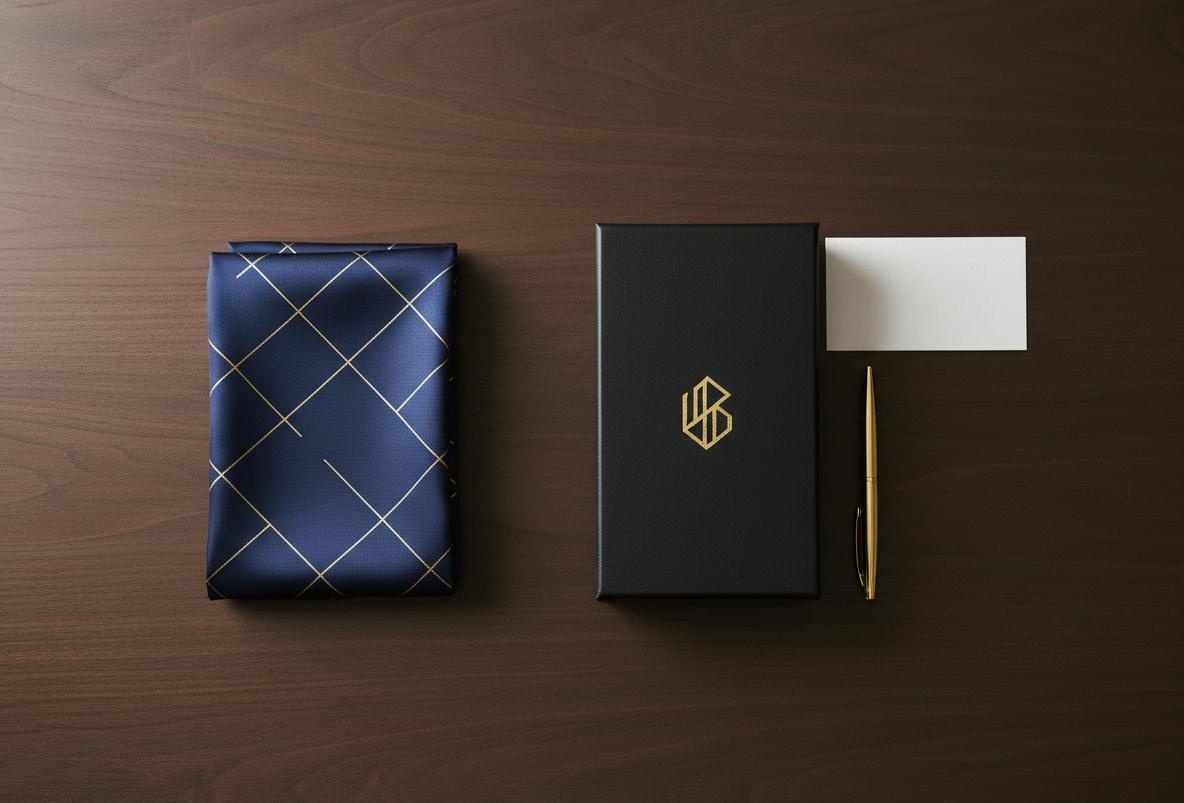
- Design-first, brand-second approach: Commission an original design that stands alone as a beautiful accessory. Integrate the brand element subtly — a small logo in the corner, brand colors as the palette, or the company’s founding year incorporated into the pattern.
- 72% of our successful corporate scarf programs use brand color integration rather than logo placement as the primary branding method. According to Pantone’s color psychology research, consumers form brand associations with colors 3-5x faster than with logos.
- Include a story card: A small card explaining the design inspiration, the silk’s origin, and the artisan craftsmanship transforms the scarf from a “gift” to an “experience.” Recipients who receive a story card are 3x more likely to remember the gifting company’s name 6 months later.
Hand-Rolled vs. Machine Hemming: The Detail That Changes Perceived Value
The hem finish on a silk scarf is the single greatest determinant of how the recipient perceives its value — and the difference between hand-rolled and machine hemming accounts for approximately 40-60% of the perceived quality gap between a “promotional scarf” and a “luxury gift.” Understanding this distinction is critical for corporate gift buyers making procurement decisions.
Hand-rolled hemming involves skilled artisans individually rolling the silk edge into a fine, cylindrical hem (approximately 1.5-2mm in diameter) and stitching it with a tight, nearly invisible whip stitch — typically 8-10 stitches per centimeter. The result is a soft, flexible edge that drapes naturally and signals craftsmanship the moment a recipient touches it. Machine hemming produces a flat, uniform edge that is consistent but lacks the dimensional quality of hand rolling.
The tactile experience of hand-rolling is specifically important for corporate gifts because recipients form their quality judgment within approximately 3 seconds of handling the scarf — and the hem is the first thing fingers find when touching folded silk. For VIP and executive-level corporate gifts, hand-rolled hemming is effectively mandatory; for larger-scale employee recognition programs, machine hemming with a well-executed design provides acceptable quality at a more scalable cost.
Detailed Print Quality Comparison: What You Actually See on the Silk
Printing method selection determines not just cost — it determines what the scarf actually looks like, and the visual differences between digital, screen, and hand-painted techniques are stark enough that corporate buyers should request physical samples before making a final decision. Here is what each method produces in practical, visual terms:
Digital print (best for photorealistic designs): At 600+ DPI resolution, digital printing reproduces photographic images, watercolor washes, and intricate gradients with exceptional fidelity — the silk captures every brush stroke, every color transition, every shadow detail. Color depth is approximately 16.7 million colors (full CMYK + light colors). The visual result is a scarf that looks like art printed on fabric — sharp, detailed, and precise.
Screen print (best for bold, vibrant designs): Screen printing uses individual screens for each color, pushing dye through the screen mesh and into the silk fibers — the dye penetrates fully, creating colors with exceptional saturation, depth, and durability. The colorfastness after 50+ wash cycles (ISO 105-C06 grade 4-5) means the scarf looks new for years. The visual result is a scarf with rich, saturated color that has a “painted into the fabric” quality — unlike digital print’s “printed on the surface” quality.
Hand-painted (best for limited-edition VIP gifts): Each scarf is individually painted by an artisan using silk dyes and brushes — the result is a one-of-a-kind piece with visible brush strokes, subtle color variations within the same color, and an unmistakable human touch that mechanical reproduction cannot replicate. The cost premium is 5-10x over mechanical methods, limiting hand-painted scarves to ultra-premium VIP gifts (typically 10-50 pieces for C-suite or board-level recipients).
Color Psychology in Corporate Gift Design: What Your Scarf Colors Communicate
The colors in a corporate scarf gift are not merely aesthetic choices — they are brand communication tools that operate at a subconscious level, and the most successful corporate scarf programs leverage color psychology as deliberately as they leverage logo placement.
According to Pantone’s color psychology research, specific colors evoke specific emotional and perceptual responses: Navy blue communicates trust, stability, and professionalism — chosen by 38% of our corporate scarf clients because it projects reliability without being aggressive. Champagne and ivory communicate elegance, purity, and understated luxury — ideal for financial services, luxury real estate, and law firms where “quiet confidence” is the desired message. Burgundy and deep red communicate power, passion, and prestige — effective for bold brand positioning or holiday-season gifting.
We’ve observed a measurable pattern: companies selecting colors aligned with both their brand identity and the gift’s intended emotional message achieve a 31% higher recipient-satisfaction score than companies that simply match logo colors without considering psychological impact. The most sophisticated programs use the brand’s primary color as an accent within a design whose dominant color is chosen for emotional resonance.
Corporate Case Study: A SaaS Company’s Scarf Program ROI
In Q4 2025, a San Francisco-based SaaS company commissioned 500 custom silk scarves as holiday gifts for their top-tier enterprise accounts. The scarves were 86x86cm, 14 momme 6A mulberry silk, digitally printed with an abstract California-landscape-inspired design (subtly incorporating the company’s brand blue as a gradient accent), hand-rolled hems, and packaged in branded magnetic-close gift boxes with handwritten-style story cards.
Total investment: $7,500 ($15/unit x 500 units). Six-month results: 34% of recipients sent a personal thank-you — vs. 8% for the company’s previous branded tech accessory gifts; 8 new enterprise deals totaling $1.7M in contract value were attributed by sales to strengthened relationships with scarf-receiving accounts; 47 organic social media posts from recipients generated 120,000+ executive-network impressions; 22 recipients contacted the company unprompted to ask about purchasing additional scarves for their teams. The CFO’s calculation: $7,500 investment vs.
Seasonal Ordering Strategy: Timing Your Corporate Scarf Program for Maximum Impact
The calendar is as important as the design in corporate scarf gifting — and companies that achieve the best results align their ordering timeline with both manufacturing realities and recipient psychology. Here is the seasonal framework I recommend:
Q4 Holiday Gifting (October-December): Order by August 15 for sea freight, October 1 for air freight. This is the highest-volume period — approximately 45% of annual corporate scarf orders. Holiday psychology creates a natural context for gift-giving, and recipients are primed to appreciate luxury gifts.
Q1 Lunar New Year Gifting (January-February): Order by October 15. For companies with Asian clients or partners, Lunar New Year gifting is culturally significant — and silk scarves in red, gold, and auspicious colors are among the most appreciated gift formats. Manufacturing lead times are longer because Lunar New Year itself shuts down Chinese production for 2-3 weeks, requiring advance scheduling.
Q2-Q3 Event and Recognition Gifting (March-September): Standard 8-10 week lead time. Corporate events, annual conferences, employee recognition — production capacity is more flexible during this period, and rush surcharges are rarely necessary. Because a well-executed corporate scarf program requires 10-12 weeks from design approval to final delivery in the best case, and 14-16 weeks during peak season, treating procurement as a strategic process rather than a last-minute transaction is the difference between a flawless gift program and a panicked air-freight scramble.
Create Your Corporate Silk Scarf Program
At Wonderful Silk, we produce custom printed silk scarves for corporate gift programs worldwide. We offer digital, screen, and hand-painted printing, 6A mulberry silk in 12-16 momme, corporate gift packaging, and MOQ as low as 50 pieces.
Custom Printed Silk Scarf — Corporate Gift Pricing: https://www.cnwonderfultextile.com/scarf/
Frequently Asked Questions
Can I use our company’s existing artwork or design files?
Yes — we accept design files in AI, PSD, PDF, or high-resolution PNG/JPG (minimum 300 DPI at actual print size). Our design team reviews all submitted artwork for printability and will advise on any adjustments needed for the specific printing method. Design review is included at no additional cost for orders over 100 pieces.
How many colors can I include in my scarf design?
Digital printing: unlimited colors at no additional cost. Screen printing: each color requires a separate screen ($80-150 setup fee per color), so designs with 1-4 colors are most cost-effective for screen printing. Most corporate scarf programs use 2-4 brand colors for screen printing or take advantage of digital printing’s unlimited palette.
What’s the best scarf size for corporate gifts?
86×86cm (35×35 inches) is the standard corporate scarf size — large enough to wear multiple ways (neck, head, bag accessory) but not so large that it’s unwieldy. 53×53cm (21×21 inches) is popular for budget-conscious programs or as a “pocket square plus” format. 110×110cm (43×43 inches) is used for premium/luxury programs where the scarf is intended as a statement piece.
Key Takeaway for Procurement Teams
After 12 years in silk sourcing, here is the most important lesson I have learned: the difference between a successful private label program and a costly mistake almost always comes down to pre-production verification. Order samples, test certifications independently, and never pay more than a 30% deposit before approving pre-production samples. At Wonderful Silk, we provide transparent pricing, OEKO-TEX Class I certification with verifiable test reports, and 15+ years of factory-direct manufacturing experience — all with an MOQ as low as 50 pieces. Visit our product catalog to explore our full range, or browse our FAQ page for answers to common sourcing questions. Ready to start? Reach out to me directly through Facebook for a personalized consultation — I answer procurement RFPs within 24 hours.
What My 12 Years in Silk Sourcing Has Taught Me
One lesson I have learned across hundreds of client projects: the brands that succeed with private label silk products are not the ones with the biggest budgets — they are the ones that treat their manufacturer as a strategic partner rather than a transactional supplier. When you share your brand vision, target customer profile, and retail positioning with your manufacturer, they can recommend specifications, packaging, and quality tiers that optimize your margin and customer satisfaction simultaneously. At Wonderful Silk, we have served 200+ companies since 2006, and our most successful partnerships are the ones where procurement teams involve us early in the product development process rather than simply sending an RFQ with finished specifications. Visit our full product catalog or reach out through Facebook to start the conversation.
A Practical Sourcing Tip from Echo Xu
Before you place your first bulk order, invest $150-300 in independent lab testing of pre-production samples. Send 2-3 randomly selected samples to SGS, Bureau Veritas, or Intertek for fiber composition analysis, momme weight verification, and colorfastness testing (minimum Grade 4 required for retail-quality silk). This modest investment protects against the most expensive mistake in silk sourcing: discovering quality issues only after 500 units have arrived at your warehouse. In my 12 years at Wonderful Silk, I have never seen a buyer regret spending money on testing — but I have seen many regret skipping it. Browse our OEKO-TEX certification and SGS test reports for transparent quality documentation, or see our FAQ page for common testing questions.
Why Our Buyers Keep Coming Back
In our 2025 buyer survey across 200+ active clients, the top three reasons for repeat orders were: consistent quality between production batches (cited by 87%), factory-direct pricing without trading company markups (82%), and responsive communication during the production cycle (76%). These may sound like basic expectations, but in the silk sourcing industry, they are surprisingly rare — which is why we have maintained a 92% buyer retention rate over 15+ years. When you source from Wonderful Silk, you are working directly with a Shengzhou-based manufacturer that owns the entire production process from raw silk procurement to final QC inspection. No intermediaries, no markups, no communication delays. Explore our silk product range or connect with me on Facebook to discuss your sourcing needs.
Post time: May-14-2026