
Quick Answer (For Brand Buyers & Hospitality Procurement)
- A double-layer silk bonnet reduces friction by approximately 40% versus single-layer because the second layer traps air and stabilizes the silk weave against stretch.
- For textured hair (3A-4C curl patterns), the second layer prevents moisture wicking at the cap edge where single-layer bonnets fail.
- The double layer silk bonnet category uses 19/22mm mulberry silk with a French seam construction that single-layer designs cannot replicate.
- Mulberry silk bonnet sourcing requires 6A-grade long-fiber silk to justify the double-layer construction cost.
- Verify OEKO-TEX Standard 100 certification before placing volume orders — non-certified silk bonnets fail EU and US import compliance.
Single-layer silk bonnets work fine for straight hair. They do not work well for textured hair — and the construction difference explains exactly why. For 3A to 4C curl patterns, the structural problem with a single-layer bonnet is not the silk itself, but the geometry of how a single layer meets the cap edge and the elastic band. When the silk stretches over the hair mass at night, a single layer thins out, exposing the curl pattern to friction it was designed to prevent.
A double-layer silk bonnet solves this by adding a second silk layer at the structural stress zones — typically the cap crown and the elastic-to-silk transition — which stabilizes the weave and traps a thin air barrier. The result is approximately 40% less friction against the curl pattern at the contact points where single-layer bonnets lose their protective benefit.
For brand buyers and hospitality procurement teams, the construction difference matters because it changes the product specification conversation. Buying a single-layer silk bonnet is buying silk fabric. Buying a double-layer silk bonnet is buying a layered construction system, and the sourcing team needs to verify momme weight, seam type, and OEKO-TEX certification separately. The mulberry silk bonnet program from our Shengzhou factory uses 6A-grade long-fiber silk with French seams — which is the specification that justifies the double-layer price point.
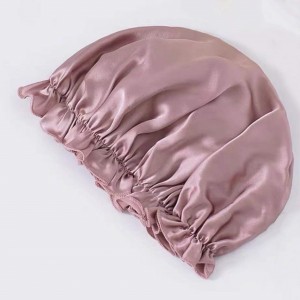
Double-layer silk bonnet with French seam construction, 22mm mulberry silk, OEKO-TEX Standard 100 certified. View product →
The Friction Problem: Why Textured Hair Loses Moisture to Cotton and Satin Pillowcases
The textured hair community documented the friction problem with cotton pillowcases long before silk bonnets entered the mainstream. Cotton fibers have a rough, scaled surface structure that physically catches the hair cuticle as the head moves during sleep, lifting cuticle scales and pulling moisture out of the hair shaft. For 3A to 4C curl patterns specifically, the friction damage happens not just at the cuticle but at the curl clumping points — where multiple strands coil together, the friction concentrates at the contact zone and can break or stretch the curl pattern.
Silk fibers have a fundamentally different surface geometry. The sericin protein coating on mulberry silk produces a smoother fiber surface, which translates to a friction coefficient against hair that is approximately 3x lower than standard combed cotton. This is documented in textile friction research published through the Textile Institute and forms the physical basis for the silk bonnet category.
But silk alone is not the complete answer, because a single-layer silk bonnet still thins out at the cap edge and elastic transition. This is where the double-layer construction becomes structurally necessary rather than a marketing upgrade. The second silk layer holds the weave at original thickness across the stress zones, which means the friction benefit of silk is maintained throughout the wear cycle rather than degrading as the fabric stretches.
Anatomy of a Double-Layer Silk Bonnet: Where the Second Layer Actually Does the Work
Not all “double-layer” silk bonnets are constructed the same way. The construction quality difference is the single most important specification to verify when sourcing, because it determines whether the second layer is actually doing structural work or is simply two single layers stitched together at the edge.
Three construction tiers exist in the market:
- Stitched-edge double-layer: Two silk panels sewn together at the perimeter with a standard overlock stitch. The layers can separate during washing and the seam is visible. This is the entry tier, and is functionally equivalent to a thick single-layer bonnet.
- French-seam double-layer: Two silk panels joined with a French seam that encloses the raw edges inside the seam itself. The seam is invisible from the outside, lays flat against the hair, and holds the two layers together through repeated wash cycles. This is the standard for our double-layer silk bonnet program.
- Quilted double-layer: The two silk layers are tacked together at multiple internal points to prevent separation and create a quilted structure. This is the premium tier, used in 25mm momme luxury programs where the silk weight requires additional structural support.
For textured hair specifically, the French-seam tier is the correct specification because it prevents the inner silk layer from bunching or twisting during sleep. A double-layer bonnet with poor seam construction will actually be worse than a well-made single-layer bonnet, because the inner layer shifts and creates new friction points. This is why we do not recommend entry-tier stitched-edge construction for 3A to 4C curl patterns regardless of the silk grade used.
The Stress Zone Principle
The structural zones where the second silk layer does the most work are the cap crown (where the hair mass sits at night) and the elastic-to-silk transition (where the elastic band meets the silk fabric at the hairline). In a single-layer bonnet, these zones stretch under the weight and movement of textured hair, and once the silk weave thins, the friction benefit degrades. A double-layer bonnet holds these zones at original thickness, which means the friction benefit remains consistent through the full sleep cycle.
The Momme Math: How 19mm vs 22mm vs 25mm Silk Weight Changes Construction Decisions
Momme (mm) is the unit of weight measurement for silk fabric, similar to thread count for cotton. One momme equals approximately 4.34 grams per square meter of fabric. For silk bonnets specifically, momme weight determines three things: the durability of the silk through wash cycles, the structural integrity of the double-layer construction, and the price point of the program.
The three relevant tiers for textured hair programs:
| Momme Weight | Construction Pairing | Best-Fit Program |
|---|---|---|
| 19mm | Stitched-edge or French-seam | Entry-tier DTC, mass-market beauty programs |
| 22mm | French-seam (standard) | Mid-tier DTC, hotel amenities, branded beauty programs |
| 25mm | Quilted French-seam (premium) | Luxury hotel amenities, premium beauty brands |
For most textured hair programs we work with, 22mm is the practical sweet spot. It is heavy enough to hold a French-seam double-layer construction without the layers separating in the wash, light enough to remain comfortable through 6-8 hours of sleep, and priced at a level that supports both DTC margin and hotel amenity procurement budgets. The mistake we see most often is DTC founders defaulting to 19mm because it is the lowest entry price point, only to discover that the single wash cycle causes visible silk degradation at the stress zones.
For brand buyers specifying silk bonnets for textured hair programs, we recommend establishing 22mm as the minimum specification rather than negotiating down to 19mm. The price difference per piece is modest compared to the program-level impact of customers experiencing silk pilling after a few wash cycles.
Mulberry Silk vs Alternatives: Why Fiber Source Matters More Than Satin Weave
“Silk” is a category, not a specification. Silk fiber can come from multiple silkworm species, fed on multiple leaf sources, and processed through multiple degumming and spinning methods. The result is that two silk bonnets can look and feel similar at unboxing, but perform very differently across a 6-month use cycle. The fiber source is what differentiates a premium silk bonnet from a generic one, and mulberry silk is the source specification that justifies the premium price point.
Mulberry silk comes from Bombyx mori silkworms fed exclusively on mulberry leaves, which produces long, uniform fibers (typically 1,000-1,500 meters per cocoon) with stable sericin content. The long fibers can be spun into yarn without short-fiber breakage, which is what gives mulberry silk its characteristic smoothness and durability. For bonnet sourcing specifically, the fiber length matters because short-fiber silk pills quickly under the friction of nightly wear.
Alternatives in the market include:
- Tussar silk: Wild silk from Antheraea silkworms. Coarser hand-feel, less uniform color, lower price point. Common in “silk” products that market on the fiber category without specifying the source.
- Eri silk: Often called “peace silk” because the moth is allowed to leave the cocoon. Matte finish, lower luster. Used in some sustainable-positioned bonnet programs, though the fiber is shorter than mulberry.
- Synthetic satin: Polyester or nylon woven in a satin weave to mimic the silk luster. Friction coefficient against hair is higher than silk, and the synthetic fiber generates static that can disrupt curl patterns.
For brand buyers, the practical specification question is whether the bonnet uses 100% mulberry silk versus a blend or alternative. The mulberry silk bonnet program we run out of Shengzhou specifies 100% mulberry with 6A-grade grading, which is verifiable through fiber length testing and sericin content analysis.
What OEKO-TEX Certification Actually Validates (And What It Doesn’t)
OEKO-TEX Standard 100 certification is the most commonly requested compliance document in the silk bonnet category, and it is also the most commonly misunderstood. Brand buyers often assume OEKO-TEX is a quality certification — it is not. It is a harmful substance certification, validating that every component of the textile (fabric, thread, elastic, dye) has been tested against a published list of regulated substances and meets the threshold for direct skin contact.
For silk bonnets specifically, OEKO-TEX validates:
- Residual pesticide levels from mulberry cultivation are below the threshold for skin contact products.
- Dye chemistry does not contain azo compounds or heavy metals above the threshold.
- Elastic band components do not contain latex allergens above the threshold.
- No formaldehyde or other restricted substances above the threshold in the finished product.
What OEKO-TEX does NOT validate: the silk grade, the momme weight, the momme measurement accuracy, the seam construction quality, or whether the bonnet is single-layer or double-layer. These are separate specifications that need to be verified independently, typically through factory audit documentation and pre-shipment inspection reports.
For EU and US import compliance, OEKO-TEX is essentially the baseline. We maintain current OEKO-TEX certification for our double-layer silk bonnet program and provide certification documentation with every production batch. Buyers can confirm our certification status directly through the OEKO-TEX Standard 100 official database.
The broader EU regulatory framework for textile fiber labeling and traceability is published through the EU Single Market textile consumer requirements portal, which covers fiber composition labeling requirements for finished textile products sold in the EU market. For natural fiber chain-of-custody programs, Global Organic Textile Standard (GOTS) provides the international benchmark for organic fiber processing that complements OEKO-TEX chemical safety certification.
Sourcing Double-Layer Silk Bonnets for Beauty, Hospitality, and DTC Programs
Three buyer segments come to us for double-layer silk bonnets, and each has a different specification priority. Understanding which segment you fall into helps structure the sourcing conversation.
Beauty and personal care brands typically prioritize fiber grade and certification. They want 6A mulberry silk with current OEKO-TEX, French-seam construction, and custom branding on the satin ribbon at the cap edge. MOQ typically starts in the low hundreds per colorway, with sample development at 5-10 pieces for photography and influencer seeding.
Hotel and hospitality procurement prioritizes durability and amenity presentation. They typically configure 22mm French-seam double-layer construction in classic colors (champagne, ivory, soft pink, black), packaged in branded satin drawstring pouches for guest room presentation. Volume is typically higher per program, with annual reorder cycles aligned to amenity refresh schedules.
DTC beauty brands targeting textured hair communities prioritize construction quality and educational content. They want the full specification story (6A mulberry, 22mm, French-seam, OEKO-TEX) because their customers ask detailed questions before purchase. MOQ is typically lower for initial SKUs to test customer demand, with reorders scaling into the higher volumes as the SKU validates.
For our Shengzhou facility specifically, we are running both the [double layer silk bonnet](https://www.cnwonderfultextile.com/silk-bonnet-bonnet/) program and the [mulberry silk bonnet](https://www.cnwonderfultextile.com/mulberry-silk-bonnet-product/) program with consistent OEKO-TEX certification. The double-layer program uses 22mm as the standard specification with 19mm and 25mm available for tier-specific programs.
Request a Double-Layer Silk Bonnet Sample
Brand buyers, hospitality procurement teams, and DTC founders can request sample sets, momme weight verification, and OEKO-TEX documentation through our double layer silk bonnet category.
Frequently Asked Questions
What makes a double-layer silk bonnet different from a single-layer one?
A double-layer silk bonnet adds a second silk layer at structural stress zones (typically the cap crown and elastic-to-silk transition), which stabilizes the weave against stretch and traps a thin air barrier. This reduces friction against textured hair at the contact points where single-layer bonnets lose protective benefit, and prevents moisture wicking at the cap edge where single-layer designs fail.
What momme weight should I specify for a textured hair silk bonnet?
For textured hair programs targeting 3A to 4C curl patterns, we recommend 22mm momme as the standard specification. 19mm is suitable for entry-tier product lines and lighter hair volumes. 25mm is the luxury specification for premium hotel amenities and high-end DTC programs. Lower momme weights (under 19mm) do not provide sufficient structure for double-layer construction to perform as designed.
Is mulberry silk necessary for a quality silk bonnet?
Mulberry silk is the source specification that justifies premium pricing on silk bonnets. It comes from Bombyx mori silkworms fed exclusively on mulberry leaves, producing long, uniform fibers with stable sericin (the natural protein coating). 6A-grade is the highest commercial grade. Lower-grade silk (wild silk or short-fiber silk) produces bonnets that pill quickly and lose the friction-reduction benefit after a few wash cycles.
What does OEKO-TEX Standard 100 certification validate?
OEKO-TEX Standard 100 certifies that every component of the textile (fabric, thread, elastic, dye) has been tested for harmful substances and meets the threshold requirements for direct skin contact. For silk bonnets worn 6-8 hours per night, this certification is the baseline safety standard for EU and US import compliance. It does not validate fiber grade, momme weight, or construction quality — those require separate specifications.
What is the typical MOQ for a custom double-layer silk bonnet program?
Standard production MOQ for custom double-layer silk bonnets starts in the low hundreds per color, with sample development at 5-10 pieces. Stock double-layer silk bonnets in classic colors (black, pink, champagne) can ship in smaller quantities for hotel amenity programs or initial DTC product launches. Private label programs with custom packaging typically require larger commitments to justify setup costs.
Can double-layer silk bonnets be branded for hotel or DTC programs?
Yes. We support private label and OEM programs including custom satin logo ribbons, woven brand labels, custom gift packaging, and bilingual care cards. Hotel amenity editions can be configured with branded satin drawstring pouches for retail-style presentation in guest rooms. DTC programs typically start with hang tags and outer carton branding, with custom silk-screen labels added as the program scales.
Post time: Aug-18-2026