
Why Silk Print Scarf Demand Is Rising in the Uniform Supply Market
As a result, we are seeing a massive pivot back toward premium accessories. Distributors and wholesale buyers are getting flooded with requests for custom silk scarves. It’s no longer just a niche request for luxury brands; it’s becoming a baseline requirement for any company wanting to project authority and approachability. The beauty of a silk print scarf lies in its versatility. You don’t have to redesign an entire uniform program to refresh a brand’s look. By simply introducing a high-quality, custom-printed accessory, procurement teams can instantly elevate the perceived value of their workforce’s attire without the headache of full-scale garment sizing and fitting. If you look at the landscape, the demand isn’t isolated to one sector. Aviation has historically been the anchor market—finding a reliable Airline Scarf Supplier is practically a rite of passage in uniform procurement. But today, hospitality chains, high-end retail staff, and even conservative banking institutions are jumping on board. Retailers want their floor staff to look like brand ambassadors, while banks are using custom scarves to soften stiff corporate suiting. From a commercial standpoint, this shift makes perfect sense. I constantly hear from HR and brand managers that employee retention and brand identity are top priorities. A well-designed scarf acts as a walking billboard, incorporating corporate colors and subtle logos in a way that feels like fashion rather than a uniform mandate. It boosts employee morale because they feel they are wearing a premium garment, which directly translates to better customer interactions. Let’s talk numbers. Completely overhauling a uniform—new jackets, trousers, blouses—costs a fortune in sampling, inventory, and rollout. On the flip side, adding a silk scarf is a high-impact, low-cost visual upgrade. For a fraction of the cost of a new blazer, a buyer can inject fresh seasonal colors or new branding into a 10,000-employee workforce. It’s the ultimate quick win for procurement managers trying to stretch their annual budgets. When you are sourcing for a uniform program, your mindset has to shift away from fast fashion. I always remind buyers that corporate wear is a completely different beast. A retail scarf might be worn once a month; a uniform scarf is worn five days a week, subjected to coffee spills, friction from seatbelts, and constant dry cleaning or hand washing. Because of this, buyers need programs that guarantee absolute consistency. If a hotel chain reorders scarves two years from now, the Pantone colors, the fabric weight, and the hem quality must match the original pilot order perfectly. You can’t afford “batch variations” when employees are standing next to each other in the lobby. Furthermore, uniform buyers need scalability. A program might start with a 500-piece pilot for regional managers and suddenly expand to 20,000 pieces globally. Procurement teams must build these programs with specifications that are easily reproducible, avoiding overly delicate weaves or obscure printing methods that bottleneck production. The foundation of a great program is the spec sheet. I generally recommend a 12 to 14 momme Twill Silk Scarf for corporate wear. Twill has a diagonal rib that makes it incredibly durable and gives it a beautiful drape. For printing, digital is dominating because of its unlimited color capabilities, though traditional screen printing is still viable for high-volume, solid-color designs. As for finishing, machine-rolled hems are standard for corporate budgets, while hand-rolled hems are reserved for executive gifting. If the scarf is too light, it feels flimsy and won’t hold a knot. If the colorfastness is poor, the dye will bleed onto a crisp white uniform blouse—a literal nightmare for procurement. Hand feel is equally critical; if it doesn’t feel soft against the neck, employees will “conveniently forget” to wear it. Getting the weight and dye-fixation right ensures high employee adoption rates. You have to think about how the scarf looks when folded, not just when laid flat. A massive logo in the center disappears once tied. Through strategic Custom Scarf Design, you should position logos at the corners or integrate them as a repeating geometric pattern. Nail down your exact Pantone coated/uncoated codes before sampling, and agree on packaging—whether it’s individual polybags for easy warehouse distribution or branded envelopes for a premium unboxing experience. Let’s address the elephant in the room: polyester. For decades, synthetic neckwear was the default because it was dirt cheap. But as I talk to buyers today, I see a massive wave of fatigue regarding cheap synthetics. Polyester doesn’t breathe, it holds odors, and it often has a cheap, plastic-like sheen under fluorescent corporate lighting. When you compare silk to other accessories, you are fundamentally comparing value propositions. Yes, silk requires a higher initial outlay, but the return on investment in terms of brand perception and wearer comfort is unmatched. We are seeing companies ditch clunky metal name badges and stiff ties in favor of fluid, elegant neckwear. Procurement teams are realizing that saving $5 on a synthetic accessory isn’t worth it if it makes a $500 uniform suit look cheap. The market is moving toward “less but better,” and silk perfectly fits that mandate. Polyester wins on raw cost and lead time, hands down. But silk absolutely destroys it on performance and positioning. Silk is a natural protein fiber; it regulates temperature, keeping flight attendants warm in a chilly cabin and cool on a sunny tarmac. From a brand positioning standpoint, handing an employee a 100% silk accessory communicates that the company values them, whereas polyester communicates cost-cutting. Here is a quick breakdown I use when consulting buyers on the silk vs. synthetic debate: Silk makes sense for premium customer-facing roles—think luxury hotel concierges, first-class cabin crew, and high-end retail associates. It’s also an excellent choice for modern, gender-neutral uniform programs where traditional neckties feel too rigid or outdated. For Uniform Accessories, silk bridges the gap between formal corporate wear and approachable modern fashion. Finding a factory that prints silk is easy; finding a supplier that understands B2B uniform programs is incredibly difficult. I’ve seen buyers get burned because they chose a consumer-focused fashion supplier who couldn’t handle strict corporate compliance or long-term inventory replenishment. When sourcing, you need a partner who views your order not as a one-off transaction, but as the start of a multi-year contract. They need to understand that if the corporate logo is Pantone 286 C, it cannot be a shade lighter in the next batch. Consistency is the currency of uniform supply. You also have to look beyond the printing machines. The real bottleneck in scarf production is often the hemming and finishing process. A supplier might be able to print 10,000 meters of silk a day, but if they don’t have enough skilled workers to roll and stitch the hems, your lead times will blow out disastrously. Always ask about their digital printing resolution and their dye-steaming process (which locks in the color). Evaluate their hemming options—do they offer a tight, dense machine stitch that won’t unravel? For quality control, ensure they have a dedicated inspection line checking for print ghosting, ink spots, and uneven borders before the scarves are ever bagged. Corporate buyers need flexibility. Look for suppliers who offer low MOQs for sampling (e.g., 20-50 pieces) so you can test pilot programs across different branches. However, verify their maximum monthly capacity to ensure they can scale when you win a 50,000-piece tender. Strict Pantone control using spectrophotometers is non-negotiable. Before wiring a deposit, I always ask: “Can you provide a physical strike-off (sample) before bulk production?” “What is your acceptable defect rate, and how do you handle replacements?” and “Do you source your raw silk directly, or buy off the open market?” These questions quickly separate the true manufacturers from the middlemen. Procurement is all about risk mitigation. With silk scarves, the risks are heavily concentrated in the dyeing and finishing stages. If you don’t set strict quality parameters in your purchase order, you leave yourself open to “quality fade,” where the first batch is perfect, but subsequent orders slowly degrade in fabric weight and print sharpness. Compliance is another major hurdle, especially if you are importing into the EU or North America. Uniforms are worn directly against the skin for 8-10 hours a day. If your supplier uses cheap, uncertified dyes containing heavy metals or restricted azo compounds, you aren’t just facing a quality issue; you’re facing a massive legal and PR liability. I always advise buyers to treat scarves with the same rigorous QC protocols they apply to core garments. Don’t let the fact that it’s “just an accessory” lull you into skipping third-party inspections. You should demand OEKO-TEX Standard 100 certification to ensure the dyes are free from harmful substances. If importing to Europe, REACH compliance is mandatory. Additionally, request ISO 105-C06 testing for colorfastness to washing and rubbing (both wet and dry). During a pre-shipment inspection (usually AQL 2.5), inspectors must check for specific scarf defects. Are the dimensions exactly 65x65cm, or did they shrink during steaming? Is the hem straight, or does the fabric pucker? Check the back of the scarf, too—good digital printing on 12mm silk should have at least 70-80% color penetration to the reverse side. The most common reasons for claims are color bleeding, off-spec Pantone matching, and “skewing” (where the square design is printed slightly diagonally off the grain of the fabric, making it impossible to fold into a perfect triangle). Addressing these tolerances in the PO prevents costly returns. Logistically, silk scarves are a dream product. They are incredibly lightweight, non-fragile, and pack down small. This gives buyers a lot of flexibility when it comes to freight, allowing for high-margin air shipments that wouldn’t be financially viable for heavy items like winter coats or boots. However, packaging can quickly eat into those margins if you aren’t careful. I’ve seen buyers request elaborate, rigid magnetic gift boxes for a 10,000-piece uniform rollout, only to realize that the boxes take up five times the cubic volume of the scarves themselves, destroying their freight budget. Margin planning requires a holistic view of the unit cost, the packaging footprint, and the distribution method. If you are a distributor, your goal is to add value through kitting and seamless replenishment without inflating your landed costs unnecessarily. For mass uniform rollouts, flat-packing in eco-friendly, biodegradable polybags is the most efficient method. If the scarves are part of an executive onboarding kit, flat paper envelopes with a custom logo offer a premium feel without adding cubic weight. Save the rigid gift boxes strictly for high-end corporate gifting or retail. Because scarves are dense when packed flat, a standard export carton can easily hold 300 to 500 pieces. Text Chart: Freight Time vs. Cost (Estimates for 5,000 pcs) Always check the HS code (typically 6243.90 for silk accessories) to calculate import duties accurately. To maximize margins, consolidate your accessory shipments with other uniform garments if possible. You can also increase your selling price to the end client by offering private label packaging—charging a premium for custom-branded belly bands or care tags. Negotiating tiered pricing based on annual volume commitments with your supplier is the strongest lever for lowering unit costs. The holy grail of B2B sales is recurring revenue. You don’t want to sell a client 1,000 scarves and never hear from them again. The goal is to integrate your silk scarves so deeply into their corporate identity that reordering from you becomes an automated, frictionless process. To do this, you have to position yourself as a solutions provider, not just a vendor. When you pitch a scarf program, pitch the inventory management, the consistent quality, and the ease of onboarding new hires. Show them that you have the back-end supply chain secured. Once a client approves a design, that artwork becomes an asset. They won’t want to go through the hassle of color-matching and sampling with a new supplier next year. If you deliver perfection on the first bulk order, you essentially lock in the replenishment business for the lifespan of that uniform iteration. Focus your efforts on industries with high employee turnover and strict grooming standards. Airlines, cruise lines, national banking networks, and global hotel franchises are goldmines. They are constantly hiring and need a steady stream of Professional Neckwear to outfit new staff every single month. When bidding on tenders, don’t just quote a price per unit. Present a “managed program.” Offer to hold buffer stock, provide rapid 48-hour dispatch for new hires, and guarantee Pantone consistency for three years. This shifts the conversation from price to reliability, which is what procurement directors actually care about. The lifecycle should look like this: First, get digital artwork approval. Second, mandate a physical strike-off (a small printed swatch) for color sign-off. Third, produce a 100-piece pilot order for wear-testing. Fourth, execute the bulk production. Finally, set up a quarterly replenishment schedule based on their historical hiring data to keep their stock levels healthy. I always tell my procurement teams to over-communicate with the supplier. Assume nothing. If you want the care label sewn exactly 2cm from the edge, put it in the PO. If you need the scarves packed in sets of 10, put it in the PO. Clarity prevents catastrophes. Ultimately, managing a silk scarf program is highly rewarding. It’s a high-visibility item that clients love, and it carries excellent margins if you control the logistics. Keep these final metrics in mind as you go to market. Prioritize 12-14mm silk twill for durability, mandate physical strike-offs for color accuracy, and optimize your packaging to save on air freight. Treat the scarf as a core uniform garment, not an afterthought. For digital printing, most reliable B2B suppliers require an MOQ of 50 to 100 pieces per design. If you are using traditional screen printing (which offers better penetration for solid colors), expect MOQs to jump to 300 or 500 pieces per design to cover the cost of screen setup. Expect 7 to 14 days for a physical sample once the artwork is finalized. For bulk production, a standard run of 1,000 to 5,000 pieces typically takes 3 to 4 weeks, depending on the complexity of the hemming and the current factory capacity. Never release the final balance payment without reviewing an AQL 2.5 third-party inspection report. Additionally, keep your OEKO-TEX certificates and colorfastness test reports on file—your corporate clients will likely request them during their own internal audits. Related reading: Twill Silk Scarf
Why Silk Print Scarf Demand Is Rising in Uniform Supply
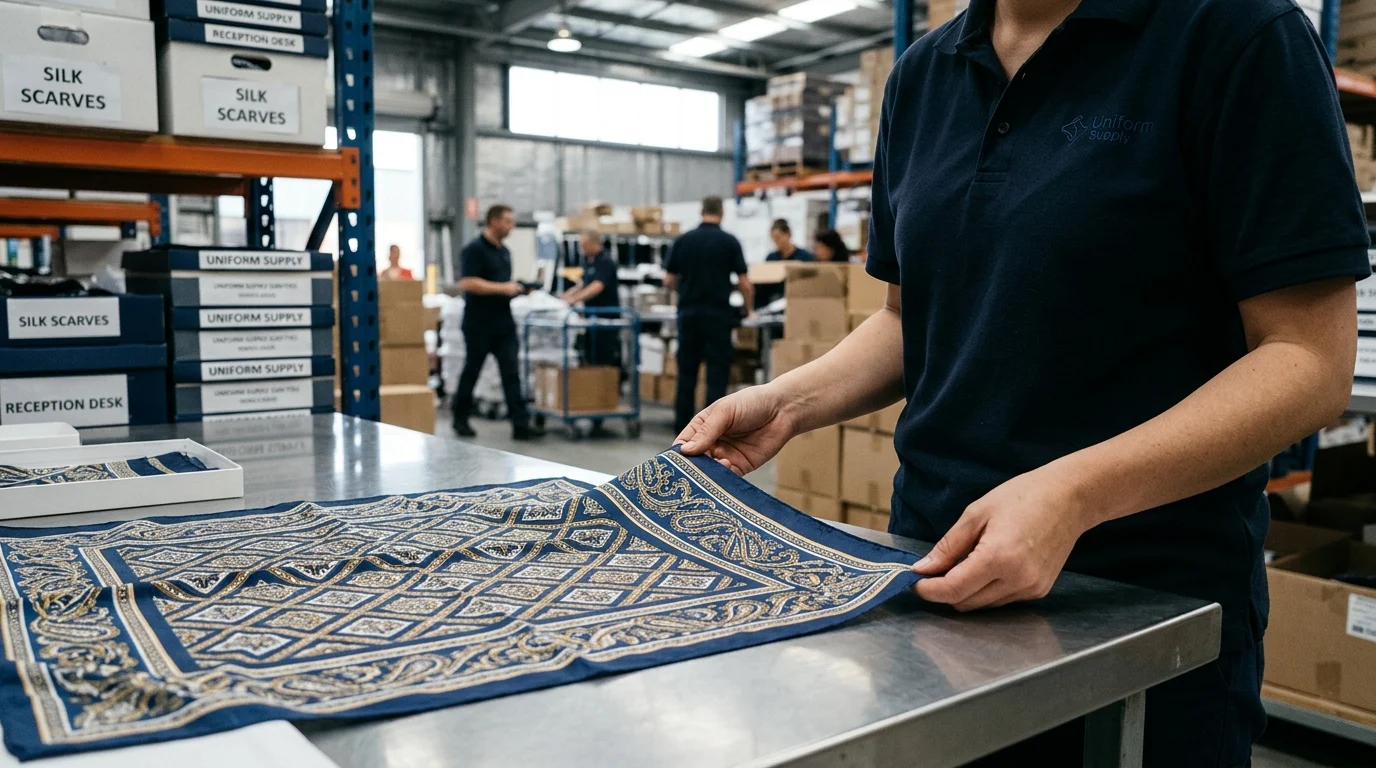
Demand shifts across hospitality, aviation, retail, banking, and corporate uniforms
Commercial drivers behind branded scarf programs
Why silk scarves offer a low-cost visual upgrade
What Uniform Buyers Need From a Silk Print Scarf Program
Fabric, print, and finishing specs that matter most
How size, weight, colorfastness, and hand feel affect adoption
What to define early for logo placement, pattern scale, color matching, and packaging
How Silk Print Scarves Compare With Polyester and Other Accessories
Silk vs polyester: cost, lead time, performance, and brand positioning
Key comparison points: MOQ, margin, durability, and care
Feature
100% Silk Twill
Polyester (Satin/Twill)
Typical MOQ
50 – 100 pcs
500+ pcs (often higher for custom)
Wholesale Margin
High (Premium pricing)
Low to Medium (Volume dependent)
Durability
High (if 12mm+ twill)
Very High (abrasion resistant)
Care
Dry clean or gentle hand wash
Machine washable
When silk scarves make sense over ties and synthetic options
How to Source a Silk Print Scarf Supplier
Supplier capabilities to evaluate: printing, hemming, and quality control
How MOQ, sampling, Pantone control, and capacity affect sourcing
Questions that reduce risk on custom orders
Compliance and Quality Risks in Silk Print Scarf Procurement
Test standards and documents buyers may require
Inspection checkpoints for print, finishing, dimensions, and shade consistency
Common production issues that lead to claims and returns
Packaging, Logistics, and Margin Planning for Silk Print Scarf Orders
Packaging formats for wholesale, gifting, and uniform programs
How to estimate carton efficiency, freight, duties, and replenishment timing
Margin levers: unit cost, private label packaging, consolidation, and pricing
How to Turn Silk Print Scarf Demand Into Repeat Business
Sales channels with the strongest reorder potential
How to position scarf programs for tenders and managed uniform contracts
Steps from artwork approval to pilot order, bulk production, and reorders
What Buyers Should Know Before Placing a Silk Print Scarf Order
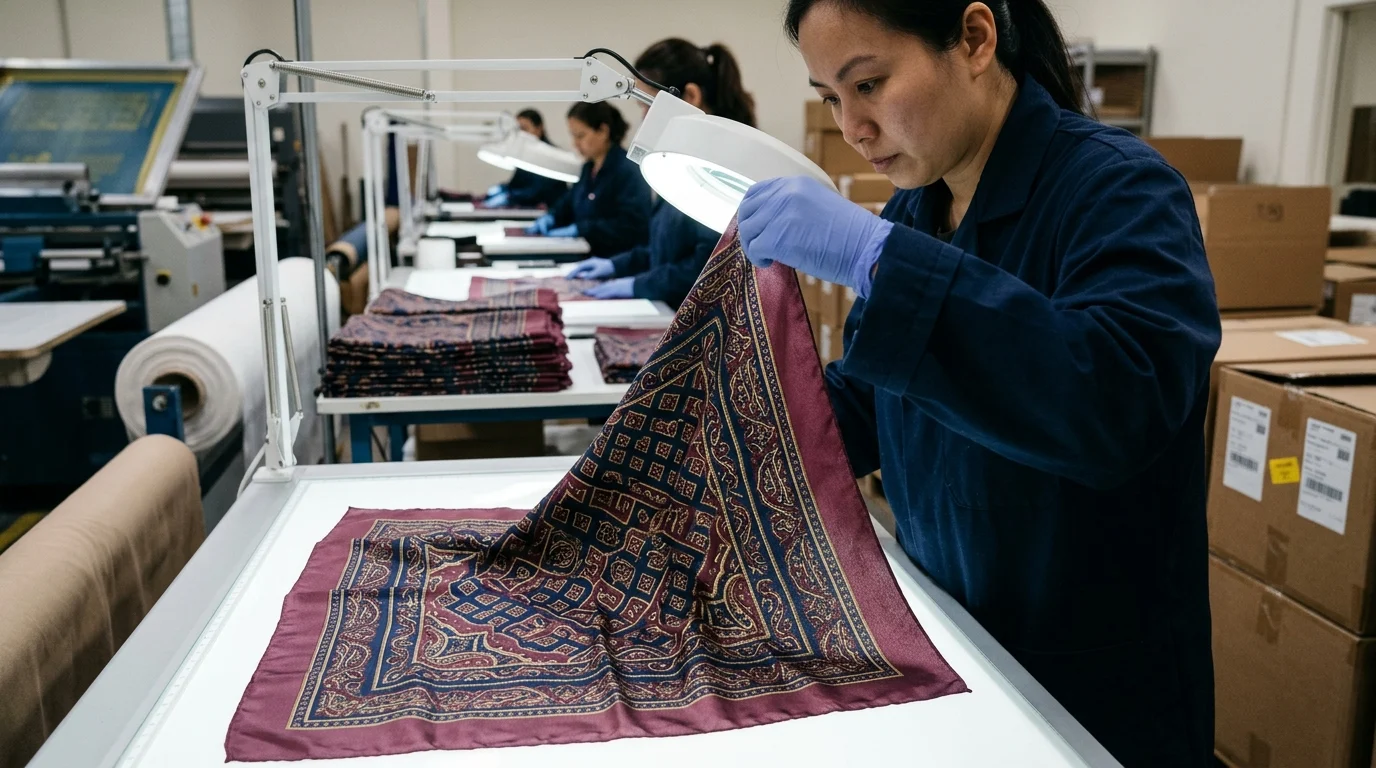
Key procurement takeaways
Typical MOQ for custom orders
Sampling and bulk production timelines
Quality and compliance documents to request before shipment
Key Takeaways
Post time: Apr-13-2026