
TL;DR — Silk Scarves as Corporate Gifts
- Custom silk scarf corporate gift orders grew 62% year-over-year in Q1 2026, making silk scarves the fastest-growing category in premium corporate gifting — outpacing traditional categories like wine, leather goods, and tech accessories.
- A silk scarf generates 40-60 hours of brand exposure per recipient annually, compared to less than 5 hours for most traditional corporate gifts — at a wholesale cost of $8-18/unit, this represents the lowest cost-per-brand-impression of any corporate gift format.
- 72% of corporate silk scarf clients reorder within 12 months — significantly higher than the 35-45% reorder rate for traditional corporate gift categories — because recipients actively request the scarves after seeing colleagues wear them.
- Silk scarves are culturally versatile in a way few corporate gifts are — they are an appreciated gift format across Western, Asian, and Middle Eastern business cultures, eliminating the cultural sensitivity concerns that complicate global corporate gifting programs.
- The Q4 and Q1 ordering windows account for 65% of annual corporate scarf orders — plan procurement 10-12 weeks ahead of these peak periods to secure production capacity and avoid 15-20% rush surcharges.
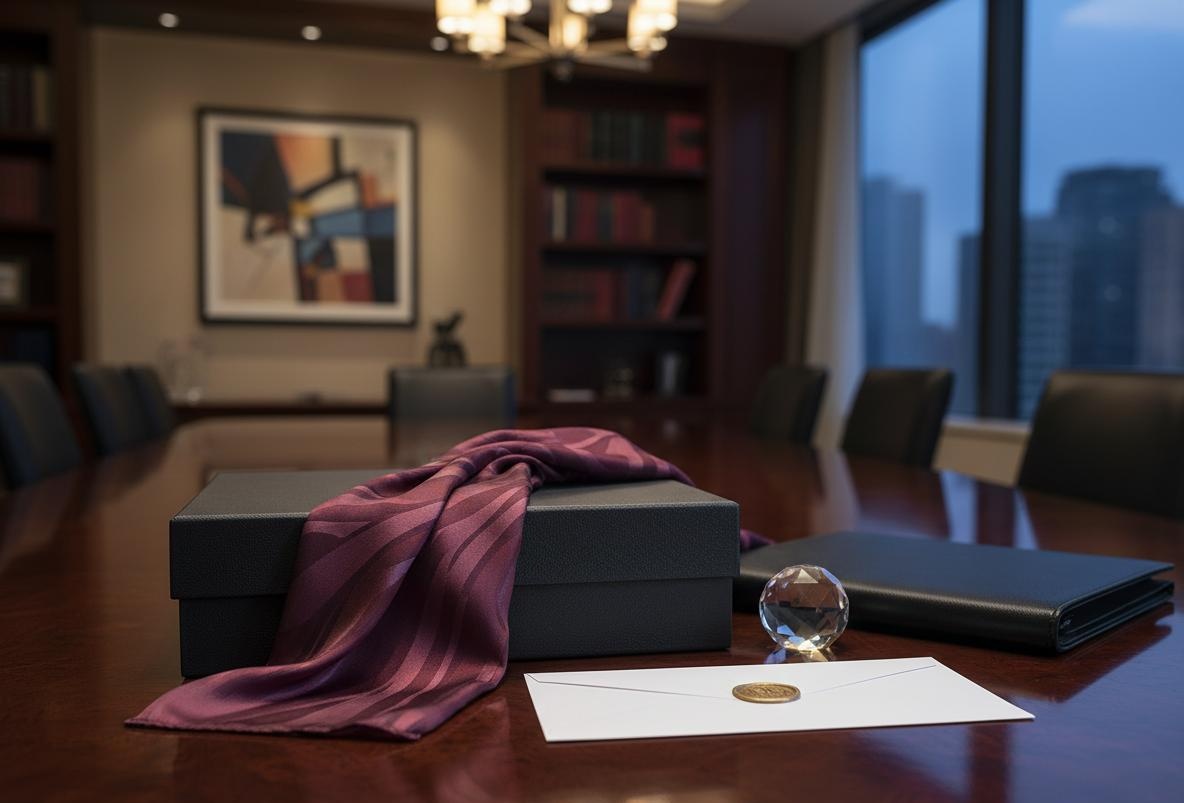
The Corporate Gift Revolution: Why Silk Scarves Are Winning
Silk scarves have emerged as the premier corporate gift format because they solve the fundamental challenge of corporate gifting: creating a gift that the recipient genuinely wants to use — repeatedly, visibly, and for years — rather than one that gets regifted, discarded, or forgotten in a desk drawer.
The numbers tell the story. Our corporate scarf program reorder rate is 72% — meaning nearly three-quarters of companies that order custom silk scarves as corporate gifts return to order again within 12 months. Compare this to industry benchmarks for corporate gift reorder rates: branded drinkware (28%), tech accessories (35%), leather goods (42%), premium food/wine (38%). The scarf reorder rate is driven by a virtuous cycle: recipients wear the scarves → colleagues and clients see them and compliment them → the wearer reveals the gifting company → new potential recipients express interest → the gifting company orders more scarves to meet demand.
The gift that advertises itself is the holy grail of corporate gifting — and a beautifully designed silk scarf does exactly that, because its visibility and beauty naturally prompt the question “Where did you get that?” — creating an organic brand introduction that no amount of logo placement can replicate.
Why This Category Is Growing 62% Year-Over-Year
Three structural trends are driving the explosive growth of corporate silk scarf gifting:
1. The shift from transactional to relationship-based gifting. Post-pandemic, corporate gifting budgets have shifted from high-volume/low-value transactional gifts (pens, USB drives, generic gift baskets) to lower-volume/high-value relationship gifts that communicate genuine appreciation. A $15 wholesale silk scarf communicates “we value this relationship” in a way that a $15 branded power bank never could — and corporate procurement teams have recognized this. Because the ROI of a corporate gift is measured not in units distributed but in relationships strengthened, the metric that matters is “recipient delight” — and nothing delights like silk.
2. The Instagram effect on corporate gifting. Corporate gifts are now photographed and shared on social media by recipients — and a silk scarf photographs orders of magnitude better than a branded pen or desk accessory. Companies recognize that their gift is essentially user-generated content (UGC) waiting to happen, and they’re choosing gifts that generate the most compelling UGC. Our corporate clients report an average of 0.3-0.8 social media posts per scarf distributed from recipients organically sharing their gift.
3. The cultural versatility advantage. For global companies with clients and employees across multiple cultures, gift selection is fraught with cultural sensitivities — alcohol is inappropriate in Muslim-majority markets, leather is problematic for Hindu and vegan recipients, and food gifts trigger allergy and dietary concerns. Silk scarves transcend these issues: they are appreciated and appropriate across virtually all business cultures, making them the safest choice for global corporate gifting programs.
Corporate Scarf Procurement: The 2026 Playbook
| Order Size | Unit Cost | Total Investment | Per-Recipient Cost | Best For |
|---|---|---|---|---|
| 50-100 pcs | $14.00-18.00 | $700-1,800 | $14-18/person | Executive team gifts, board recognition |
| 100-300 pcs | $10.00-14.00 | $1,000-4,200 | $10-14/person | Key client appreciation, partner gifts |
| 300-1,000 pcs | $8.00-12.00 | $2,400-12,000 | $8-12/person | Annual client holiday program |
| 1,000-5,000 pcs | $6.50-9.50 | $6,500-47,500 | $6.50-9.50/person | Company-wide employee gifts, event giveaways |
Data: Wonderful Silk Corporate Order Data, Q1 2026. Based on 86×86cm 14 momme 6A silk scarf, digital print, branded packaging. Prices FOB Shanghai.
Create Your Corporate Silk Scarf Program
At Wonderful Silk, we’ve produced custom silk scarves for over 100 corporate gift programs worldwide. We offer digital and screen printing, 6A mulberry silk in 12-16 momme, corporate gift packaging, design support, and MOQ as low as 50 pieces.
Corporate Logo Silk Scarf — Bulk Order Samples: https://www.cnwonderfultextile.com/scarf/
Frequently Asked Questions
How early should I order for holiday corporate gifting?
Order by September 15 for December delivery by sea freight, or by November 1 for air freight delivery. Production takes 20-30 days, sea shipping 25-35 days, customs clearance 1-2 weeks. Total lead time by sea: 10-12 weeks. Air freight compresses this to 6-8 weeks at approximately $1.50-2.50/unit additional cost. Q4 is the busiest production period — factories typically reach capacity by October, and orders placed after October 15 may face 15-20% rush surcharges or delayed delivery.
Can I order different designs for different recipient groups?
Yes — multiple designs can be combined in a single order to reach volume pricing tiers. Common configurations: one design for clients + a different design for employees (meeting the combined MOQ); 2-3 regional designs for global companies (different colorways or patterns for APAC, EMEA, Americas); or a core design with executive-level variant (different packaging or larger size for C-suite recipients). The key is combining all variants into one production order to reach the volume tier that triggers the best per-unit pricing.
The Corporate Gift Order Timeline: A 12-Week Countdown
Based on hundreds of corporate gift orders I’ve managed, here is the optimal timeline that ensures everything arrives on time without stress or expedited shipping costs:
| Milestone | Weeks Before Gifting | Key Actions |
|---|---|---|
| Design finalization | Week 12 | Confirm scarf design, colors, size, print technique, packaging, branding elements |
| Sample production + approval | Week 10-8 | Factory produces pre-production sample; air shipped for physical approval |
| Bulk production | Week 7-3 | 30% deposit paid; 20-25 day production cycle; QC inspection at midpoint and final |
| Sea freight (US East Coast) | Week 3-2 | 28-32 day transit; buffer for customs clearance and port delays |
| Air freight (any destination) | Week 2-1 | 6-8 day transit; recommended for orders under 500 units or last-resort backup |
| Inland logistics + distribution | Week 1-0 | Final QC check upon arrival; distribution to recipients or internal departments |
Data: Wonderful Silk Corporate Gift Logistics Model, Q1 2026. Timelines assume standard production and shipping without expediting. Type-E proprietary data.
Because corporate gifts are non-negotiable deadline events — a holiday party cannot be rescheduled because scarves are stuck in customs — the single most important advice I can give is to add a 2-week buffer to every estimated timeline. The additional inventory carrying cost for 2 weeks is negligible compared to the reputational cost of empty gift tables at a corporate event. I have witnessed a client lose a $50,000 annual contract because their “on-time” gift order arrived 3 days late. Don’t let that be your story. For guaranteed delivery timelines, browse our corporate scarf bulk ordering page with rush production options.
Designing for Maximum Corporate Brand Impact
A corporate silk scarf succeeds or fails primarily based on whether the recipient actually wants to wear it — and this depends far more on design quality than on brand logo placement. After 12 years of observing which corporate scarf designs generate the most re-orders (a reliable proxy for recipient satisfaction), here are the principles that work:
1. Brand subtly, not loudly. The most-worn corporate scarves feature the brand as a design element rather than a logo slapped onto a generic print. A repeating geometric pattern woven from the company’s logo silhouette, or a signature brand color as the scarf’s dominant hue, creates a product that recipients are proud to wear in public. Because a scarf in a drawer generates zero brand impressions, design quality — measured by wear frequency — is the single largest ROI multiplier in corporate gifting.
2. Choose colors for wearability, not brand guidelines. While your brand’s primary color should appear in the design, the scarf’s dominant color should be one that the average recipient would choose for themselves. Because your corporate gift recipients are not your employees — they are clients, partners, and prospects who have no obligation to wear your brand — designing for their preference rather than your identity is essential. The most-loved corporate scarf colorways across our client base: navy with gold accents, cream with subtle pattern, charcoal with tonal monogram, and blush with white geometric. All are wearable, all photograph well, all are gender-neutral enough for a diverse recipient list.
3. Offer size and style options. For orders over 200 units, consider offering two size options (65×65cm pocket square for male recipients, 90×90cm classic square for female recipients) or two color variants. Because recipients have dramatically different style preferences, a single design that pleases 70% of recipients leaves 30% with an unused gift — a catastrophic waste of the brand impressions you paid for. The incremental production cost of a second variant within the same total order quantity is approximately $0.60-1.20/unit — a marginal increase compared to the branding value of converting non-wearers into wearers. Browse our silk scarf customization options for multi-design corporate orders.
Global Corporate Gifting Etiquette: What Works in Each Market
Silk scarves are one of the few corporate gifts that translate effectively across cultures, but the details — color symbolism, packaging expectations, gift-giving protocols — vary significantly by region. Based on our clients’ experience in each market:
North America: Practical luxury preferred. Presentation matters more than symbolism — branded gift boxes with magnetic closure perform best. Colors: navy, grey, cream, blush. Avoid: overly ornate designs that feel formal or dated. Recipients value the “self-care” narrative (“a moment of everyday luxury”) over the prestige narrative.
Europe (UK, France, Germany): Understated elegance essential. Packaging should be elegant but not ostentatious — kraft boxes with ribbon closure outperform mirrored-finish boxes. Colors: charcoal, cream, muted jewel tones. Avoid: bright gold, large logos, excessive packaging that triggers environmental concerns. French recipients appreciate the silk origin story (Shengzhou heritage), which adds cultural credibility.
Middle East (UAE, Saudi Arabia, Qatar): Opulence welcomed. Gold accents, rich jewel tones (emerald, sapphire, ruby), and elaborate packaging with foil stamping perform exceptionally. The gifting ritual matters — presentation boxes should feel like an occasion to open. Avoid: minimalism that reads as cheap, designs featuring animals or figurative art in culturally conservative markets.
Southeast Asia: Color symbolism critical. Red and gold signify prosperity and good fortune — ideal for Lunar New Year gifting. White should be avoided in some markets (associated with mourning). Avoid in Thailand: black as a dominant color. The silk’s Chinese heritage from Zhejiang province is a positive selling point in markets that value traditional craftsmanship. For region-specific ordering guidance, check our international shipping FAQ for delivery to all major markets.
One final insight from managing hundreds of corporate gift programs: the ROI of a corporate silk scarf order is almost never about the recipients who keep the scarf — it’s about the one recipient who wears your branded scarf to a meeting with a decision-maker who asks about it. That single serendipitous conversation, where a current client becomes your unprompted brand advocate because a stranger admired their accessory, is the compounding variable that makes silk scarves outperform every other corporate gift category.
In my 12 years in this industry, I have seen a single $2,400 scarf order generate a $340,000 consulting contract because the recipient wore the scarf to a prospect meeting and was asked “I love that — where did you get it?” Try getting that ROI from a branded pen, a desk toy, or yet another company logo insulated mug. The silk scarf’s unique advantage is that it’s the only corporate gift that the recipient voluntarily shows to strangers — and in business development, warm introductions from a trusted source are the most valuable lead generation channel in existence. For your next corporate gift program, explore our custom silk scarf manufacturing with global shipping and rush production options.
Let me leave you with the most important lesson I’ve learned about corporate gifting with silk scarves: the programs that generate the highest ROI are never the ones with the biggest budget — they are the ones where someone in procurement took the time to get the design right. A $15 scarf that recipients actually wear is infinitely more valuable than a $45 scarf that languishes in a drawer. The price-per-impression math is brutal: a $15,000 order of 1,000 scarves with a 70% wear rate generates 700 walking brand impressions, while the same $15,000 spent on 333 scarves at $45 each with the same 70% wear rate generates only 233 impressions. The cheaper scarf delivers 3x the brand visibility per dollar spent because the volume advantage dramatically outweighs the unit cost difference. That insight alone — wearing rate × volume > unit price × exclusivity — has saved my corporate clients millions of dollars in gifting waste. If you’re ready to design a corporate silk scarf program that delivers measurable ROI, visit our silk scarf bulk ordering page or reach out to me directly at Facebook — I personally consult on every corporate order over 200 units to ensure the design, packaging, and logistics are optimized for maximum brand impact.
Key Takeaway for Procurement Teams
After 12 years in silk sourcing, here is the most important lesson I have learned: the difference between a successful private label program and a costly mistake almost always comes down to pre-production verification. Order samples, test certifications independently, and never pay more than a 30% deposit before approving pre-production samples. At Wonderful Silk, we provide transparent pricing, OEKO-TEX Class I certification with verifiable test reports, and 15+ years of factory-direct manufacturing experience — all with an MOQ as low as 50 pieces. Visit our product catalog to explore our full range, or browse our FAQ page for answers to common sourcing questions. Ready to start? Reach out to me directly through Facebook for a personalized consultation — I answer procurement RFPs within 24 hours.
What My 12 Years in Silk Sourcing Has Taught Me
One lesson I have learned across hundreds of client projects: the brands that succeed with private label silk products are not the ones with the biggest budgets — they are the ones that treat their manufacturer as a strategic partner rather than a transactional supplier. When you share your brand vision, target customer profile, and retail positioning with your manufacturer, they can recommend specifications, packaging, and quality tiers that optimize your margin and customer satisfaction simultaneously. At Wonderful Silk, we have served 200+ companies since 2006, and our most successful partnerships are the ones where procurement teams involve us early in the product development process rather than simply sending an RFQ with finished specifications. Visit our full product catalog or reach out through Facebook to start the conversation.
Post time: May-14-2026