
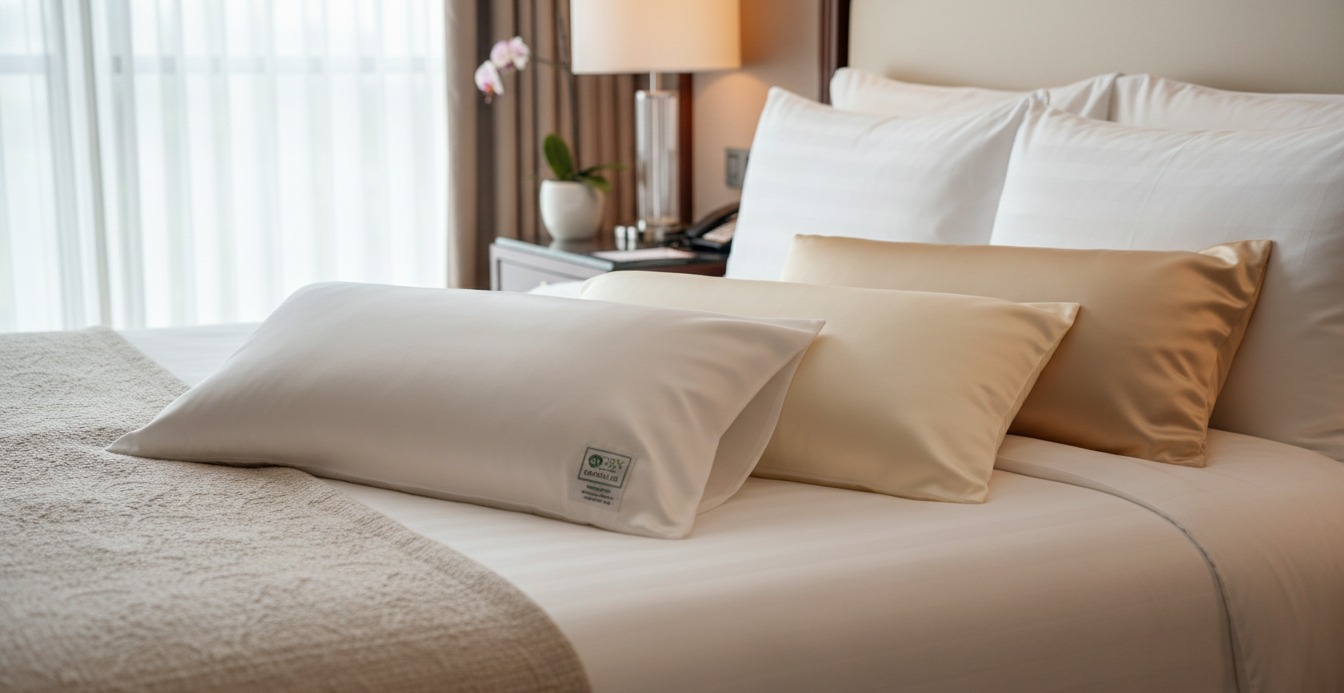
- 30 momme silk = ~130 g/m², delivering 750+ thread count — roughly double that of 19 momme, with dramatically superior durability for high-turnover hotel environments.
- Properly cared for, 30 momme pillowcases last 200+ industrial wash cycles, cutting replacement costs by 40-60% versus lower-momme alternatives over a 3-year horizon.
- OEKO-TEX Standard 100 and ISO 9001 certifications are non-negotiable baseline requirements — always verify through issuing body databases before ordering.
- MOQs typically range 50-200 pieces; request 10-20 sample pieces first to evaluate laundering performance with your housekeeping team.
- Measure existing pillows, account for 2-3% laundering shrinkage, and negotiate colorway samples against your current linen palette before committing to bulk.
I have spent twelve years navigating silk supply chains for properties across 30+ countries, and I can tell you this: the difference between a 30 momme silk pillowcase and a 19 momme one is not a marketing talking point — it is the difference between linen that lasts three years and linen that needs replacing every eight months. For five-star hotel procurement teams, that distinction directly affects your operating budget, your guest satisfaction scores, and your reputation for attention to detail.
In this guide, I walk through everything you need to evaluate, specify, and source 30 momme silk pillowcases for your property — from what momme actually measures and why it matters for durability testing, to how to vet suppliers and structure your first bulk order so it performs under real housekeeping conditions.
1. What Does “30 Momme” Actually Mean?
Momme (abbreviated mm) is the Japanese silk industry standard for measuring fabric weight. One momme equals 4.34 grams per square meter (gsm). When you see “30 momme” on a specification sheet, it means the silk weighs approximately 130 gsm. To put that in context for hotel buyers used to thinking in thread count: a standard 30 momme mulberry silk fabric in a plain weave contains roughly 750+ threads per square inch, compared to 400-450 for 19 momme and 300-350 for 16 momme.
I find that many hotel procurement managers have been told “momme equals quality” without understanding why. The momme weight directly determines how tightly the silk fibers are packed into the weave, and that packing density controls everything from luster retention to pilling resistance to thermal regulation. A higher momme count means less fiber-to-fiber friction per cycle, which is precisely why 30 momme silk survives the repetitive laundering that luxury hotels demand.
| Momme Weight | 16 mm | 19 mm | 22 mm | 30 mm ★ | 40 mm |
| Weight (gsm) | ~70 | ~83 | ~96 | ~130 | ~174 |
| Approx. Thread Count | 350/in² | 400/in² | 550/in² | 750+/in² | 900+/in² |
| Hotel Wash Cycles (est.) | 30-50 | 50-80 | 80-120 | 200-300+ | 300-400+ |
| Best For | Consumer/home | Boutique hotels | Upper-mid hotels | 5-star / luxury | Ultra-luxury suites |
The jump from 19 to 30 momme is the most impactful upgrade for hotel linen. Beyond 30 momme, improvements become marginal for most hotel applications — a 40 momme pillowcase feels slightly heavier and more indulgent, but the durability gains diminish while material costs escalate significantly. For a 5-star property balancing guest experience against operating margins, 30 momme sits in the sweet spot.
2. Why Thread Density Matters for Hotel Environments
Consumer-grade silk pillowcases are designed for one person’s bedroom — used nightly, washed once or twice a week, and replaced when the owner gets bored or the fabric shows wear. Hotel environments are nothing like that. A busy city-center 5-star hotel can see 300+ pillowcase laundry cycles per piece per year. In a resort property with seasonal peaks, that same pillowcase might go through 8 wash cycles in a single week during spring break.
Thread density is what determines whether silk can survive that abuse without developing the three failure modes hoteliers care about most: pilling, loss of luster, and dimensional instability (shrinkage or stretching). In a tightly packed 30 momme weave, individual silk fibers are less exposed to mechanical friction during each wash cycle. Each fiber carries less of the load, so the collective fabric degrades more slowly. This is why denser silk actually feels smoother over time — lighter-weight silks often arrive at a hotel feeling buttery soft, then deteriorate faster than procurement teams expect.
When I work with hotel procurement teams for the first time, I always ask about their current linen failure patterns. More often than not, properties using 19 or 22 momme silk report that pillowcases start pilling within 3-4 months and lose their characteristic sheen within 6-8 months. Switching to 30 momme with proper care protocols consistently extends that performance window to 24-36 months — and that is where the real economics live.
- Pilling resistance: Martindale abrasion test ≥30,000 cycles (ISO 12945-2) before pilling rating falls below 3
- Colorfastness: ISO 105-C10 Grade 4+ for washing; Grade 4+ for perspiration if applicable
- Dimensional stability: ≤3% shrinkage after 10 wash cycles at 30°C (AATCC 135)
- Luster retention: Visual assessment Grade 3+ after 100 wash cycles under standard conditions
- Seam slippage: ≥40N seam resistance (ISO 13936-2) for closure construction
- pH of fabric: 4.5-7.5 range (OEKO-TEX requirement, critical for guest skin contact)
3. Durability Testing: What Hotel Buyers Should Demand
I always advise procurement teams to request actual test reports — not just supplier data sheets — before signing off on bulk orders. The difference between a fabric spec sheet and a third-party laboratory report is the difference between marketing material and verified performance data. Here is the minimum testing protocol I recommend every 5-star property require from their silk pillowcase supplier.
3.1 Pre-Shipment Testing Checklist
| Test Item | Standard | Minimum Requirement | Why It Matters |
|---|---|---|---|
| Pilling resistance | ISO 12945-2 | ≥30,000 Martindale cycles, Grade 3+ | Prevents fabric bobbling in industrial washers |
| Wash colorfastness | ISO 105-C10 | Grade 4+ for color change & staining | Maintains appearance through repeated laundering |
| Dimensional stability | AATCC 135 | ≤3% shrinkage in both directions | Ensures consistent fit on pillows over time |
| Seam integrity | ISO 13936-2 | ≥40N force to seam slippage | Prevents closure failure in housekeeping |
| Formaldehyde content | OEKO-TEX Standard 100 | <75 mg/kg (all product classes) | Guest skin safety on face-contact textile |
| Silk composition | ISO 1833 / Burn test | 100% mulberry silk, no blends | Authenticity verification for premium pricing |
3.2 At-Arrival Verification for Housekeeping Teams
Once your order arrives, your housekeeping manager should conduct a quick verification protocol before stock goes into circulation. Catching quality issues before items enter the laundry rotation saves enormous headache later. Run these checks on a sample of every batch:
- Visual inspection: Check for inconsistent dyeing, weave irregularities, or seam defects under bright overhead lighting. Silk should appear uniformly lustrous from edge to edge.
- Friction pill test: Rub a 10cm area vigorously with a white cloth for 30 seconds. If color transfers or surface pills immediately, the fabric quality is inadequate for industrial use.
- Transparency check: Hold the pillowcase to a light source — consistent opacity throughout indicates even weave density. Thin spots will fail first in laundering.
- Dimensional check: Measure the pillowcase flat against a standard pillow form. Allow 3-5% for first-wash shrinkage and confirm the fit remains adequate at that dimension.
- pH strip test: Lightly dampen a corner with distilled water and touch with pH paper. Reading should fall between 4.5 and 7.5 for safe skin contact.
I have seen properties receive silk pillowcases that passed initial visual inspection but failed within the first 20 wash cycles due to inadequate dye fixation or seam slippage. Building these verification steps into your receiving process takes less than 30 minutes per batch but protects years of guest experience quality.
4. Hotel Grade vs. Consumer Grade Silk: The Real Differences
One of the most common procurement mistakes I see is hotel buyers purchasing silk pillowcases from consumer-focused suppliers and wondering why the linens degrade so quickly. Consumer silk and hotel-grade silk are engineered for fundamentally different use cases, and understanding those differences is prerequisite to making smart bulk purchasing decisions.
Consumer silk pillowcases are designed for the individual buyer’s experience: they arrive feeling luxurious, they perform well for the first 3-6 months of personal use, and when they start to show wear the consumer simply buys a new set. Hotel silk must perform under conditions no individual consumer ever imposes on their bedding: industrial washers, high-volume rotation, variable laundering temperatures, and housekeeping staff who are trained for efficiency, not fabric gentleness. A pillowcase marketed at retail as “premium silk” is almost never built to survive that environment.
- Typically 16-19 momme weight
- Designed for 50-100 total wash cycles
- Retail packaging and brand marketing focus
- Single-user care patterns assumed
- No industrial laundering protocols required
- Variable quality consistency between batches
- Minimum 22 momme, ideal 30 momme weight
- Engineered for 200-300+ wash cycles
- Technical spec sheets and test reports provided
- Industrial wash protocols documented
- Pre-shrunk finishing for dimensional stability
- Batch-to-batch consistency guarantees required
When you are evaluating a supplier, ask specifically for their hotel linen reference list. A reputable silk manufacturer serving the luxury hotel sector will have documented case studies with property names, order volumes, and performance tracking data spanning at least 2-3 years. If a supplier cannot provide this, their product may be consumer-grade re-labeled — a surprisingly common situation in the silk bedding market.
5. Sizing, Shrinkage, and Care Protocols for Hotel Operations
Getting the right size pillowcase is not as simple as it sounds when you are dealing with silk at scale. I have worked with properties that ordered “standard king” from three different suppliers and received three different actual dimensions. Always measure your actual pillows before finalizing尺寸 specifications with your supplier. Account for the fact that silk will shrink 2-3% on first wash even when pre-shrunk finishing is applied, and plan your dimensions accordingly.
For hotel laundering protocols, the critical rules are straightforward: wash temperature never exceeds 30°C (86°F), pH-neutral silk detergent is mandatory (never enzyme-based detergents which break down silk protein), and tumble drying must be on lowest heat setting or air-dried flat. Ironing is rarely necessary for 30 momme silk — the fabric’s own weight and the weave structure keep it relatively wrinkle-free after line drying.
- US Standard: 51x76cm (20x30in) — most common for city hotels
- US Queen: 51x91cm (20x36in) — mid-scale and resort properties
- US King: 51x102cm (20x40in) — luxury suite standard
- EU Standard: 65x65cm — boutique European properties
- EU King: 65x80cm — European luxury tier
- Asian Standard: 48x74cm — China, Japan, Korea market
- Asian King: 48x90cm — Asian luxury/resort segment
One operational consideration many procurement teams overlook: silk pillowcases are significantly more slippery than cotton ones. If your property uses fitted sheets or mattress protectors with any level of grip, the reduced friction of silk against cotton can cause pillow migration that housekeeping teams find frustrating. I recommend specifying a slight overlap dimension (adding 3-5cm to both width and length) to ensure the silk pillowcase stays properly positioned on the pillow throughout the guest night.
6. Certifications Hotel Buyers Must Verify Before Ordering
Certifications are only as valuable as your verification process. I cannot stress this enough: a certificate hanging on a supplier’s wall is meaningless if it is expired, or if it covers a different product than the one being shipped. Always verify certifications independently through the issuing organization’s public database. This takes 10 minutes and can prevent a costly quality incident.
For the luxury hotel sector specifically, the certifications that matter most are OEKO-TEX Standard 100 (mandatory — it confirms no harmful substances are present in the textile at skin-contact levels), ISO 9001 (verifiable quality management system), and if silk source provenance matters to your brand, GOTS for organic silk claims. Be highly skeptical of any supplier claiming OEKO-TEX without being able to provide the specific certificate number tied to their production batch.
For Chinese suppliers exporting to international markets, the combination of CCC (China Compulsory Certificate) for domestic compliance and CIQ (China Inspection and Quarantine) inspection reports for export clearance provides a baseline of governmental quality assurance. These are not optional — shipments without proper CIQ documentation may be held at destination port, which can delay your linen rotation by weeks.
7. Wholesale Procurement Walkthrough: From Sample to Bulk Order
The procurement process for hotel silk pillowcases at commercial scale differs materially from purchasing consumer linens. Here is the sequence I walk every new hotel client through. Do not skip step one — the sample evaluation phase is where you save yourself from a bulk order mistake.
- Request samples (10-20 pieces): Order in each colorway you are considering. Specify you want production-line samples, not pre-production prototypes. Evaluate wash performance on these samples for 10-15 wash cycles before proceeding.
- Conduct the five-point verification (Section 3.2): Your housekeeping manager should sign off on the sample batch before procurement issues a purchase order. This is your last chance to reject on quality grounds without financial consequence.
- Confirm specifications in writing: Lock momme weight, weave construction, dimensions (pre- and post-shrink), colorfastness ratings, and seam construction in the purchase order. Ambiguity here leads to disputes on delivery.
- Negotiate payment terms: For first orders from new suppliers, a 30% deposit with balance paid against shipping documentation is standard. Established relationships can often move to 30/70 or even letter of credit terms.
- Plan your linen rotation: A typical 200-room 5-star property needs approximately 400-600 silk pillowcases in active rotation to maintain spare sets for laundering and replacement. Calculate this number before your first order lands.
- Establish quality feedback loop: Set up a quarterly review with your housekeeping director to track pillowcase performance. Catching a quality trend early (pilling in under 50 cycles, color shift after 30 washes) lets you renegotiate with the supplier before your entire stock is compromised.
Lead times for commercial silk orders run 21-35 days for production plus 7-15 days for shipping from China. Factor this into your property’s linen budget calendar — switching from cotton to silk mid-operational-year is disruptive and expensive if you have not planned the transition 60-90 days in advance.
8. Our Sourcing Services for Hotel Buyers
At Wonderful Silk, we specialize in commercial-grade silk bedding for the luxury hospitality sector. Every pillowcase we produce for hotel clients goes through our five-point quality verification before shipping, and we provide third-party test reports with every bulk order as standard practice. Our production facility in Shengzhou, Zhejiang — the heart of China’s mulberry silk industry — has supplied linen to properties in North America, Europe, Middle East, and Asia-Pacific.
I personally oversee all hotel client accounts. Whether you are opening a new property and need to build your silk linen program from scratch, or you are an existing hotel looking to upgrade from lower-momme silk, I will work with your procurement and housekeeping teams to ensure the specification, sampling, and delivery process is smooth. We guarantee batch-to-batch consistency — a critical commitment that many silk suppliers cannot make reliably.
If you would like to discuss your property’s silk requirements, I invite you to reach out directly. You can explore our hotel product catalog or visit our main website to see the full range of silk bedding solutions we offer to hospitality partners.
© 2026 Wonderful Silk All rights reserved.
Post time: Jun-01-2026