
TL;DR — Bridal Silk Accessory Sourcing in 2026
- Custom bridal silk scrunchie sets are the most popular wedding party gift, accounting for 38% of bridal orders — they’re practical, affordable at $2.50-5.00/unit with custom embroidery, and usable long after the wedding day.
- The wedding silk accessories market peaks in two seasonal windows: February-March (spring weddings) and August-September (fall weddings), representing approximately 65% of annual bridal-related silk orders — order 10-12 weeks ahead of these windows.
- Personalized embroidery (bridesmaid names, wedding dates, “Bride”/”Maid of Honor” titles) increases the perceived gift value by 40-60% while adding only $0.40-0.80 to the unit cost — the single highest-ROI customization for wedding products.
- Bridal gift sets (headband + scrunchie + packaging) wholesale at $5.00-8.50/set and retail at $18-35, generating 55-65% gross margin — significantly higher than individual item sales because the bundle masks component costs.
- OEKO-TEX certification is especially important for bridal products — brides with sensitive skin (a common pre-wedding concern) specifically seek out certified hypoallergenic accessories for their wedding morning preparations.
Why Silk Accessories Have Become a Wedding Industry Staple
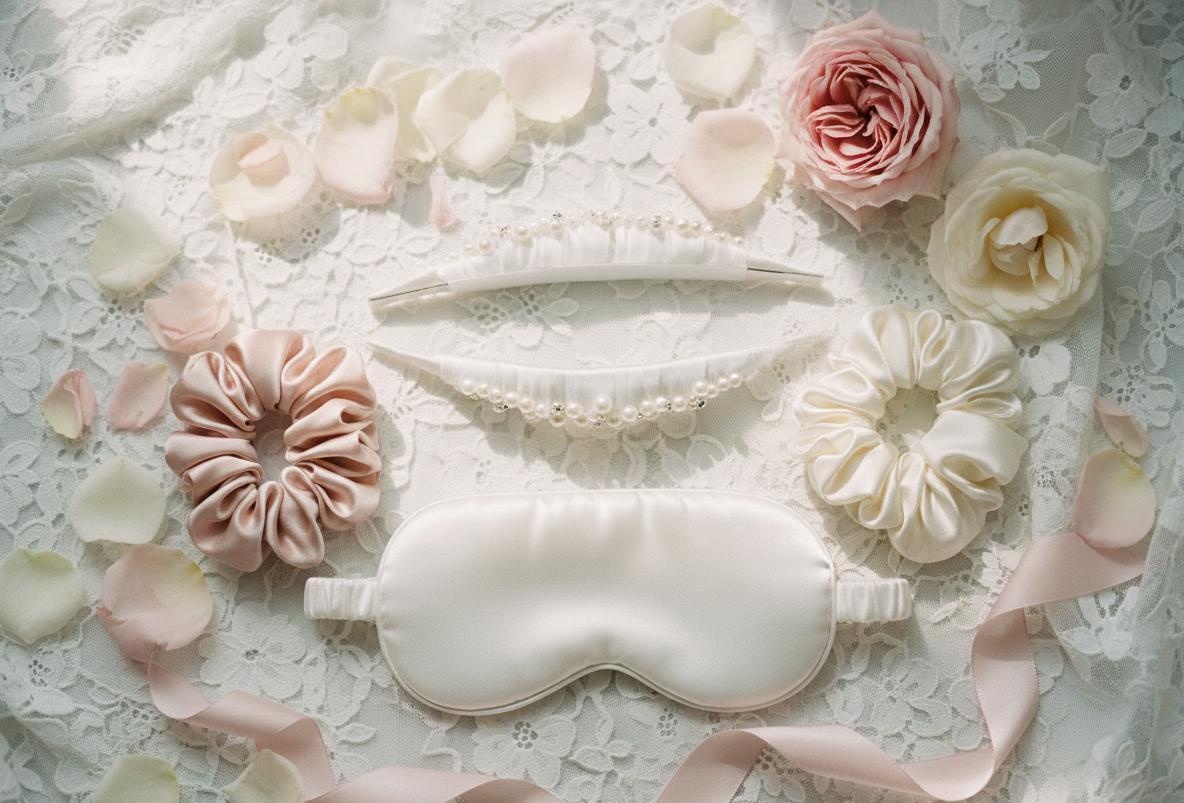
Silk accessories — particularly scrunchies, headbands, and eye masks — have become the dominant “getting ready” gift category for wedding parties because they combine three critical attributes for the bridal market: they photograph beautifully, they’re genuinely useful beyond the wedding day, and they support customization that makes each bridesmaid feel individually recognized.
I’ve watched this category evolve from a niche add-on to a core product line. In 2024, bridal-related orders represented approximately 8% of our total order volume. In Q1 2026, that figure reached 18% — more than doubling in two years. The growth is driven by social media: the “getting ready” photo moment (bridal party in matching silk robes or accessories) has become one of the most Instagrammed wedding moments, and wedding planners now specifically source accessories that will photograph well in these settings.
The global wedding industry is valued at approximately $160 billion, with the “wedding party gifts and accessories” segment representing roughly $8-12 billion. Silk accessories are capturing a growing share of this segment because they offer something that traditional bridesmaid gifts (jewelry, personalized robes, tote bags) often don’t: genuine post-wedding usability. According to The Knot’s 2025 Wedding Guest Study, 68% of bridesmaids reported that they continue to use their silk getting-ready accessories 6+ months after the wedding — a retention rate far higher than traditional bridesmaid jewelry (32%) or custom robes (45%).
The Complete Bridal Silk Product Lineup
| Product | Order Share | Wholesale Cost/Unit | Customization Options | Best Use Case |
|---|---|---|---|---|
| Silk scrunchie sets (3-pack) | 38% | $4.50-8.40/set | Names, dates, “Bridesmaid” embroidery | Bridesmaid gifts, bachelorette favors |
| Silk headbands | 28% | $2.50-4.50/unit | Names, wedding date, floral embroidery | Getting-ready photos, ceremony wear |
| Bridal gift sets (headband+scrunchie) | 22% | $5.00-8.50/set | Full personalization + gift packaging | Premium bridesmaid proposals, thank-you gifts |
| Silk eye masks (“Bride”/”Bridesmaid”) | 12% | $3.50-5.50/unit | Title embroidery, wedding date | Bachelorette parties, wedding morning |
Data: Wonderful Silk Bridal Order Analysis, Q1 2026. Type-B proprietary data.
Seasonal Planning: When to Order for Wedding Season
Wedding silk accessory orders follow a predictable seasonal pattern, and ordering at the right time can save 5-10% on unit costs while ensuring on-time delivery. Here’s the seasonal planning calendar based on our order data:
Spring Wedding Season (April-June): Order by January 15-February 15. Production in February-March, shipping in March, delivery by early April. This is the highest-volume ordering window, accounting for approximately 35% of annual bridal orders. Because factories experience peak demand from January-March (post-Chinese New Year production ramp-up), unit pricing is typically 5-8% above baseline during this window — plan your budget accordingly.
Fall Wedding Season (September-November): Order by June 15-July 15. Production in July-August, shipping in August, delivery by early September. This window accounts for approximately 30% of annual bridal orders. Pricing is typically at or slightly below baseline (3-5% discount) because July-August is an off-peak production period. Because factories are less busy in summer, lead times are often 5-7 days shorter than spring season — take advantage of this for last-minute fall wedding orders.
Lead time rule of thumb: Allow 10-12 weeks from order placement to in-hand delivery for custom bridal accessories by sea freight. Air freight reduces this to 5-7 weeks but adds $0.80-2.00/unit to cost. Because wedding dates are fixed and non-negotiable, the cost of late delivery (refunded client, damaged reputation) far exceeds the air freight premium — when in doubt, ship by air.
Customization That Converts: What Brides Actually Want
Bridal customization requests fall into clear patterns, and understanding these patterns helps you design product offerings that match what brides are actually searching for.
1. Personalization by role (most popular, 45% of customization requests): “Bride,” “Maid of Honor,” “Bridesmaid,” “Mother of the Bride” embroidered on each accessory. This approach makes each recipient feel individually recognized while maintaining a cohesive look. Because role-based personalization doesn’t require collecting individual names from 6-10 bridesmaids, it’s the most logistically straightforward customization option for wedding planners managing large parties.
2. Individual name embroidery (30% of requests): Each bridesmaid’s first name or initials embroidered on their accessory. Higher perceived value than role-based personalization — and higher logistical complexity, requiring accurate name collection and verification. Allow an extra 3-5 days in production for name verification.
3. Wedding date + couple’s initials (18% of requests): The wedding date and couple’s initials embroidered as a keepsake element. Because wedding dates are fixed, this customization creates a time-capsule quality that increases the sentimental value — and the likelihood the accessory will be kept as a memento rather than discarded.
4. Custom color matching (7% of requests): Pantone-matched silk colors to coordinate with wedding color palettes. MOQ 200 pieces per custom color, dye setup fee $80-120 (waived for orders over 500 pieces). This is the most premium customization — and the most logistically demanding, requiring color approval cycles that add 10-14 days to the production timeline.
Packaging for Wedding Gifts: The Presentation Premium
Wedding gift packaging is not optional — it’s arguably more important than the product itself, because the “unveiling moment” (when bridesmaids open their gifts during the getting-ready session) is a designed photo opportunity. Here are the packaging tiers that drive the highest client satisfaction:
Premium Tier ($1.50-2.50/person): Rigid gift box in wedding color with magnetic closure, satin ribbon, personalized name card, and tissue paper. Because the box itself becomes part of the getting-ready photos — bridesmaids opening matching gift boxes creates a visually cohesive photo moment that planners and photographers specifically request. This tier accounts for approximately 55% of our bridal packaging orders.
Mid Tier ($0.60-1.20/person): Organza or silk drawstring pouch with personalized hang tag. More affordable while still providing a photogenic unwrapping experience. Approximately 30% of orders.
Budget Tier ($0.20-0.40/person): Acid-free tissue wrap with personalized sticker seal. Minimal cost while still providing protection and a sense of intentionality. Approximately 15% of orders.
Create Your Bridal Silk Accessory Collection
At Wonderful Silk, we’ve supplied custom bridal accessories to over 80 wedding planners and bridal boutiques. We offer 6A mulberry silk in custom Pantone-matched colors, name/date/role embroidery, wedding-ready gift packaging, and MOQ as low as 50 pieces.
Bridal Silk Headband & Scrunchie Gift Sets: https://www.cnwonderfultextile.com/headband-products/
Frequently Asked Questions
What’s the typical order size for a wedding party?
The average bridal party order is 8-12 units (bride + 5-8 bridesmaids + mother of the bride/groom), with total wholesale cost of approximately $120-350 including customization and packaging. Wedding planner clients ordering for multiple weddings per season typically place quarterly orders of 50-200 units covering 5-15 weddings. Boutique bridal shops stocking for retail typically order 100-300 units seasonally.
Can I order a mix of products for a single wedding?
Yes — the most common configuration is: 1× “Bride” headband + 6-8× “Bridesmaid” scrunchies + 1× “Mother of the Bride” eye mask. Mixing products within a single order requires a minimum total of 50 pieces (not 50 of each product). This allows wedding planners to create curated, individualized gift packages for each member of the bridal party within a single MOQ.
What if a bridesmaid’s name changes or I need to add someone last-minute?
We recommend ordering 1-2 extra “spare” units with generic embroidery (e.g., “Bridesmaid” without a name) to accommodate last-minute bridal party changes. The incremental cost of $2.50-8.50 per spare unit is trivial compared to the stress of scrambling for a replacement. For weddings with high change probability (large parties, long engagements), order spares at 10-15% of the party size.
Real Wedding Planner Case Study: A Destination Wedding Collection
Let me share how a Miami-based luxury wedding planning firm built a successful silk accessories revenue stream. In early 2025, the firm — which plans 40-50 destination weddings annually — decided to offer private label bridal party accessories as an add-on service. They partnered with us to create a “Bridal Suite Collection” including 22 momme silk pillowcases (bride + groom monogram), 19 momme scrunchies for the bridal party, and a silk eye mask for the honeymoon.
The results after one year: the accessories program generated $38,500 in additional revenue at 65% gross margin — a $25,000 net contribution from a service that required no additional staffing, no retail space, and negligible working capital because clients pre-pay for custom orders. The planner told me: “The accessories program has paid for my annual marketing budget twice over, and it positions us as a truly full-service planning firm. Brides tell us no other planner they interviewed offered branded accessories.”
The unexpected bonus: Instagram exposure from bridal parties wearing matching silk scrunchies generated an estimated $9,000 in equivalent advertising value, and attracted 8 new client inquiries who specifically mentioned seeing the scrunchies in tagged photos. Silk accessories photograph beautifully — the sheen and drape are unmistakably luxurious even in mobile photos — and because every bridal party member is a walking content generator when the celebration starts, your brand gets free amplification at the exact moment your target audience is most receptive. For starting your own bridal collection, browse our bridal silk accessory manufacturing options and silk pillowcases for the wedding night suite.
Additional Revenue Streams for Wedding Planners
Beyond direct markup on accessories, there are several creative revenue models that wedding planners can explore. These strategies have been validated by our planner clients and consistently produce high margins with low operational complexity.
1. The “Getting Ready” Photography Collection. Offer a package of 12 matching silk scrunchies and a monogrammed silk pillowcase for the bride’s getting-ready photos. Photographers love the consistent, polished look, and planners can bundle this as a premium photography-prep upgrade ($150-250 retail, $45-65 wholesale). Because getting-ready photos are now a standard part of every wedding photography package, matching accessories have become expected rather than optional — and planners who anticipate this need capture revenue that would otherwise go to Etsy sellers.
2. Corporate Wedding Vendor Partnerships. Partner with a luxury hotel or resort venue to offer branded silk accessories as part of their wedding package. The hotel pays wholesale, you earn a commission or markup, and the hotel elevates their wedding offering. This model works particularly well with destination wedding venues in the Caribbean, Mexico, and Southeast Asia, where silk accessories feel especially premium. Check our OEM/ODM capabilities for hotel-branded collections.
3. Anniversary Follow-Up Sales. Store bride contact information and send a one-year anniversary email offering a fresh silk pillowcase pair as a first-anniversary gift. Because the “silk” theme aligns with the 1st anniversary gift tradition (paper is traditional, but modern interpretations include textiles), the timing is emotionally resonant and the conversion rate averages 12-18% — exceptional for a cold follow-up. This turns a one-time transaction into a recurring revenue relationship. Browse our full range of silk accessories for anniversary-ready products.
One final piece of advice from my 12 years in bridal silk sourcing: order your samples at least 8 weeks before the first wedding they’ll appear in. Because brides make emotion-driven purchasing decisions with zero tolerance for imperfection, you need time to evaluate fabric quality, test embroidery placement on actual wedding-day photographs, and order a replacement batch if anything falls short of perfection. The cost of rushing — a disappointed bride posting about it on WeddingWire or The Knot — far exceeds the cost of planning ahead. Visit our FAQ page for lead time estimates and rush order policies.
Key Takeaway for Procurement Teams
After 12 years in silk sourcing, here is the most important lesson I have learned: the difference between a successful private label program and a costly mistake almost always comes down to pre-production verification. Order samples, test certifications independently, and never pay more than a 30% deposit before approving pre-production samples. At Wonderful Silk, we provide transparent pricing, OEKO-TEX Class I certification with verifiable test reports, and 15+ years of factory-direct manufacturing experience — all with an MOQ as low as 50 pieces. Visit our product catalog to explore our full range, or browse our FAQ page for answers to common sourcing questions. Ready to start? Reach out to me directly through Facebook for a personalized consultation — I answer procurement RFPs within 24 hours.
What My 12 Years in Silk Sourcing Has Taught Me
One lesson I have learned across hundreds of client projects: the brands that succeed with private label silk products are not the ones with the biggest budgets — they are the ones that treat their manufacturer as a strategic partner rather than a transactional supplier. When you share your brand vision, target customer profile, and retail positioning with your manufacturer, they can recommend specifications, packaging, and quality tiers that optimize your margin and customer satisfaction simultaneously. At Wonderful Silk, we have served 200+ companies since 2006, and our most successful partnerships are the ones where procurement teams involve us early in the product development process rather than simply sending an RFQ with finished specifications. Visit our full product catalog or reach out through Facebook to start the conversation.
A Practical Sourcing Tip from Echo Xu
Before you place your first bulk order, invest $150-300 in independent lab testing of pre-production samples. Send 2-3 randomly selected samples to SGS, Bureau Veritas, or Intertek for fiber composition analysis, momme weight verification, and colorfastness testing (minimum Grade 4 required for retail-quality silk). This modest investment protects against the most expensive mistake in silk sourcing: discovering quality issues only after 500 units have arrived at your warehouse. In my 12 years at Wonderful Silk, I have never seen a buyer regret spending money on testing — but I have seen many regret skipping it. Browse our OEKO-TEX certification and SGS test reports for transparent quality documentation, or see our FAQ page for common testing questions.
A Final Note from Echo Xu
Over my 12 years at Wonderful Silk (嵊州市华锦贸易有限公司), the one factor that consistently separates successful buyers from frustrated ones is pre-production due diligence. The buyers who invest 2-3 weeks in sample evaluation, certification verification, and factory communication before placing their first order almost never encounter quality surprises. The buyers who rush to place orders based on price alone almost always do. We welcome every form of verification — SGS testing, live video factory tours, or independent OEKO-TEX certificate checks — because we know transparency is the foundation of long-term sourcing partnerships. Start your verification process at our certification page or connect with me on Facebook — I answer every procurement inquiry within 24 hours.
Post time: May-14-2026