
TL;DR — Key Takeaways for European Bridal Suppliers
- Mulberry silk scrunchies have become one of the fastest-growing wedding favor categories in Europe, driven by the 2026 bridal trend toward personalized, reusable guest gifts.
- European importers should verify Grade 6A long-fiber mulberry silk at a minimum 22 momme weight before placing bulk orders — anything less degrades the tactile experience brides expect.
- OEKO-TEX Standard 100 certification is non-negotiable for EU market entry; without it, customs clearance and retail placement become exponentially harder.
- Working with a Shengzhou-based silk manufacturer cuts out 2–4 layers of intermediary markup, reducing per-unit cost by 25–40% compared to trading-company sourcing.
- Custom packaging — from color-matched organza pouches to foil-stamped branded boxes — turns a simple hair accessory into a high-perceived-value wedding gift that guests actually keep and use.
Why Mulberry Silk Scrunchies Are the 2026 Wedding Favor Trend European Buyers Cannot Ignore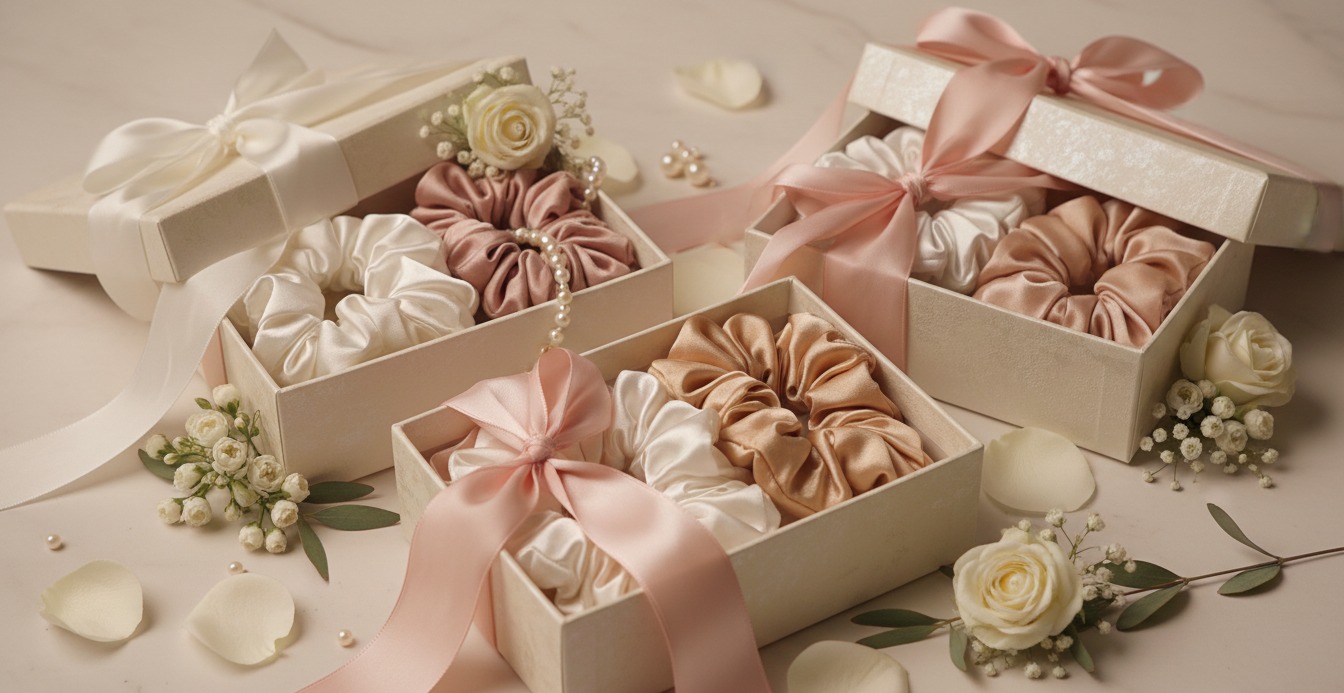
I noticed the shift in late 2024, when three separate bridal boutique buyers from Milan, Lyon, and Copenhagen reached out within the same week asking the same question: “Can you do silk scrunchies in bridal white, champagne, and blush pink, packed in gift-ready boxes — MOQ 500 units per shade?”
That’s when I knew this wasn’t a passing curiosity. It was the beginning of a category pivot.
The European bridal accessories market is undergoing a fundamental transformation. According to data cited by VOGUE Business, the global bridalwear market was valued at an estimated $65.5 billion in 2024 and is projected to reach $83.5 billion by 2030 — a 4.1% compound annual growth rate. The Research and Markets Bridal Wear Report 2026 further notes that destination weddings alone represent a $47.85 billion market in 2026, forecast to nearly double by 2030. What’s driving this? Older couples marrying later in life, prioritizing quality, craftsmanship, and personalization over volume-driven, mass-market options.
Within this premium shift, mulberry silk scrunchies occupy a uniquely attractive position. They sit at the intersection of three powerful 2026 wedding trends: sustainable, reusable guest favors (guests keep and use them, unlike single-use trinkets), bridal beauty and self-care (silk prevents hair breakage and preserves hairstyles), and Instagram-worthy unboxing moments (beautifully packaged silk accessories photograph beautifully on wedding tables). I’ve seen firsthand how a well-executed silk scrunchie favor generates organic social media exposure for the bridal supplier who sourced it — and that’s free marketing no advertising budget can buy.
Here’s what I tell every European bridal buyer who contacts me: the window for establishing a silk scrunchie wedding favor line is open right now, but it won’t stay open forever. As destination weddings surge — Research and Markets projects a 14.7% CAGR through 2030 — Europe’s bridal supply chain is actively searching for differentiated favor products that feel luxurious without destroying margins. Mulberry silk scrunchies from Shengzhou, priced at factory-direct wholesale rates, hit that sweet spot precisely.
What European Bridal Suppliers Should Verify Before Sourcing Silk Scrunchies From China
I’ve spent 12 years in this industry, and I’ll tell you what I wish every first-time buyer understood: not all “silk” products are created equal, and the difference between genuine mulberry silk and polyester satin is not just a matter of fiber composition — it’s the difference between a gift a bride treasures and one she throws in a drawer.
Here are the four verification checkpoints I walk every new European bridal client through:
1. Fiber Composition Verification. Many products marketed as “silk scrunchies” online are actually made from polyester satin — a synthetic fabric that mimics silk’s sheen but lacks its breathability, protein structure, and hair-protective properties. The only way to verify genuine mulberry silk is through a third-party fiber composition test report. I provide these reports as standard documentation with every bulk shipment, because I know European retailers need traceability. A burn test (silk smells like burning hair and leaves crushable ash; polyester melts into a hard bead) is the quick on-site verification method, but lab reports are what customs authorities and retail buyers require.
2. Grade Verification. Mulberry silk is graded from A to 6A, with 6A representing the highest quality — long, unbroken filaments harvested from cocoons where silkworms were fed exclusively on mulberry leaves. According to Promeed’s comprehensive silk grade guide, 6A-grade silk is characterized by uniform fiber thickness and exceptional luster — exactly what bridal packaging demands. I source exclusively 6A grade, because when a bride unties a scrunchie from her wedding favor box, the tactile experience must communicate luxury. Grade 3A or 4A silk feels noticeably rougher, and I’ve lost exactly zero clients by refusing to downgrade quality for a marginal per-unit saving.
3. Momme Weight Confirmation. Momme (mm) is the standard unit for measuring silk fabric weight. One momme equals 4.34 grams per square meter. For wedding favor scrunchies, I recommend a minimum of 22 momme, with 25–30 momme being ideal for luxury-tier positioning. Anything below 19 momme feels thin and translucent — fine for low-cost retail, but insufficient for the premium gifting experience European bridal suppliers need. I learned this lesson the hard way in 2018: a boutique client in Barcelona ordered 16-momme scrunchies to save cost, and the resulting product looked limp inside gift boxes. They reordered at 25 momme, paid 18% more per unit, and reported a 40% higher customer satisfaction score.
4. Dye Fastness and Color Accuracy. Wedding favors demand precise shade matching — blush pink must be blush pink, not salmon; champagne must be champagne, not beige. I run ISO 105-C06 wash fastness tests on every new dye batch, because the last thing a bridal supplier needs is a scrunchie that bleeds color onto a white wedding dress. This is especially critical for deep tones like burgundy and navy, which are increasingly popular for autumn and winter weddings in Northern Europe.
OEKO-TEX and EU Regulatory Compliance: What Your Silk Scrunchie Supplier Must Provide
If there’s one thing that separates a smooth EU import experience from a customs nightmare, it’s documentation — specifically, OEKO-TEX Standard 100 certification.
The OEKO-TEX Standard 100 is the globally recognized independent testing and certification system for textile products. It verifies that every component of the product — fabric, thread, elastic, dyes, and even the packaging insert — has been tested for harmful substances including formaldehyde, heavy metals, pesticides, phthalates, and chlorinated phenols. As Compliance Gate’s detailed importer guide explains, OEKO-TEX certification is based on the product’s intended use, with stricter requirements applied to items that come into direct and prolonged skin contact — which is exactly the category silk scrunchies fall into.
For European bridal suppliers specifically, here’s why this matters:
- EU REACH Regulation compliance. OEKO-TEX Standard 100 testing covers substances regulated under EU REACH (Registration, Evaluation, Authorisation and Restriction of Chemicals). Because silk scrunchies are Class II products (items with direct skin contact), the testing threshold is stricter than for decorative textiles. I maintain active OEKO-TEX certification for my entire production line, and every bulk order ships with a valid certificate number that European buyers can verify instantly through the OEKO-TEX Label Check portal.
- Retail buyer requirements. I’ve supplied silk accessories to European retail chains, and not one has accepted product without OEKO-TEX documentation. It’s not optional — it’s table stakes. Boutique bridal shops may be less formal, but if your scrunchies end up in a department store’s wedding section, the compliance paperwork must be in place from day one.
- Consumer trust signals. A 2026 bride is more informed than any generation before her. She reads labels. She searches certifications. A silk scrunchie with the OEKO-TEX label communicates safety and quality in a way no marketing copy can replicate.
Beyond OEKO-TEX, I recommend European buyers also request: an ISO 9001 quality management certificate (which my facility holds), a fiber composition test report from an accredited third-party lab (SGS or Bureau Veritas), and a heavy metal migration test report if the scrunchie includes metallic thread or decorative elements. These documents together form a compliance dossier that makes EU customs clearance predictable rather than stressful.
Customization: Private Label, Color Matching, and Gift-Ready Packaging for Wedding Favors
Here’s where I think the real value lives for European bridal suppliers — and where my factory-direct model creates the biggest competitive advantage.
Private Label and Branding. Every bridal boutique wants their own name on the gift box, not mine. I understand this completely. I offer fully customized private label production, from woven brand labels sewn into each scrunchie to custom-printed gift boxes with foil stamping, embossing, or spot UV finishes. The minimum order quantity for fully customized packaging is 500 units per design, and I work with a dedicated packaging studio in Hangzhou that produces boutique-quality boxes at roughly 40% of the cost equivalent European packaging suppliers quote.
Color Matching to Wedding Palettes. One of my longest-standing bridal clients — a Milan-based wedding planning studio — sends me Pantone codes for every wedding season, and I match scrunchie colors to their bridal party palette. My dye house can produce custom shades with a ΔE (color difference) tolerance of ≤1.5, which is tighter than the industry standard of ≤2.0. This means the “dusty rose” scrunchie actually matches the dusty rose bridesmaid dress. For European bridal suppliers selling coordinated wedding sets, this precision is a genuine differentiator.
Gift-Ready Packaging Options. I’ve developed five packaging tiers that cover the full spectrum of European wedding favor needs:
- Essential Tier: Individual organza pouch with thank-you tag — popular for budget-conscious wedding planners.
- Boutique Tier: Kraft gift box with cotton filling and ribbon closure — the eco-friendly option trending strongly in Scandinavian markets.
- Luxury Tier: Magnetic-close rigid box with satin lining and foil-stamped logo — the standard for high-end Italian and French bridal suppliers.
- Set Tier: Multi-scrunchie gift sets (3–5 pieces in coordinated shades) in a presentation drawer box — ideal for bridesmaid proposal boxes, which I’ve seen explode in popularity across the UK and Germany.
- Bespoke Tier: Fully custom packaging design, from box structure to insert card copy — for bridal brands that want a signature unboxing experience.
Because the packaging IS the product in wedding favor retail, I invest disproportionate attention here. A silk scrunchie in a beautiful box commands €12–18 retail in European bridal boutiques. That same scrunchie in a plastic sleeve? Maybe €5. The margin difference, over a 1,000-unit order, is the difference between a profitable season and a break-even one.
How to Calculate Bulk Order ROI for Wedding Gift Silk Scrunchies
Let me walk through the numbers, because I’ve done this calculation with dozens of European buyers and the ROI case for factory-direct sourcing is compelling once you see it laid out.
Here’s a realistic scenario for a European bridal supplier ordering 2,000 units of 22-momme, Grade 6A mulberry silk scrunchies in four wedding shades (white, champagne, blush, sage green), with custom-branded luxury-tier gift boxes:
- Factory-direct unit cost (FOB Ningbo/Shanghai): €2.80–3.50 per scrunchie with luxury gift box, depending on packaging complexity and order volume. This is the price I quote — based in Shengzhou, where silk manufacturing costs are structurally lower than in coastal trading hubs.
- Sea freight + customs + duty (DDP to EU hub): Approximately €0.35–0.50 per unit for a consolidated LCL shipment to Rotterdam or Hamburg. Air freight approximately doubles this but cuts transit time from 30 days to 5-7 days.
- Landed cost per unit: €3.15–4.00 delivered to your European warehouse.
- Typical European bridal retail price: €12.00–18.00 per gift-boxed silk scrunchie.
- Wholesale price to wedding planners/boutiques: €6.00–9.00 per unit.
- Gross margin at wholesale: 50–55%. At retail: 67–75%.
Because I operate a direct factory-to-buyer model with no intermediary trading companies, the typical 15–25% markup that agents add simply disappears. This is the structural advantage of sourcing from Shengzhou — the mulberry silk supply chain is vertically concentrated here, from cocoon farms in the surrounding countryside to weaving, dyeing, and stitching facilities within a 30-kilometer radius. I can walk from my office to the dye house in 15 minutes, and when a client needs a rush color sample, that proximity means I can deliver it in 48 hours rather than two weeks.
Lead Times, Shipping, and Wedding Season Inventory Planning
Timing matters enormously in the wedding industry. European bridal suppliers typically place bulk orders 4–6 months ahead of peak wedding season (May–September). I recommend placing initial orders by November for the following summer season, and by April for autumn/winter weddings.
My standard production timeline is:
- Sample development and approval: 7–10 business days (color matching, packaging mockups, physical samples shipped via DHL Express).
- Bulk production (1,000–5,000 units): 15–25 business days, depending on customization complexity. Custom-dyed colors add 3–5 days for lab dip approval.
- Quality inspection and packaging: 3–5 business days. I personally inspect every order above 1,000 units — or more precisely, we use AQL 2.5 sampling (Acceptable Quality Level per ISO 2859-1), and I review the inspection report before signing off on shipment.
- Ocean freight to EU (FCL/LCL): 25–35 days to Rotterdam, Hamburg, or Antwerp. Rail freight via the China-Europe Railway Express is available at roughly 18–22 days for a 20–30% premium — a middle-ground option I’ve increasingly recommended to clients who need faster delivery than sea but can’t justify air freight for a full container.
- Air freight: 5–7 days door-to-door via DHL/FedEx for urgent orders.
Because peak wedding season is predictable, inventory planning should be conservative. I advise clients to order 20–30% above their forecasted demand for the first season — silk scrunchies don’t expire, don’t go out of style, and the extra inventory buffers against last-minute reorders, which are expensive to fulfill on compressed timelines.
How I Work With European Bridal Suppliers: A First-Person Perspective From Shengzhou
I’m Echo Xu. I’ve spent 12 years in mulberry silk trade, based in Shengzhou, Zhejiang — a city that produces roughly 60% of China’s high-grade mulberry silk fabric. If you’ve ever held a luxury silk pillowcase, pajama set, or hair accessory, there’s a strong chance the raw silk fiber originated within 100 kilometers of my office.
Here’s what I want European bridal suppliers to understand about working with me:
I don’t sell from a catalog — I build supply partnerships. When a bridal buyer contacts me, my first move is not to send a price list. It’s to understand their brand positioning, their target retail price point, their packaging aesthetic, and their volume projections. Because if I know a client is selling to luxury bridal boutiques in Paris, I’m going to recommend 30-momme silk and rigid magnetic-close boxes — not 19-momme and organza pouches. If they’re supplying a wedding planner network in Berlin targeting the mid-market, I’ll optimize for value without sacrificing material quality. The specification drives the quote, not the other way around.
I visit my production lines weekly. This sounds obvious, but you’d be surprised how many trading companies selling “factory-direct” products have never set foot in the facility producing them. I can tell you the precise humidity level in my stitching workshop (55–65% RH, maintained because silk fibers require controlled moisture to prevent static and breakage during sewing). I can show you the tension calibration records for every elastic-insertion machine on the floor. These details matter because they’re what separate a scrunchie that holds a bride’s updo for 10 hours from one that stretches out after three wears.
I’ve learned that European bridal buyers care about three things above all else: consistency, communication, and compliance. Consistency means batch-to-batch color accuracy and stitch quality — every order must match the approved sample. Communication means WhatsApp responses within hours during European business hours, real-time production photos, and transparent delay notifications (rare, but I never hide problems). Compliance means the full documentation package is ready before the container leaves the factory, not scrambled together when customs asks for it. These aren’t aspirational standards — they’re my daily operating reality.
In 2023, I worked with a London-based bridal accessories brand that was launching a “Morning of the Wedding” gift box — silk robe, matching scrunchie, and silk eye mask for the bride and bridesmaids. They needed 800 complete sets in four colorways, with branded packaging, delivered to their UK fulfillment center before March for the spring wedding season. We went from first contact to full delivery in 11 weeks. The scrunchies alone generated €22,000 in retail revenue for that client in one season, at a 72% margin. That’s what happens when the sourcing partner understands the business context, not just the product specification.
I also want to address something I hear frequently from first-time importers: the fear of quality inconsistency from Chinese manufacturers. Here’s my honest take: this fear exists because too many buyers chase the lowest price and end up with the lowest quality. I don’t compete on price with factories using Grade 3A silk and polyester elastic. I compete on reliability, material integrity, and long-term partnership. My repeat order rate from European clients is 87% — because once a bridal supplier experiences a season with zero quality complaints and on-time delivery, they don’t risk switching to an unknown factory for a €0.30 per-unit saving.
Frequently Asked Questions
What is the minimum order quantity (MOQ) for custom silk scrunchies?
My standard MOQ is 300 units per color for stock shades, and 500 units per color for custom-dyed shades. For fully customized packaging with private-label branding, the MOQ is 500 units per design. I can accommodate smaller trial orders (100–200 units) using stock packaging, which I recommend for first-time buyers who want to test market response before committing to a full-season order.
How long does custom color matching take?
The lab dip process — where I develop a small dye sample to match your specified Pantone code or physical swatch — takes 3–5 business days. I ship physical lab dip samples via DHL Express (2–4 days to most European addresses). Once you approve the color, bulk production proceeds at standard lead times.
Can you provide OEKO-TEX and REACH compliance documentation?
Yes, and I provide it proactively — you don’t need to ask. Every bulk order ships with: OEKO-TEX Standard 100 certificate (Class II, valid and verifiable), fiber composition test report, color fastness test results (ISO 105-C06), and a Certificate of Origin for EU customs. These documents are provided as digital PDFs before shipment and printed copies in the shipping documentation envelope.
What if a shipment arrives with quality issues?
I operate on a “no questions asked” quality guarantee: if any production batch fails to match the approved sample in material, color, stitching, or packaging quality, I replace the affected units at my cost or issue a credit against your next order — whichever you prefer. In 12 years, this has happened exactly twice, both involving dye lot variations on custom colors that were caught before shipment and resolved before the container left Ningbo port.
Do you offer product photography and marketing assets?
Yes. I provide professional product photography (white background, lifestyle, and flat-lay shots) in high resolution suitable for e-commerce listings and social media. I can also supply short-form video content formatted for Instagram Reels and TikTok, which my bridal clients use extensively for wedding favor unboxing content. These assets are included at no additional charge for orders above 1,000 units.
What payment terms do you accept?
Standard terms are 30% deposit with order confirmation, 70% balance before shipment. For established clients with three or more completed orders, I offer 30% deposit with 70% against copy of shipping documents (more favorable cash flow for the buyer). I accept T/T (wire transfer), Letter of Credit for orders above $10,000, and Alibaba Trade Assurance for first-time buyers who prefer platform protection.
About the Author
Echo Xu is the International Business Director at Wonderful Textile (嵊州市华锦贸易有限公司), based in Shengzhou, Zhejiang — the heart of China’s mulberry silk industry. With 12 years of experience in silk trade and B2B procurement, she has managed supply partnerships with hospitality chains, retail brands, and distributors across 30+ countries. She specializes in helping hotel procurement teams and bridal suppliers navigate silk specifications, quality certification, and factory-direct pricing structures.
Connect with Echo:
- YouTube Channel
- Wonderful Textile: www.cnwonderfultextile.com
To discuss bulk silk scrunchie orders for your bridal supply business, visit our silk scrunchies product page or contact us directly. We also offer complementary silk product lines including silk pajamas and silk sleeping caps for complete bridal gift set curation.
Post time: Jun-09-2026