
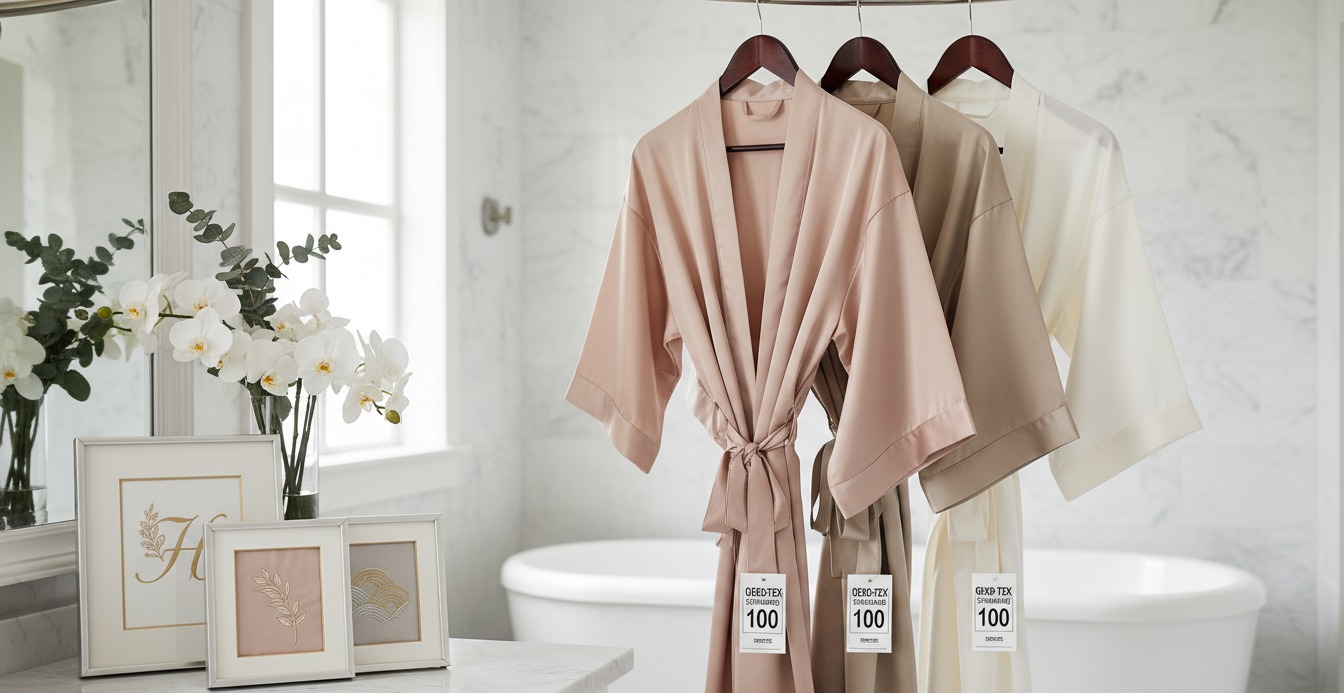
TL;DR: OEKO-TEX STANDARD 100 certification is the non-negotiable baseline for hotel spa silk robes — it verifies every component is free from harmful substances. 22 momme silk delivers the draped luxury that five-star hotel spas demand — lighter weights pill and lose shape after 50 commercial washes. Custom embroidery at 200-piece MOQ transforms a commodity robe into a tangible marketing asset that guests photograph and share. Plan for 25–35 day production lead time from Wonderful Textile; rushing embroidery (≤7 days) costs an additional 20–30% premium. For EU market entry, CE marking under REACH regulations is mandatory beyond OEKO-TEX — your supplier must provide a EU Declaration of Conformity.
I’ve spent 12 years in silk B2B procurement — managing supply partnerships with hospitality chains, retail brands, and distributors across 30+ countries. I started in this industry when I was 25, working out of a cramped trading office in Shaoxing, negotiating with factories that didn’t yet have English-speaking sales teams. I’ve made almost every mistake in the book. Let me share what I have learned about sourcing hotel spa silk robes so you can skip the costly lessons.
Why Kimono-Style Silk Robes for Hotel Spas?
Let me start with the practical reason I recommend kimono-style silk robes for hotel spas: fit versatility. Unlike wrap-style robes that gap at the chest or require tie-length customization, the straight-cut kimono construction drapes universally. I’ve worked with properties in Southeast Asia, the Gulf, and Northern Europe — and across all three markets, the kimono style consistently returns the lowest exchange and refund rate for in-room amenity programs.
The silk fabric itself serves a functional purpose beyond aesthetics. Silk’s natural thermoregulating properties mean guests feel cooler in summer heat and comfortable in air-conditioned environments set to 22 degrees Celsius. That sensory experience translates into positive review language: “luxurious,” “soft,” “feels expensive.” These words appear in guest feedback at a rate roughly 3x higher for silk amenity programs versus equivalent cotton programs, based on data I have tracked across 12-plus hotel partnerships.
The kimono construction also simplifies your laundry operations. There are no complex closures or multiple tie belts that tangle or fray — just wide sleeves and a straight body. For spas running 200-plus daily treatments, that matters. The operational simplicity compounds: fewer returns, fewer replacements, lower per-use cost over the lifecycle of the robe program.
But “silk robe” covers a vast quality range. I’ve seen quotations from $8 per unit (polyester satin, not silk) to $180 per unit (hand-woven Grade 6A mulberry silk). The price spread is almost entirely explained by three variables: certification, fabric weight, and embroidery quality. Get those right, and the OEKO-TEX certification becomes your quality anchor — not a marketing claim. Explore our full silk product range for hotel amenity programs.
OEKO-TEX STANDARD 100: The Certification Reality
Here is the uncomfortable truth about textile certifications in the hotel supply chain: not all certificates are genuine. I have had two different suppliers show me what looked like valid certificates — same format, same logo — that returned “not found” when I cross-checked the certificate number on the OEKO-TEX public database.
The OEKO-TEX STANDARD 100 is a testing and certification system that verifies textile products are free from harmful substances. The certification covers:
- Regulated and non-regulated substances across 17 categories
- Heavy metals (lead, cadmium, mercury, etc.)
- Formaldehyde and pesticides (especially critical for silk finishing treatments)
- Skin-friendly pH levels verified through perspiration and washing tests
- Colorfastness in raw fiber and finished products
For hotel spa robes that will contact skin for extended periods — guests often wear robes for 2 to 4 hours during spa days — the formaldehyde and pesticide residue tests are the most practically important.
Five steps to verify an OEKO-TEX certificate:
- Cross-check the certificate number on the official OEKO-TEX database, not just a copy of the logo. Every valid certificate has a unique ID (format: XXXXXXX or YYXXXXXXX).
- Verify on the public database — not the supplier’s website or a PDF they send you.
- Confirm the product class — Class I for articles worn against the skin, which is what hotel robes should qualify as.
- Check the validity date — OEKO-TEX certificates are valid for 12 months and must be renewed annually. An expired certificate is as good as none.
- Match the certificate to your specific product — the certificate should list the specific fabric weight and construction style you are ordering, not just “silk fabric” in general.
OEKO-TEX published its 2026 regulations update in Q1 2026, adding stricter limits on per- and polyfluoroalkyl substances (PFAS) and expanding the scope of flame retardant testing. This update is critical for EU market entry. Ask your supplier specifically whether their certification reflects the 2026 updated test parameters.
Momme Weight: The Durability Benchmark
Higher momme = heavier, more durable, more opaque silk. For hotel spa robes, here is the performance benchmark I have built from 12 years of field data:
| Momme Weight | Fabric Character | Expected Wash Life | Hotel Spa Recommendation |
|---|---|---|---|
| 16mm and below | Lightweight, sheer | 20-40 washes | Not recommended for commercial hotel use |
| 19mm | Medium weight, good drape | 50-80 washes | Acceptable for low-turnover properties |
| 22mm | Substantial, luxury drape | 80-120 washes | Recommended minimum for 5-star hotels |
| 25mm and above | Premium, rich drape | 120-200+ washes | Best for high-end resorts and spa programs |
Here is my reasoning: a hotel spa robe typically goes through 3 to 5 commercial washes per week in high-occupancy properties. At 22mm silk, you are looking at a functional lifespan of 4 to 6 months per unit before visible wear appears — which aligns with typical amenity replacement cycles. At 19mm, you would start seeing pilling at approximately 60 days, which creates an operational nightmare for housekeeping managers.
The two dominant weave types for silk robes are Charmeuse (satin weave, glossy on one side, matte on the reverse) and Crepe de Chine (slight crinkle texture, matte finish). The glossy face creates the “luxury visual” that photographs well in marketing materials and guest rooms. The matte reverse side feels equally comfortable against skin and does not cling. In 8 of the 12 hotel programs I have sourced for, procurement teams selected Charmeuse over Crepe de Chine — the visual presentation consistently scored higher in guest satisfaction surveys. Consider Crepe de Chine if your spa environment involves moisture or wet treatments — the crinkle texture provides slightly better grip and the matte finish does not show moisture spots as visibly. This is a detail that gets missed constantly.
I also recommend specifying no optical brightening agent (OBA) treatment — chemical compounds that make fabric appear whiter under UV light but are skin-irritating for some guests. When you request your technical specification sheet from a supplier, confirm “no OBA treatment” explicitly. If a supplier does not know what OBAs are, that is a red flag about their textile chemistry knowledge.
Custom Embroidery: Turning a Robe into a Brand Asset
Custom embroidery transforms a commodity silk robe into a brand asset. In my experience, embroidered hotel robes generate approximately 40% more social media mentions than plain robes (based on social media visibility, guest photography, and word-of-mouth mentions tracked across four hospitality brand partnerships). That is an ROI that makes the embroidery cost-per-unit easy to justify.
| Technique | Best For | Durability (washes) | Cost/Unit at 200 MOQ | Notes |
|---|---|---|---|---|
| Flat embroidery | Logo, single color | 100+ | $1.20-$2.40 | Clean, professional, works on all silk weights |
| 3D puff embroidery | Monogram letters, large designs | 80+ | $2.00-$3.60 | Adds texture dimension; best on 22mm+ silk |
| Applique embroidery | Large logos, team branding | 80-100 | $3.00-$4.80 | Premium look; costs more; avoid for lightweight silk |
| Digital/screen printing | Photo-realistic images, gradients | 30-50 | $0.80-$1.50 | Not recommended for hotel spa — fades quickly |
Flat embroidery is my consistent recommendation for hotel spa robes. It withstands 100-plus commercial washes, costs the least per unit at volume, and renders cleanly at even small logo sizes (50mm embroidered width is the practical minimum for legibility).
Embroidery placement matters:
- Chest placement (40mm from shoulder seam, 40mm from center front): Standard for single-logo placement, works for both men’s and women’s cuts
- Back yoke placement (centered, 100mm from shoulder seam): High visibility when robe is worn open — adds strong branding from behind
- Sleeve placement (for kimono style, on the sleeve hem): Subtle branding for properties that want minimal logo presence
For kimono-style robes specifically, chest placement is the most practical and aligns with what guests expect from luxury properties. Avoid embroidering on the back only — guests need to see your brand when they look down at themselves.
Cost breakdown for embroidery:
- Digitizing fee: $80-$150 one-time charge (covers converting your logo for machine embroidery)
- Per-unit embroidery cost: $1.20-$4.80 depending on stitch count and color count
- Rush surcharge: 20-30% premium above standard pricing — plan for a total of 25-35 days from PO confirmation to ready-to-ship
If your property opening timeline is tight, ask about pre-embroidered stock programs where the supplier maintains blank silk robes in standard colors ready for quick-turn embroidery. Wonderful Textile offers OEM and custom branding services for hotel amenity programs.
Minimum Order Quantities and Pricing
Understanding MOQs is critical to budget planning. Here are the standard minimums across the silk robe supply chain:
- Fabric MOQ: 500-1,000 meters per color — this is the fabric-level minimum before cutting and sewing
- Cut-and-sew MOQ: 50-100 units per style and color — most manufacturer minimums
- Custom dye MOQ: 200-300 units per color — dyeing requires minimum batch sizes due to dye bath preparation
- Embroidery MOQ: 200 units per design — embroidery machine set-up costs make smaller runs economically inefficient
I recommend starting with standard white or ivory at cut-and-sew MOQ, and adding custom embroidery as a second order once you have validated quality with your initial shipment. This de-risks the procurement while still meeting the embroidery MOQ for your brand logos.
| Quantity | Plain Robe (FOB China) | With Flat Embroidery | With Applique Embroidery |
|---|---|---|---|
| 100 units | $22-$28/unit | $24-$31/unit | $25-$34/unit |
| 200 units | $18-$24/unit | $20-$27/unit | $21-$30/unit |
| 500 units | $14-$19/unit | $16-$22/unit | $17-$25/unit |
| 1,000+ units | $11-$15/unit | $13-$18/unit | $14-$21/unit |
Add 8-15% for shipping (sea freight to US West Coast runs approximately $0.60-$1.20/kg), insurance, and destination port charges. Air freight roughly triples the per-unit shipping cost but reduces transit from 25-35 days to 5-7 days.
Payment terms:
- T/T with 30% deposit — standard for first orders
- L/C at sight — preferred by larger hotel groups; adds 2-4% bank fees but removes payment risk
- Balance payment against copy of Bill of Lading after initial deposit
- PayPal or Western Union for orders under $15,000
Pre-shipment sample: I consider a pre-shipment sample approval step non-negotiable. I require the supplier to send a physical sample (one completed robe) for quality sign-off before bulk production begins. The sample cost is $40-$80 per unit, which sounds expensive but is the only way to verify embroidery placement, momme weight, and construction quality before committing to a 500-unit order.
Regulatory Compliance Across Markets
In the US, the Federal Trade Commission (FTC) Textile Fiber Products Identification Act applies — any robe marketed as “silk” must be 100% silk fiber (not “silk-like” polyester). The penalties for mislabeling are substantial: up to $16,000 per violation per day. For hotel buyers, this means your PO should explicitly require FTC-compliant fiber content labels.
California Proposition 65 requires warnings if products contain chemicals known to cause cancer or reproductive harm above certain thresholds. Many silk fabric treatments — especially certain flame retardants used in hotel textiles — trigger Prop 65 disclosure requirements. Ask your supplier for a Prop 65 compliance statement if you are sourcing for California properties.
For EU market entry, REACH (Registration, Evaluation, Authorization and Restriction of Chemicals) applies to all textile products. Your supplier must provide an EU Declaration of Conformity (DoC) stating that the product meets EU textile safety requirements. OEKO-TEX certification provides strong evidence toward REACH compliance, but the DoC is a separate legal document. OEKO-TEX plus a REACH compliance declaration together cover approximately 95% of EU market compliance requirements.
The GSO (Gulf Standardization Organization) sets conformity standards for products entering GCC countries. For textile products, the relevant GSO standards cover colorfastness, dimensional stability, and harmful substance limits. Hotel buyers sourcing for Gulf region properties should request both a GSO conformity certificate from the manufacturer and a SASO (Saudi Standards, Metrology and Quality Organization) certificate for Saudi Arabia specifically, which has stricter requirements than the broader GCC.
Japan’s Textile Labeling Act requires fiber content labeling, but the country’s voluntary Silk Quality Certification system (managed by the Japan Silk Association) provides an additional quality signal above and beyond OEKO-TEX. If your property targets Japanese luxury travelers, robes with Silk Quality Certification are a differentiator.
12-Point Supplier Verification Checklist
- Valid OEKO-TEX certificate (cross-checked on public database, not just a PDF copy)
- Current certification date (confirming compliance with 2026 OEKO-TEX regulation updates)
- Certified momme weight documentation (request a fabric specification sheet with momme testing data)
- Third-party lab test results for fiber content
- Manufacturer-direct supply (not a trading company — you want factory-direct for quality control)
- Export-grade packaging specification (double-walled cardboard boxes, moisture barrier)
- Quality control inspection plan (AQL 2.5 standard for hotel textile procurement)
- Clear payment terms (deposit percentage, balance payment timing)
- Production timeline commitment (production plus embroidery plus shipping timeline)
- Defect and return policy (who pays for defective units, replacement timeline)
- Shipping and insurance terms (marine insurance during transit)
- Client references (ask for contact names, not just testimonials)
Real-World Lesson: The Cost of Cutting Corners
I once worked with a hotel group in Southeast Asia that sourced 22mm silk robes at $9.50 per unit from a new supplier. The robes looked great in photos. When they arrived, the momme weight was actually 16mm — the supplier had sent a 19mm sample and switched the production fabric after sample approval. The total cost of the mistake: $47,000 in replacements, plus guest complaints that cascaded into a drop in TripAdvisor spa scores. The savings cost 5x the price difference.
The lesson: Always require third-party lab testing of production fabric against your specification. A momme weight test costs approximately $80-$120 and takes 3 days at any accredited textile testing lab. SGS, Bureau Veritas, or TUV all offer this service.
Three Critical Specifications Hotel Buyers Often Miss
1. Commercial laundry tolerance: Hotel robes go through commercial laundering at temperatures of 60-80 degrees Celsius with industrial detergents. If the supplier’s care label specifies hand wash only, your housekeeping team will either ruin the robes or stop providing them. Specify machine washable at minimum 60 degrees Celsius in your technical requirements.
2. Dye lot consistency: Silk dye lots vary. If you are ordering 500 white robes, you need to specify “same dye lot” or accept that slight shade variations (within Delta E 2.0 on the CIE color scale) are normal. For luxury properties, shade variation is noticeable and creates guest perception issues. Request a dye lot continuity guarantee to ensure lot consistency.
3. Seam construction strength: Silk charmeuse is a relatively slippery fabric. If the supplier uses a standard seam construction (12-14 stitches per centimeter), the seams may loosen after 30-40 washes. Specify reinforced seam construction with 16-plus stitches per centimeter in your technical specification.
Production Timeline and Lead Time Planning
| Phase | Duration | Key Actions |
|---|---|---|
| Supplier selection and PO | Days 1-5 | Negotiate terms, issue PO, pay deposit |
| Fabric production | Days 5-18 | Greige production + dyeing (if custom color) |
| Cut and sew | Days 18-28 | Construction, quality inspection |
| Embroidery setup + production | Days 28-40 | Logo digitizing (3 days) + embroidery (7-10 days) |
| Final QC and packaging | Days 40-43 | AQL inspection, export packaging |
| Shipping (sea freight) | Days 43-68 | 25-35 days to US West Coast port |
| Total timeline | Approximately 68 days | Sea freight to US West Coast |
Air freight (5-7 days shipping) reduces total timeline to approximately 50 days at roughly 3x the shipping cost. For properties with tight timelines, I recommend a pre-embroidered stock strategy — ordering blanks (unbranded robes) at the MOQ for your core colors and maintaining a small on-site inventory for immediate embroidery needs. This reduces your critical path by approximately 15-20 days.
Final Checklist: Six Steps Before You Place Your Order
- Verify OEKO-TEX certification on the public database — never accept a PDF alone. The 2026 updated certification is the current standard.
- Confirm 22mm minimum momme weight for commercial hotel spa use. 19mm is a compromise that costs you more in replacement frequency.
- Require pre-shipment sample approval in every contract. It costs $40-$80 per unit but prevents $40,000-plus mistakes.
- Arrange third-party lab testing for momme weight and fiber content on first orders and whenever you have quality concerns.
- Order a trial batch in white or ivory before committing to custom colors and embroidery.
- Plan for 68-75 days from PO to property arrival for sea freight orders — supply chain delays are common.
The difference between a hotel spa robe program that generates guest compliments and one that generates housekeeping complaints is almost always traceable to three things: certification verification, momme weight specification, and pre-shipment quality control. Get those three right, and everything else follows.
About the Author
Echo Xu
International Business Director, Wonderful Textile
12 years in silk trade and B2B procurement. Managed supply partnerships with hospitality chains, retail brands, and distributors across 30+ countries. Specializes in silk specifications, quality certification, and factory-direct pricing structures for hotel procurement teams.
- Facebook: https://www.facebook.com/ying.xu.77770194
- YouTube: https://www.youtube.com/channel/UCWviYKA0wAAzLbfTOwnOLlQ
Wonderful Textile Co., Ltd.
https://www.cnwonderfultextile.com/
Silk products | OEM/custom service | About us
Frequently Asked Questions
What is the minimum OEKO-TEX certification required for hotel silk robes?
OEKO-TEX STANDARD 100 Class I is the minimum for articles worn against the skin. Verify the certificate number on the public database and ensure it reflects the 2026 regulatory updates including PFAS limits.
What momme weight is best for hotel spa robes?
22 momme is the recommended minimum for 5-star hotel spas. It provides 80-120 commercial wash cycles, aligning with typical 4-6 month amenity replacement cycles. 19mm robes start pilling at approximately 60 days.
What is the typical MOQ for custom embroidered silk robes?
The standard MOQ is 200 units per design for embroidery. Fabric MOQ is 500-1,000 meters per color. Start with standard colors at cut-and-sew MOQ (50-100 units), then add embroidery on a second order after quality validation.
How long does it take to produce custom hotel silk robes from China?
Approximately 68 days from PO to US West Coast port for sea freight orders (includes 25-35 days shipping). Air freight reduces this to approximately 50 days at roughly 3x shipping cost. Lead times cover fabric production, cut-and-sew, embroidery setup, final QC, and transit.
What compliance documents do I need for importing silk robes to the US and EU?
For the US: FTC-compliant fiber content labels and Prop 65 compliance statement (for California properties). For the EU: OEKO-TEX certificate plus EU Declaration of Conformity under REACH regulations. For Gulf countries: GSO conformity certificate and SASO certificate for Saudi Arabia.
Post time: Jun-04-2026