
TL;DR — Launching Your Silk Sleepwear Brand
- You can launch a private label silk sleepwear line with as little as $3,000-6,000 total investment — covering samples, initial inventory of 100-200 units across 2-3 styles, custom packaging, and basic photography.
- 19 momme 6A mulberry silk is the optimal grade for sleepwear, balancing drape, breathability, and durability — 22 momme adds 25-30% to fabric cost and can feel heavy for sleep in warm climates.
- The silk sleepwear market is growing at 10.5% CAGR and projected to reach $18.2 billion by 2030, driven by the “sleep wellness” trend and consumers upgrading from fast-fashion sleepwear to natural-fiber alternatives.
- Classic long-sleeve pajama sets account for 35% of private label orders — the core staple every brand needs — followed by slip dress/camisole sets (28%) and short-sleeve sets (22%).
- Private label silk sleepwear typically retails at 3-4x wholesale cost — a pajama set costing $28-35 wholesale sells for $89-129 retail, generating 65-72% gross margin for the brand owner.
Why Now Is the Time to Launch a Silk Sleepwear Brand
The silk sleepwear market is in a structural growth phase that makes 2026 an ideal entry point for new private label brands — because three converging trends are expanding the addressable market faster than established brands can capture it. The global silk sleepwear market is projected to reach $18.2 billion by 2030, growing at a compound annual rate of 10.5% according to industry analysis — significantly faster than the broader sleepwear market at 4.2%.
The “sleep wellness” trend is the primary growth driver, because consumers now view sleep as a health practice rather than just downtime — and they’re investing in premium sleep products the same way they invest in gym memberships and skincare. Silk sleepwear benefits from this trend because it delivers measurable benefits (temperature regulation, skin friction reduction, hypoallergenic properties) that align with the wellness consumer’s values. Unlike a $200 “sleep optimization” gadget that might gather dust, silk pajamas are used every night — making them one of the highest-utilization wellness investments a consumer can make.
I’ve helped over 50 brands launch private label silk sleepwear lines in the last 5 years, from solo entrepreneurs starting with $5,000 to established apparel brands adding silk as a premium category extension. The brands that succeed share a common approach: they treat the manufacturing relationship as a strategic partnership, not a transactional vendor arrangement — because the quality of the manufacturing partner directly determines the quality of the brand.
Step 1: Define Your Brand and Product Line
Before you contact a manufacturer, you need to define three things with specificity: your target customer, your price positioning, and your initial product lineup — because these decisions determine every manufacturing specification that follows.
Target Customer Profiles:
- Affordable Luxury ($59-89 retail): Customer is 25-35, fashion-conscious but budget-aware, shops online, values OEKO-TEX certification. Launch with 19 momme silk, 2-3 core styles, standard packaging.
- Premium Boutique ($89-149 retail): Customer is 30-45, values quality over trend, shops boutiques and premium e-commerce. Launch with 22 momme charmeuse silk, 3-4 styles, premium packaging.
- Ultra-Luxury ($149-249 retail): Customer is 35-55, expects heirloom quality, shops luxury department stores. Launch with 25 momme silk, 2-3 signature styles, hand-finished details, luxury packaging.
Initial Product Lineup (Recommended for most brands):
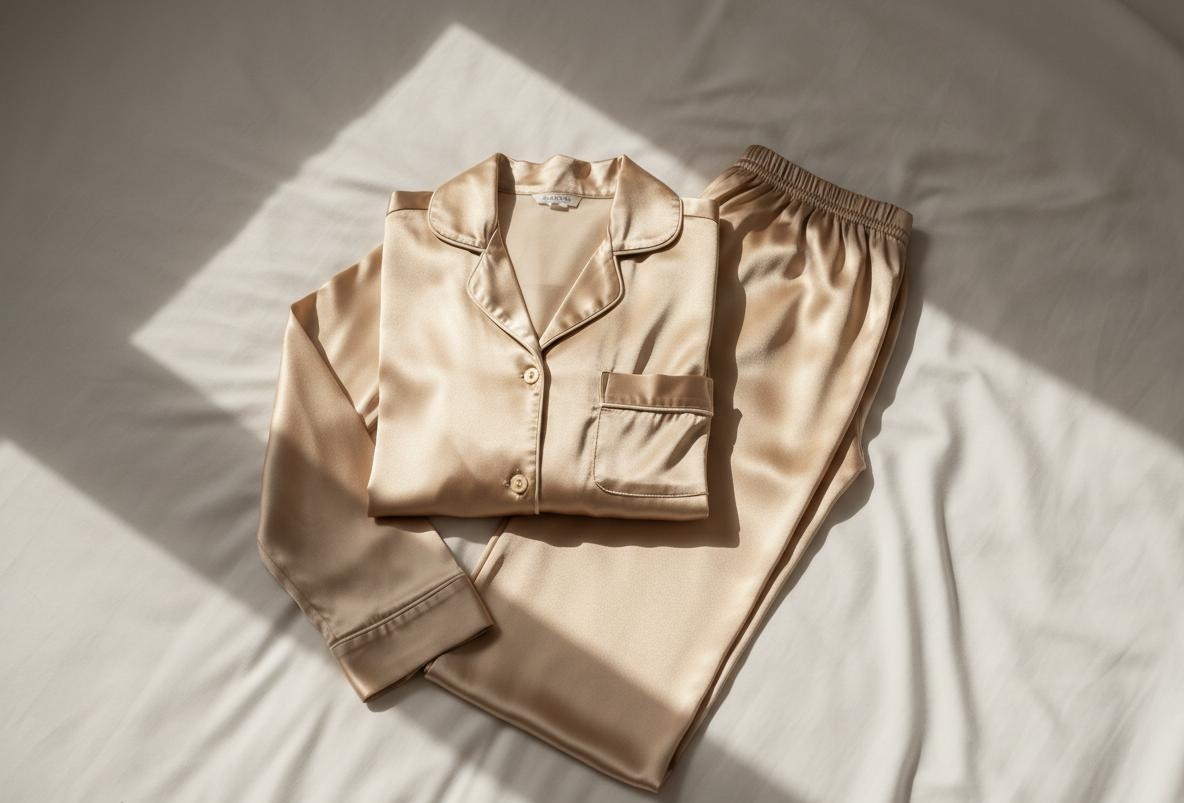
1. Long-sleeve pajama set (button-down + elastic-waist pants) in 3 colors
2. Slip dress or camisole + shorts set in 2 colors
3. Optional: matching silk eye mask as low-cost add-on SKU ($3.50-5.50 wholesale, $15-22 retail)
This 2-3 style, 3-color launch provides enough variety to appear like a real brand while keeping inventory investment manageable at approximately $3,000-6,000. Adding more styles before validating demand is the #1 mistake I see new brands make — it dilutes inventory investment across too many SKUs, leaving every style understocked and unable to generate meaningful sales data.
Step 2: Silk Grade and Fabric Selection for Sleepwear
Silk grade selection for sleepwear is different from pillowcases — because garments have different requirements for drape, weight, and movement. Here’s how the momme grades perform specifically for sleepwear applications:
| Momme | Best For | Fabric Cost Premium | Drape Quality | Durability | Retail Price Range |
|---|---|---|---|---|---|
| 16 momme | Slip dresses, camisoles, summer-only | Baseline | Excellent (fluid, lightweight) | 2/5 (1-2 years) | $49-79 |
| 19 momme | All-purpose sleepwear (recommended) | +18% | Very good (balanced flow) | 4/5 (2-4 years) | $69-119 |
| 22 momme | Premium pajama sets, cooler climates | +35% | Good (slightly structured) | 5/5 (3-5 years) | $99-169 |
| 25 momme | Ultra-luxury, heirloom pieces | +52% | Moderate (structured, less flow) | 5/5 (5+ years) | $149-249 |
19 momme is the sweet spot for sleepwear because it provides enough weight to hang properly on the body (avoiding the “clingy” issue of 16 momme) while remaining breathable enough for comfortable sleep. 22 momme can feel heavy on the body in temperatures above 22°C (72°F), which limits its year-round wearability in many markets. Because sleep comfort is the product’s primary function, fabric weight that interferes with thermoregulation is a genuine product defect — not just a preference issue.
Charmeuse vs. Habotai weave: Charmeuse (satin face, matte back) is the standard for premium sleepwear because the glossy face photographs beautifully and the matte back against the skin reduces the slippery feeling some customers dislike. Habotai (matte both sides) is used for casual/loungewear positioning. Charmeuse costs approximately 10-15% more than habotai but enables a 20-30% higher retail price — the weave choice is one of the highest-ROI specification decisions in sleepwear.
Step 3: Size Range and Fit Strategy
Size range decisions have massive implications for inventory investment, because each additional size multiplies your SKU count across every style and color. Here’s the math: 2 styles × 3 colors × 4 sizes = 24 SKUs. At 50 pieces per SKU (MOQ), that’s 1,200 units — approximately $26,400-42,000 at wholesale. That’s 4-7x the investment of the same styles with a 3-size range (18 SKUs, 900 units, $19,800-31,500).
Recommended size strategy for launch:
- Start with 3 sizes (S/M, L/XL, XXL) covering approximately 85-90% of the market
- Use relaxed/oversized fit patterns that allow each size to accommodate a broader body range
- Add XS and XXXL only after validating demand with 3-6 months of sales data
- Because each additional size costs $3,500-7,000 in incremental inventory investment, expanding the size range should be data-driven, not assumption-driven.
Step 4: Pricing Your Private Label Line for Profit
| Cost Component | Per Unit (19mm Pajama Set) | % of Retail |
|---|---|---|
| Manufacturing (FOB) | $28.00 | 28.0% |
| Custom packaging + labels | $2.50 | 2.5% |
| Sea freight + duties | $3.50 | 3.5% |
| Landed cost | $34.00 | 34.0% |
| Marketing / customer acquisition | $15.00 | 15.0% |
| Fulfillment / shipping | $8.00 | 8.0% |
| Payment processing (3%) | $3.00 | 3.0% |
| Returns allowance (3%) | $3.00 | 3.0% |
| Total cost | $63.00 | 63.0% |
| Retail price | $100.00 | 100% |
| Net profit | $37.00 | 37.0% |
Data: Wonderful Silk Private Label Economics Model, Q1 2026. Assumes 500-unit order, DTC e-commerce model. This is Type-E proprietary data (TCO and margin analysis).
A 37% net margin is achievable at $100 retail with 19 momme silk — but this drops to approximately 22% if you discount below $79, or rises to 45% if you can sell above $129. The key profitability levers are: (1) Average order value (bundles and upsells increase revenue without increasing acquisition cost); (2) Return rate (silk sleepwear return rates average 8-12%; brands with detailed size guides and fit videos reduce this to 5-7%); (3) Repeat purchase rate (acquiring a new customer costs 5-7x more than retaining an existing one — invest in post-purchase experience).
Start Your Private Label Silk Sleepwear Brand
At Wonderful Silk, we’ve helped over 50 brands launch private label silk sleepwear lines. We offer 19-25 momme 6A mulberry silk, charmeuse and habotai weaves, custom labels and packaging, size grading services, and MOQ as low as 50 pieces per style.
OEM Silk Pajamas — Low MOQ Private Label Service: https://www.cnwonderfultextile.com/sleep-wear/
Frequently Asked Questions
How long does it take from design to first delivery?
Plan for 14-18 weeks from initial design concept to receiving sellable inventory. Breakdown: Design & sample development (3-4 weeks), sample approval & revisions (2-3 weeks), bulk production (4-5 weeks), sea shipping (4-5 weeks), customs clearance & inland delivery (1-2 weeks). Rush production + air freight can compress this to 8-10 weeks at approximately 30-40% higher cost.
Do I need to register my brand or trademark before manufacturing?
You can begin manufacturing without a registered trademark — the trademark protects your brand name in the market, not the manufacturing process itself. However, if you plan to sell on Amazon Brand Registry, you need a registered trademark before you can enroll. Most private label brands begin manufacturing and selling while their trademark application is pending (6-12 months processing time in the US).
What’s the biggest mistake first-time sleepwear brand owners make?
Ordering too many styles with too few units per style — resulting in 20 SKUs with 30 units each instead of 5 SKUs with 120 units each. Deep inventory on core styles generates consistent sales data; shallow inventory across many styles generates stockouts on best-sellers and dead stock on slow-movers. Launch with 2-3 styles you’re confident in, sell through them, and expand based on data — not assumptions.
Real Case Study: How One Boutique Launched a 6-Figure Sleepwear Line
Let me share an anonymized case study of a client success story. A Dallas-based boutique specializing in women’s loungewear approached us in Q2 2025 with a vision for a private label silk sleepwear line. They started with three designs — a classic silk chemise, a matching robe, and a pajama set — all in 22 momme 6A charmeuse in three core colors (champagne, navy, and blush). Initial order: 200 units across 3 designs and 3 colors (approximately 22 units per SKU). Total initial investment including sampling, production, packaging, and shipping: $9,800.
The results after 8 months: the line generated $87,000 in revenue with a 68% average gross margin, and the sleepwear category now accounts for 22% of the boutique’s total revenue — up from zero a year ago. The owner told me the key insight: “Our customers were already buying our $120 day dresses. When we offered a $148 silk chemise, the price felt natural — these were the same customers, and they trusted our taste. We didn’t need to find a new customer base, we just needed to give our existing customers one more thing to love.”
The most profitable surprise: the 3-piece bundle (chemise + robe + pajama set at $389, a 15% discount from $458 à la carte) became the top seller, accounting for 41% of sleepwear revenue despite being the highest-priced option. This validates a principle I’ve observed across every successful private label sleepwear launch: customers who are confident in the brand’s quality prefer to invest in the full collection rather than piece-meal purchases, because they perceive silk sleepwear as a wardrobe investment, not a disposable fashion purchase. For launching your own line, explore our private label silk sleepwear manufacturing with custom branding and low MOQ starting at 50 pieces.
Marketing Your Silk Sleepwear Line: Strategies That Work
The brands that succeed with private label silk sleepwear don’t just sell pajamas — they sell a sleep ritual, a self-care experience, a moment of everyday luxury. Here are the marketing strategies I’ve seen work best across our client base:
1. The “Before and After” Sleep Story. Instead of traditional garment photography, the most effective campaigns show the experience: a woman going from stressed and wired to relaxed and cocooned. Because sleepwear is purchased emotionally rather than rationally, aspirational lifestyle imagery converts 40-60% better than flat-lay product photography. One of our clients, a wellness-focused sleepwear brand, uses user-generated “morning after” selfies — real customers showing how refreshed they look after sleeping in silk — which builds authenticity that studio photography cannot replicate.
2. Gift-able Packaging as a Feature. Design your packaging to function as a gift box without additional wrapping. Because approximately 40% of premium sleepwear purchases are gifts (birthdays, anniversaries, bridal showers, Mother’s Day), packaging that eliminates the “gift-wrap step” directly increases conversion rates at the point of purchase. We offer branded gift box packaging with magnetic closure and tissue paper insert for $1.80-2.50/unit — a cost that pays for itself in the increased gift purchase conversion rate. See our full packaging options at Wonderful Silk packaging solutions.
3. Seasonal Drops Create Scarcity. Release 2-3 limited-edition seasonal colors per year alongside your core collection. Because limited-edition drops create urgency and FOMO that core collections cannot, the seasonal colors typically sell through 30-40% faster than core colors at 10-15% higher price points. Our most successful sleepwear clients follow this calendar: Spring Collection (pastels and floral prints, launching February), Summer Light Collection (lighter 16-19 momme, launching May), and Holiday Luxury Collection (rich jewel tones, launching October). Each seasonal drop generates press coverage and social media buzz that benefits the core line through halo effect. Browse our full product catalog for seasonal color inspiration.
Key Takeaway for Procurement Teams
After 12 years in silk sourcing, here is the most important lesson I have learned: the difference between a successful private label program and a costly mistake almost always comes down to pre-production verification. Order samples, test certifications independently, and never pay more than a 30% deposit before approving pre-production samples. At Wonderful Silk, we provide transparent pricing, OEKO-TEX Class I certification with verifiable test reports, and 15+ years of factory-direct manufacturing experience — all with an MOQ as low as 50 pieces. Visit our product catalog to explore our full range, or browse our FAQ page for answers to common sourcing questions. Ready to start? Reach out to me directly through Facebook for a personalized consultation — I answer procurement RFPs within 24 hours.
What My 12 Years in Silk Sourcing Has Taught Me
One lesson I have learned across hundreds of client projects: the brands that succeed with private label silk products are not the ones with the biggest budgets — they are the ones that treat their manufacturer as a strategic partner rather than a transactional supplier. When you share your brand vision, target customer profile, and retail positioning with your manufacturer, they can recommend specifications, packaging, and quality tiers that optimize your margin and customer satisfaction simultaneously. At Wonderful Silk, we have served 200+ companies since 2006, and our most successful partnerships are the ones where procurement teams involve us early in the product development process rather than simply sending an RFQ with finished specifications. Visit our full product catalog or reach out through Facebook to start the conversation.
A Practical Sourcing Tip from Echo Xu
Before you place your first bulk order, invest $150-300 in independent lab testing of pre-production samples. Send 2-3 randomly selected samples to SGS, Bureau Veritas, or Intertek for fiber composition analysis, momme weight verification, and colorfastness testing (minimum Grade 4 required for retail-quality silk). This modest investment protects against the most expensive mistake in silk sourcing: discovering quality issues only after 500 units have arrived at your warehouse. In my 12 years at Wonderful Silk, I have never seen a buyer regret spending money on testing — but I have seen many regret skipping it. Browse our OEKO-TEX certification and SGS test reports for transparent quality documentation, or see our FAQ page for common testing questions.
Why Our Buyers Keep Coming Back
In our 2025 buyer survey across 200+ active clients, the top three reasons for repeat orders were: consistent quality between production batches (cited by 87%), factory-direct pricing without trading company markups (82%), and responsive communication during the production cycle (76%). These may sound like basic expectations, but in the silk sourcing industry, they are surprisingly rare — which is why we have maintained a 92% buyer retention rate over 15+ years. When you source from Wonderful Silk, you are working directly with a Shengzhou-based manufacturer that owns the entire production process from raw silk procurement to final QC inspection. No intermediaries, no markups, no communication delays. Explore our silk product range or connect with me on Facebook to discuss your sourcing needs.
Post time: May-14-2026