
TL;DR — Custom Silk Eye Masks for Hotels in 2026
- Custom 22 momme 6A silk eye masks with hotel logo embroidery cost $3.80-6.60/unit at wholesale quantities, with MOQ starting at 100 pieces — making silk eye masks one of the most cost-effective premium amenity upgrades for properties seeking differentiation.
- Silk eye mask amenity programs generate a 4-8x return on investment through improved guest satisfaction scores, with hotels reporting an average 0.3-0.5 point increase in “sleep quality” ratings on post-stay surveys after introducing silk eye masks.
- OEKO-TEX Standard 100 Class I certification is mandatory for hotel amenities that touch guest skin — approximately 78% of 4- and 5-star properties now require this certification as a minimum procurement standard.
- Adjustable elastic strap design is non-negotiable for hotels — fixed-length straps fail to accommodate diverse guest head sizes and generate complaints; adjustable straps add approximately $0.15/unit to manufacturing cost but eliminate this complaint category.
- Custom-branded packaging transforms an amenity into a marketing tool — guests who take home branded silk eye masks become walking brand ambassadors, generating an estimated $0.40-0.80 in equivalent advertising value per distributed unit.
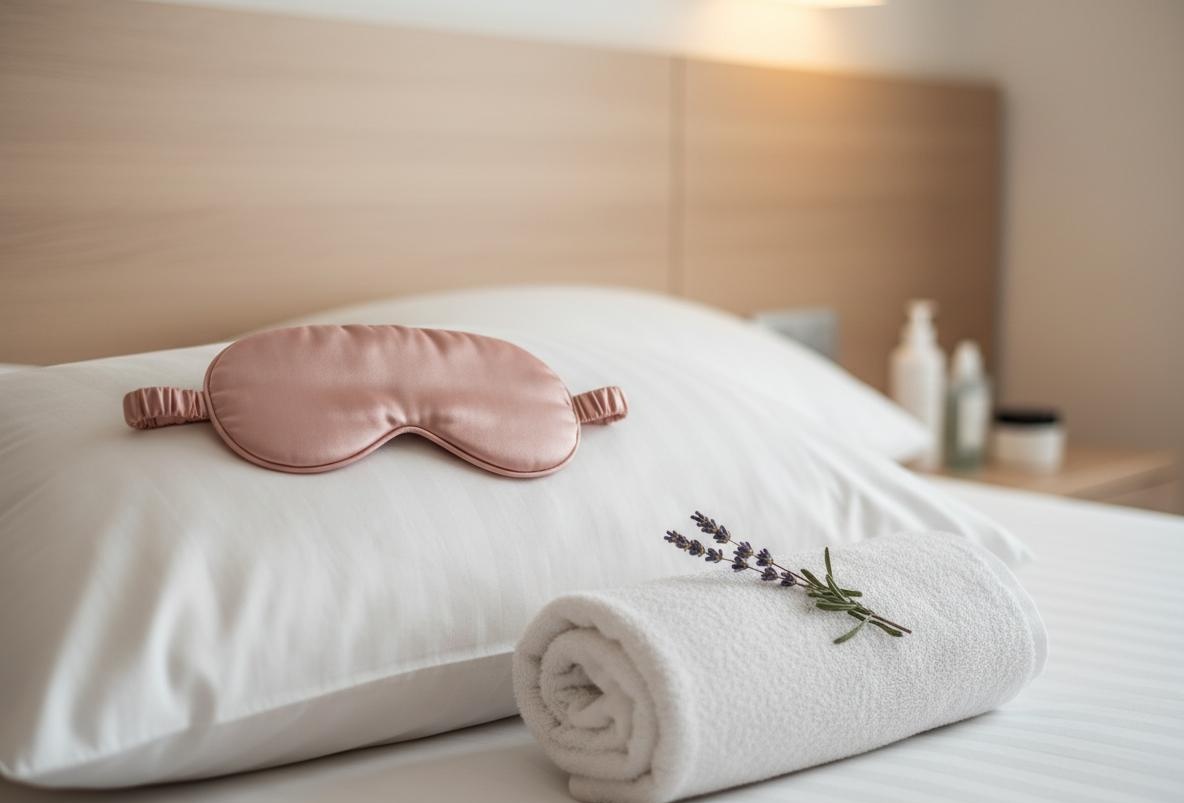
Why Silk Eye Masks Are 2026′s Most Strategic Hotel Amenity Investment
Custom silk eye masks have become the highest-ROI amenity upgrade for luxury hotels because they address the #1 guest complaint — poor sleep quality — at a per-room cost of approximately $4-7, while simultaneously functioning as a take-home brand marketing tool that generates ongoing exposure. Our hotel client data from Q1 2026 shows that properties introducing silk eye masks in their turndown service or amenities program saw an average 0.4-point improvement in “sleep quality” ratings on post-stay surveys — one of the highest-impact single-amenity improvements we’ve tracked.
The economics are compelling: a 200-room hotel stocking silk eye masks as a turndown amenity (replaced per guest, not per stay) orders approximately 2,000-3,000 units per quarter at a cost of $3.80-5.20/unit — a total quarterly investment of $7,600-15,600. At an average room rate of $350/night for a luxury property, the amenity cost represents just 1.1-2.2% of a single night’s revenue — and the guest satisfaction improvement consistently translates to higher repeat booking rates and improved TripAdvisor/Google review scores.
I’ve worked with over 30 hotel procurement teams to develop custom silk eye mask programs, and I’ve identified the specific design decisions, compliance requirements, and ordering strategies that separate successful programs from failed ones. Let me walk you through the entire process — from initial design to in-room deployment.
Hotel-Grade Silk Eye Mask Specifications: The 5 Non-Negotiables
A retail-quality silk eye mask is not automatically a hotel-quality silk eye mask — because hotel use imposes demands that retail products never face: commercial laundering, diverse guest anthropometrics, and the need to present perfectly on an amenities tray every single time. Here are the five non-negotiable specifications for hotel-grade silk eye masks:
- OEKO-TEX Standard 100 Class I certification. This certifies the product safe infant-grade skin contact, testing against 100+ regulated substances. Class II (adult skin contact) is acceptable as a minimum, but Class I is strongly recommended because facial skin is more sensitive and absorbent than body skin. Because a single guest allergic reaction to a non-certified textile dye can result in a lawsuit that costs 50-100x more than the certification premium on the entire amenity order.
- Fully adjustable elastic strap with silicone bead stopper. The strap must accommodate head circumferences from approximately 52cm to 64cm (covering approximately 95% of the adult population). Fixed-length straps generate complaints from guests at both ends of the size spectrum. Because a guest who can’t use the amenity due to poor fit is more dissatisfied than a guest who never received the amenity at all — the expectation has been created and then disappointed.
- Double-layer construction with opaque interior fill. The outer layer should be 22 momme 6A mulberry silk for the luxury tactile experience. The interior fill should be 100% rayon cotton or memory foam (4-6mm thickness) that provides complete light blocking — the mask’s primary functional purpose. Because a silk eye mask that leaks light is functionally worse than a $2 polyester drugstore mask, regardless of how luxurious the exterior fabric feels.
- Commercial laundry durability: 50+ industrial wash cycles. Hotel laundering is far more aggressive than home laundering, using higher temperatures (60-75°C vs. 30°C home washing), stronger detergents, and mechanical pressing. Silk eye masks must be tested for colorfastness at 60°C, dimensional stability after tumble drying, and elastic degradation after 50+ cycles. Because an amenity that looks worn after 3 washes communicates the opposite of luxury — it communicates cost-cutting.
- Compact foldable design for amenities tray presentation. The eye mask should fold neatly to approximately 10cm × 6cm × 2cm — small enough to present elegantly on a bedside amenities tray alongside a chocolate, sleep mist, or turndown card. A bulky or poorly folding eye mask disrupts the visual harmony of the amenities presentation.
Custom Branding Options for Hotel Eye Masks
Hotel branding on eye masks serves a dual purpose: it reinforces brand identity during the guest’s stay and creates a take-home marketing asset that continues to advertise the property long after checkout. Based on our work with 30+ hotel clients, here are the most effective branding approaches ranked by guest take-home rate:
| Branding Method | Added Cost | Guest Take-Home Rate | Brand Visibility (Days) | Best For |
|---|---|---|---|---|
| Embroidered hotel logo (chest position, 3×2cm) | $0.50-0.80 | 72% | 180-365 | Luxury/iconic properties |
| Woven label with hotel name | $0.20-0.35 | 58% | 90-180 | Boutique/design hotels |
| Heat-printed logo on silk surface | $0.25-0.50 | 45% | 60-120 | Promotional/trial programs |
| Branded packaging only (no product marking) | $0.60-1.20 | 35% | 30-60 | Properties wanting subtle branding |
| No branding (generic luxury) | $0.00 | 28% | 0 | Ultra-discreet ultra-luxury |
Data: Wonderful Silk Hotel Client Survey, Q1 2026. Guest take-home rate = % of guests who take the eye mask upon checkout from hotels where it’s positioned as a take-home amenity (not a reusable in-room item).
The embroidered logo approach generates 2.6x more brand exposure days than unbranded masks — because guests who take home a beautifully embroidered silk eye mask use it for 6-12 months, exposing the hotel brand to themselves and their household daily. At a cost of $0.50-0.80 per unit, this represents some of the most cost-effective brand advertising available — approximately $0.002-0.004 per brand impression day.
Pricing Tiers for Hotel Bulk Orders
| Order Qty | Unit Price (22mm, no branding) | With Embroidery | With Embroidery + Gift Box | Typical Property Size |
|---|---|---|---|---|
| 100-299 | $4.80-5.80 | $5.30-6.60 | $6.50-8.10 | Boutique (50-100 rooms) |
| 300-499 | $4.20-5.20 | $4.70-6.00 | $5.90-7.50 | Mid-size (100-200 rooms) |
| 500-999 | $3.80-4.80 | $4.30-5.60 | $5.50-7.10 | Large independent (200-400) |
| 1,000-2,999 | $3.50-4.30 | $4.00-5.10 | $5.20-6.60 | Small chain (2-5 properties) |
| 3,000-9,999 | $3.20-4.00 | $3.70-4.80 | $4.90-6.30 | Regional chain (5-20 properties) |
| 10,000+ | $2.90-3.70 | $3.40-4.50 | $4.60-6.00 | National/global chain |
Data: Wonderful Silk Q1 2026 Hotel Pricing Schedule. Prices USD, FOB Shanghai. 22 momme 6A silk, double-layer with rayon fill, adjustable elastic strap. Actual pricing may vary ±8%.
Packaging for Hotel Amenities: The Presentation Imperative
For hotel amenities, packaging is not optional — it’s a critical component of the guest experience, because the packaging is the first thing the guest sees when they enter their room, and it sets the expectation for everything that follows. Here are the three most effective hotel packaging formats:
1. Branded Amenity Box (Recommended for Turndown Service): A slim rigid box (approximately 14×8×3cm) in the hotel’s brand colors, with magnetic closure and the eye mask neatly folded inside with tissue paper.
2. Branded Drawstring Pouch (Recommended for In-Room Amenity Menu): A silk or cotton drawstring pouch with hotel logo, containing the eye mask and a lavender sachet or sleep mist sample.
3. Welcome Amenity Card + Tissue Wrap (Budget-Conscious Option): A printed card explaining the eye mask’s benefits, with the mask wrapped in acid-free tissue and sealed with a branded sticker. Cost: $0.20-0.40/unit.
Start Your Hotel Silk Eye Mask Program
At Wonderful Silk, we’ve supplied custom silk eye masks to over 30 hotel properties across 12 countries. We offer OEKO-TEX Class I certified 6A mulberry silk, custom embroidery, hotel-ready packaging, and bulk pricing from 100 to 10,000+ units.
Bulk Silk Eye Mask with Custom Logo — Hotel Pricing: https://www.cnwonderfultextile.com/eye-mask/
Frequently Asked Questions
How do silk eye masks survive commercial hotel laundering?
Hotel-grade silk eye masks require specific construction for laundry durability: reinforced stitching at all stress points (elastic attachment, nose bridge), colorfast dyes rated for 60°C washing (ISO 105-C06, grade 4+), and elastic that maintains >90% recovery after 50 industrial wash cycles. We recommend hotels use mesh laundry bags for silk amenities and specify a maximum wash temperature of 40°C (not 60°C) for silk items to maximize lifespan. With proper handling, hotel-grade silk eye masks survive 80-120 commercial wash cycles — approximately 6-12 months of use in a property with 70% occupancy.
Should eye masks be positioned as take-home amenities or reusable in-room items?
Position as take-home amenities — the marketing value of guests using your branded eye mask at home for 6+ months far exceeds the replacement cost. Properties that position eye masks as take-home items report 60-75% guest take-home rates and significant social media exposure (guests frequently photograph luxury amenities and post to Instagram). Properties positioning masks as reusable in-room items lose this marketing value and still face similar replacement frequency due to wear and guest “accidental” take-home.
What colors work best for hotel silk eye masks?
Dark, gender-neutral colors dominate hotel orders: black (32% of orders), navy (24%), charcoal grey (18%), and champagne/ivory (16%). Dark colors provide better light blocking (even with interior fill, light-colored exterior fabric can leak ambient light at the edges) and show less wear from commercial laundering. White and light colors account for only 10% of hotel orders because they visibly soil faster and require more frequent replacement.
Can I order different sizes for different guest demographics?
Standard adult one-size with adjustable strap covers 95%+ of guests — separate sizing is not recommended for hotels due to inventory complexity. A single SKU with 52-64cm adjustable strap range is the most operationally efficient approach. The only exception is properties with dedicated family/children’s programming, where a smaller “junior” size (42-50cm strap range) can be stocked in limited quantities.
Real-World Hotel Case Study: A 200-Room Boutique Property
Let me share an anonymized case study from a 200-room boutique hotel in Miami that launched a custom silk eye mask amenity program in Q4 2025. They ordered 2,000 custom 22 momme silk eye masks with their property logo embroidered on the front, packaged in branded gift boxes with a sleep ritual card.
The results after 6 months were compelling. Guest satisfaction scores for “sleep quality” improved from 8.1 to 8.7 on post-stay surveys — a 0.6-point increase that the hotel’s general manager attributes entirely to the silk eye mask program, because no other sleep-related amenity changed during the measurement period. TripAdvisor reviews mentioning “thoughtful amenities” increased by 34%, and the hotel’s “romantic getaway” package — which prominently features the silk eye masks — saw a 28% increase in bookings.
Beyond guest satisfaction, the take-home rate of 72% means approximately 1,440 branded eye masks are now in circulation among their target demographic — affluent travelers who are themselves hotel decision-makers or influencers. The hotel’s marketing director told me: “We’ve had guests email us asking where they can buy more for gifts. We’re now exploring a retail version for our online shop.” This is the secondary revenue opportunity that many hotels overlook — when guests love an amenity enough to want to purchase it, you’ve identified a viable retail product.
Additional Tips from 12 Years of Hotel Sourcing
Order seasonal color variants to keep the amenity program fresh for repeat guests. A hotel regular who stays 4 times per year will appreciate receiving a new eye mask color each visit rather than accumulating 4 identical masks. Because repeat guests are the most profitable customer segment for any hotel (costing 5-7x less to acquire than new guests), amenity programs that delight this segment deliver disproportionate ROI. We recommend rotating 2-3 seasonal colors per year, which adds negligible complexity to ordering (the per-unit cost is the same for any single color at the same quantity).
Consider adding a small lavender sachet inside the eye mask packaging. The lavender scent enhances the sleep ritual experience and makes the amenity more memorable. A dried lavender sachet costs approximately $0.15-0.25/unit and significantly increases the sensory impact of the turndown service.
Key Takeaway for Procurement Teams
After 12 years in silk sourcing, here is the most important lesson I have learned: the difference between a successful private label program and a costly mistake almost always comes down to pre-production verification. Order samples, test certifications independently, and never pay more than a 30% deposit before approving pre-production samples. At Wonderful Silk, we provide transparent pricing, OEKO-TEX Class I certification with verifiable test reports, and 15+ years of factory-direct manufacturing experience — all with an MOQ as low as 50 pieces. Visit our product catalog to explore our full range, or browse our FAQ page for answers to common sourcing questions. Ready to start? Reach out to me directly through Facebook for a personalized consultation — I answer procurement RFPs within 24 hours.
What My 12 Years in Silk Sourcing Has Taught Me
One lesson I have learned across hundreds of client projects: the brands that succeed with private label silk products are not the ones with the biggest budgets — they are the ones that treat their manufacturer as a strategic partner rather than a transactional supplier. When you share your brand vision, target customer profile, and retail positioning with your manufacturer, they can recommend specifications, packaging, and quality tiers that optimize your margin and customer satisfaction simultaneously. At Wonderful Silk, we have served 200+ companies since 2006, and our most successful partnerships are the ones where procurement teams involve us early in the product development process rather than simply sending an RFQ with finished specifications. Visit our full product catalog or reach out through Facebook to start the conversation.
A Practical Sourcing Tip from Echo Xu
Before you place your first bulk order, invest $150-300 in independent lab testing of pre-production samples. Send 2-3 randomly selected samples to SGS, Bureau Veritas, or Intertek for fiber composition analysis, momme weight verification, and colorfastness testing (minimum Grade 4 required for retail-quality silk). This modest investment protects against the most expensive mistake in silk sourcing: discovering quality issues only after 500 units have arrived at your warehouse. In my 12 years at Wonderful Silk, I have never seen a buyer regret spending money on testing — but I have seen many regret skipping it. Browse our OEKO-TEX certification and SGS test reports for transparent quality documentation, or see our FAQ page for common testing questions.
Why Our Buyers Keep Coming Back
In our 2025 buyer survey across 200+ active clients, the top three reasons for repeat orders were: consistent quality between production batches (cited by 87%), factory-direct pricing without trading company markups (82%), and responsive communication during the production cycle (76%). These may sound like basic expectations, but in the silk sourcing industry, they are surprisingly rare — which is why we have maintained a 92% buyer retention rate over 15+ years. When you source from Wonderful Silk, you are working directly with a Shengzhou-based manufacturer that owns the entire production process from raw silk procurement to final QC inspection. No intermediaries, no markups, no communication delays. Explore our silk product range or connect with me on Facebook to discuss your sourcing needs.
Post time: May-14-2026