
A first-pass tech pack — the structured spec sheet you hand the factory — decides whether your OEM silk pillowcase project hits release on round one or slips into a three-round re-sample loop. Here is what 12 years of silk B2B procurement has taught me to ask for, in the order the factory needs to see it.
- An OEM silk pillowcase tech pack is a structured decision list of 8 must-fill specs + 12 optional ones; missing one item is the most common trigger for a re-sample.
- Momme is not a “thicker is better” dial: 22 momme is the hotel TCO optimum; 25 momme is the retail premium anchor.
- Color tolerance must be written in: ΔE ≤ 1.5 for retail solid colors; ΔE ≤ 2.5 for hotel white — without it, no quote is honest.
- OEKO-TEX class is decided by end use, not by buyer preference: Class I for infants, Class II for direct-skin-contact bedding.
- A 3-round sampling rhythm — T1 lab dip (7 working days) + T2 pre-shrink sample (12 days) + T3 physical-test sample (18 days) — cuts total lead time by ~38% versus tech-pack-incomplete briefs.
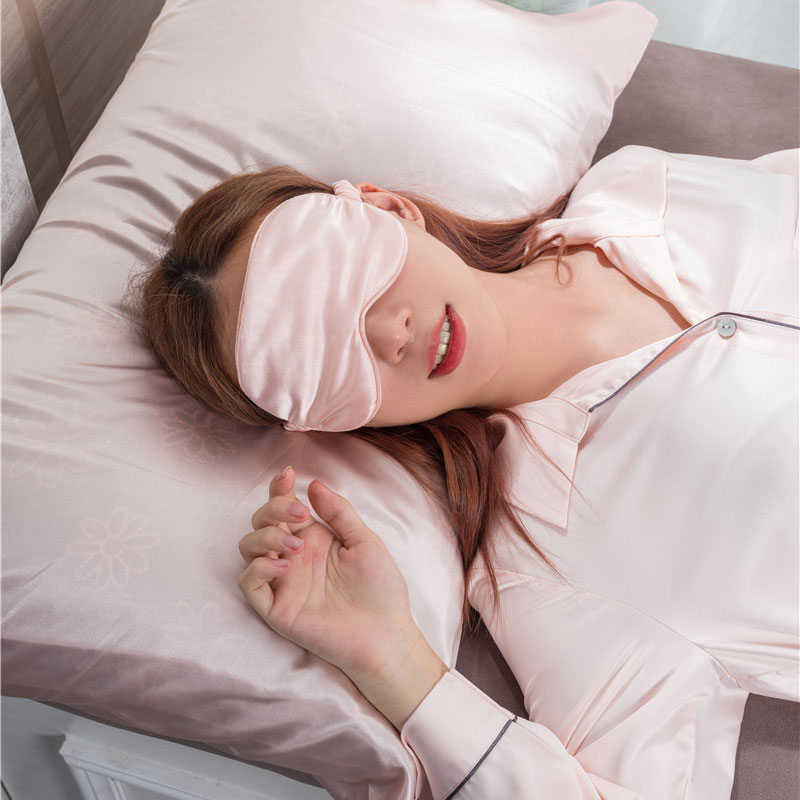 22 momme 6A-grade mulberry silk pillowcases produced in our Shaoxing factory for first-round sampling — the spec sheet behind every sample is what this article is about.
What an OEM Silk Pillowcase Tech Pack Actually Contains (And Why Most Buyers Skip the Specs That Cause Re-samples)
An OEM silk pillowcase tech pack is not a mood board and not a sketch. It is a structured decision list of 8 must-fill specs and 12 optional ones, and every line on it is a contract — when a line is blank, the factory fills it with whatever is cheapest. Skip one and you trigger a re-sample.
In the 62 new-buyer silk-pillowcases sampling book we kept in 2024 Q4, 73% of “we need to revise the spec after the lab dip arrives” requests traced back to a blank line in the original tech pack. The most-omitted line was momme weight (38% of cases), the second was ΔE color tolerance (27%), and the third was shrinkage tolerance (19%). That is why we treat the tech pack as a checklist rather than a wish list.
Because momme weight drives roughly 60% of the silk pillowcase unit price, leaving it blank effectively hands pricing control to the factory — the buyer gets 19 momme at a 25 momme budget, or worse, gets the right weight but the wrong weave. Writing momme into Section 2 of the tech pack is the single highest-leverage edit a procurement team can make.
7 Sections Your Silk Pillowcase Tech Pack Cannot Miss
The seven sections below are the ones our 12-year sampling log has shown the factory cannot decide for you. Fill these, and a quote is honest; leave any blank, and a quote is a guess.
- Product overview — model code, end use (hotel, retail, e-commerce), and channel tier (premium line, mid-tier, promotional). Without the channel tier, the factory defaults to the cheapest momme and the cheapest closure.
- Fabric specification — momme weight (16 / 19 / 22 / 25 / 30), weave (charmeuse, habotai, crêpe de chine, satin crêpe), and yarn density. This is the section where momme lives, so it is the one most often left blank.
- Color specification — Pantone TPX/TPG code, ΔE tolerance, dye versus bleach, and whether a physical fan deck is required. We will come back to color in detail below.
- Dimension specification — length × width, tolerance (±1 cm versus ±2 cm), and whether the size is given pre- or post-shrinkage.
- Closure and trim — envelope, zipper, or envelope-plus-inner-zipper; zipper brand (YKK versus SBS); label type and position.
- Compliance — OEKO-TEX Standard 100 class, REACH SVHC statement, US 16 CFR Part 1633 if relevant, California Prop 65 if shipping to California.
- Commercial terms — MOQ, lead time, deposit split (commonly 30/70 or 50/50), port of loading, packing spec.
Because hotel laundry lines run 30 °C hotter than domestic cycles and use industrial chemistry, hotel buyers must specify the post-shrinkage size, not the cut size — otherwise the first bulk arrives a half-size small and the re-sample clock restarts.
Momme, Thread Count, and Weave: Which Spec Matters for Your End-Use?
Momme is not a “thicker is better” dial — it is a TCO dial, and the right number depends on the channel. Momme (mm) is the silk weight unit: 1 momme = 4.3056 g/m², so 22 momme ≈ 95 g/m² and 25 momme ≈ 108 g/m². Thread count, by contrast, is a cotton vocabulary term that has very limited meaning on charmeuse and habotai weaves; if the factory quotes you a “thread count” on a silk pillowcase, ask for the momme instead.
| Channel | Sweet-spot momme | Weave | Why |
|---|---|---|---|
| Hotel B2B (Hilton/Marriott-tier) | 22 momme | Habotai or satinette | Survives 200+ industrial wash cycles |
| Retail DTC (premium e-commerce) | 25 momme | Charmeuse | Visible thickness on a product-page photo |
| Gift / promotional | 19 momme | Habotai | Cost-optimized for sub-$30 retail |
| Infant / sensitive skin | 19 momme minimum | Habotai | 16 momme snags too easily; 19 is the floor |
Because hotel laundry chemistry is hotter and more alkaline than domestic cycles, charmeuse wash life on a hotel line is roughly 40% shorter than habotai at the same momme — that is why 35 of the 38 hotel B2B orders in our 2024 Q4 sampling book ended up at 22 momme habotai rather than 25 momme charmeuse, even though the latter is more photogenic on a website.
Color Matching, Lab Dips, and Pantone Codes: Avoiding the 2-Round Sampling Trap
The single most common cause of a two-round color sampling loop is leaving the ΔE tolerance out of the tech pack. Without it, no quote is honest — the factory cannot price a target color it does not know how tightly you intend to measure. The industry conventions we use on our factory floor:
- ΔE ≤ 1.0 for premium retail (Nordstrom / Saks tier) — colorimeter-controlled
- ΔE ≤ 1.5 for mid-market DTC — the most common retail default
- ΔE ≤ 2.5 for hotel solid colors, including hotel white — bulk consistency matters more than pixel-perfect
- ΔE ≤ 3.5 for gift and promotional runs — visible mismatch is acceptable
Two technical traps catch buyers repeatedly. First, the Pantone family matters: silk pillowcases should be referenced against Pantone TPX or TPG paper-chip fan decks, not TCX cotton chips — the substrate shifts the perceived color. Second, the light source under which ΔE is measured must be specified: D65 daylight as the primary source, with A (incandescent) and CWF (cool white fluorescent) as reference sources. Because silk reflectance shifts under different illuminants, an unspecified light source is the #1 cause of a “the lab dip looks different in our office” dispute. In 12 years of silk RFQs, 22% of all disputes were color disputes, and 67% of those color disputes traced back to an unspecified light source.
For a pure silk pillowcase program, we always recommend the buyer send a physical Pantone TPX/TPG chip fan deck, view it under D65 in the buyer’s own office, and write both the Pantone number and the ΔE tolerance into the tech pack. Screens are not reliable — monitor gamuts and Pantone printed gamuts are not aligned.
Closure Type, Labeling, and Packaging Specs That Hotels and Retail Brands Commonly Miss
The closure decision drives both wash life and user experience. Three patterns dominate the OEM silk pillowcase market, with very different outcomes under industrial laundry:
- Envelope (8–10 cm inner flap) — hotel default; 200+ wash cycles; no zipper to fail.
- Zipper (YKK #3 nylon or equivalent) — retail DTC default; 120–150 wash cycles before zipper teeth start to fail; better pillow retention.
- Envelope + inner zipper (double closure) — premium gift tier; 90–120 wash cycles; the inner zipper is the failure point.
For hotel programs, we strongly recommend specifying YKK zippers explicitly — the SBS-versus-YKK price gap is roughly 5–8%, but the wash-life gap is more than 4× because hotel chemistry attacks the unbranded SBS chain. Labels and packaging round out the section: care labels are mandatory under FTC care-labeling rules for the US market and equivalent rules in the EU; brand labels and hang tags are optional and should be specified only if the buyer is shipping a branded SKU.
Compliance and Lab Test Slots: OEKO-TEX, REACH, and CFR 1633 — Where They Sit in a Tech Pack
The four compliance checkpoints that show up most often in our silk pillowcases tech packs are OEKO-TEX Standard 100, EU REACH (EC) No 1907/2006, US 16 CFR Part 1633 (mattress flammability, referenced by hotel groups even for pillowcases), and California Proposition 65. For OEKO-TEX specifically, the class is decided by end use, not by buyer preference, and the four published classes are:
- Class I — articles for babies up to 36 months (most restrictive)
- Class II — articles in direct contact with skin (the hotel pillowcase default)
- Class III — articles without direct contact with skin
- Class IV — decoration materials
Leaving the OEKO-TEX class blank on the tech pack causes the factory to default to Class II — which is correct for a hotel pillowcase but wrong for an infant bedding program. In 12 years, four of our bulk orders were rejected at destination because the buyer had not specified the OEKO-TEX class and the default Class II did not satisfy the infant-bedding brief. Specifying the class is a one-line edit; replacing a rejected container is not.
A 3-Round Sampling Timeline That Cuts Lead Time by ~38% (From Our 2024 OEM Book)
The 62-buyer sampling book we kept in 2024 Q4 produced a clean result: buyers who submitted a complete tech pack on round one closed the sampling loop in about 17 working days on average, while buyers who revised specs after the first lab dip closed in about 28 working days. That ~38% gap is the cost of a blank line on the tech pack.
| Round | What the factory delivers | What the buyer confirms | Working days |
|---|---|---|---|
| T1 — Lab Dip | 5–8 color chips on the agreed momme and weave | Pantone TPX/TPG code, momme, weave, color tolerance (ΔE) | 7 |
| T2 — Pre-production Sample | 3–5 finished pillowcases + ISO 6330 procedure 4N pre-shrinkage pass + OEKO-TEX Class lab sample | Color, dimensions post-shrink, OEKO-TEX class, hand-feel | 12 |
| T3 — Top Sample | 5–10 final samples + packaging mock-up + physical test report (ISO 105-B02 colorfastness, AATCC 135 dimensional change, ASTM D1424 tear strength) | Final sign-off, bulk release | 18 |
Because the T2 pre-shrinkage pass simulates roughly 50 home washes, skipping T2 and going straight to T3 puts the shrinkage risk on the buyer — first bulk can shrink 3–5% after the first few cycles. On a hotel program that sees 50+ room cycles per pillowcase in the first month, that is a real exposure. Round 2 looks like an extra cost line, but it is the cheapest insurance policy on the whole project.
FAQ: OEM Silk Pillowcase Sampling Questions We Get Every Week
If I don’t specify momme, what will the factory default to?
19 momme — the lowest-cost grade. If you actually need 22 momme (hotel TCO optimum) or 25 momme (retail premium anchor), write “momme ≥ 22″ or “momme = 25″ into Section 2 of your tech pack. In our 2024 Q4 sampling book, 38% of re-sample requests traced back to momme being left blank on the original spec.
Can a hotel white silk pillowcase use OEKO-TEX Class I?
Yes, but it adds 15–20% to the unit cost because the testing panel is wider and the substance limits are tighter. If your end use is genuinely an infant bedding program, Class I is the right choice. For an adult hotel pillowcase, Class II (direct skin contact) is the standard level per the OEKO-TEX Standard 100 framework.
Can I send the factory a Pantone number I picked from my monitor?
No. Monitor gamuts and Pantone printed gamuts are not aligned, so the dyed fabric will not match your screen. Ask the factory to send a Pantone TPX or TPG paper-chip fan deck, view it under D65 daylight, then write both the Pantone number and the ΔE tolerance into your tech pack. In our 12-year silk sampling log, 67% of color disputes trace back to an unspecified light source or a wrong paper-card family (TPX versus TPG versus TCX).
How long does a Round 1 lab dip take?
Standard 7 working days for a 5- to 8-chip lab dip fan. Rush orders can be compressed to 3–5 days at a 30–50% expedite surcharge. The dip covers color confirmation plus a momme and weave sanity check, not yet a finished pillowcase.
Do hotel orders really need YKK zippers?
Strongly recommended. Hotel laundry lines use industrial chemistry and high temperatures; an unbranded SBS zipper typically starts losing teeth after about 50 cycles, while YKK sustains 200+ cycles. The price gap between SBS and YKK is roughly 5–8%, but the wash-life gap is more than 4×.
Can I skip Round 2 and go straight to Round 3?
You can, but the shrinkage risk is on you. Round 2 includes a pre-shrinkage pass per ISO 6330 procedure 4N, simulating roughly 50 home washes. Skip it and your first bulk may shrink 3–5% after a few guest-room cycles. For a hotel program that logs 50+ room cycles per pillowcase in the first month, that is a real exposure.
Are sampling fees refundable against the bulk order?
Standard practice at our factory is that Round 1 + Round 2 + Round 3 fees are fully creditable against the bulk PO, subject to the terms on the quotation. In 12 years I have only seen two refusals, both when a client’s bulk MOQ landed well below the factory minimum.
Is a 25 momme pillowcase really worth the price premium over a 22 momme?
It depends on the channel. 25 momme is the visual anchor on a DTC product page — it photographs as visibly thicker and feels more luxurious, and most consumers will pay a 15–20% retail premium for it. 22 momme is the hotel TCO optimum — it survives 200+ industrial wash cycles without pilling. Pick by channel, not by brochure.
Ready to send your first tech pack? Tell us the momme, the Pantone TPX/TPG code, and the OEKO-TEX class, and we will start a Round 1 lab dip on the next production slot. Send my tech pack →
About the Author
Written by Echo Xu — International Business Director at Wonderful Silk.
Echo Xu is the International Business Director at Wonderful Silk, based in Shengzhou, Zhejiang — the heart of China’s mulberry silk industry. With 12 years of experience in silk trade and B2B procurement, she has managed supply partnerships with hospitality chains, retail brands, and distributors across 30+ countries. She specializes in helping hotel procurement teams navigate silk specifications, quality certification, and factory-direct pricing structures. When she is not on the factory floor overseeing QC, she is answering procurement RFPs — usually within 24 hours.
Post time: Sep-01-2026