
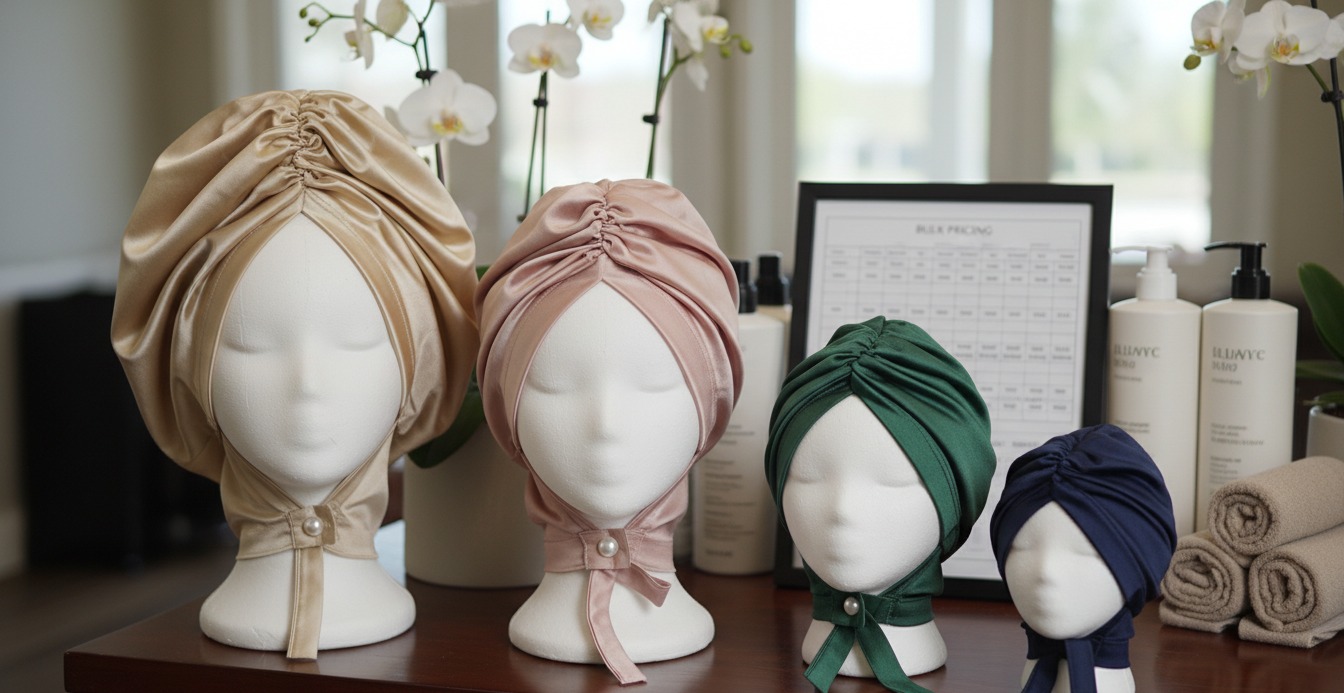
Why Silk Hair Wrap Turbans Are a High-Margin Opportunity for Salons and Spas
I’ve been sourcing silk hair turbans for spa, salon, and hospitality buyers for over a decade, and the product category has evolved dramatically. Today, silk hair wrap turbans are one of the highest-ROI category additions a salon or spa buyer can make — and here’s why most buyers underestimate them.
Most salons and spas still default to cotton hair towels. But cotton, when wrapped tightly around wet hair and left for 15–20 minutes, causes significant mechanical damage to the hair cuticle. The friction of cotton fibers against wet hair creates frizz, breakage, and the exact opposite of the smooth, glossy result your stylists worked hard to create. Because silk has a friction coefficient roughly 40% lower than cotton (according to ASTM D3887 fabric friction testing standards), silk turbans reduce that mechanical damage substantially. So clients leave the salon with hair that’s genuinely healthier — not just visually styled but structurally intact.
For spa and hotel buyers specifically, branded silk hair turbans represent an underutilized brand visibility opportunity. A client who uses a silk hair turban with your spa’s logo during a treatment is experiencing your brand in an intimate, sensory way — during the most relaxed moment of their visit. That level of brand touchpoint depth is extremely difficult to manufacture through traditional marketing channels, and it’s one of the reasons my clients who add silk turbans to their amenity programs consistently report higher repeat booking rates.
Adjustable Closure Types: Elastic Band vs Drawstring vs Velcro
Choosing the right closure type is one of the most consequential decisions for your silk hair turban program — and it’s the one most buyers rush through. Here’s the honest comparison:
Elastic band closures are the workhorse of high-volume salon environments. The elastic band is sewn into the turban crown and creates a stretch fit that most clients find secure and comfortable. The primary advantage is speed: clients can apply and remove an elastic-band turban with one hand, which matters significantly in a busy salon where efficiency directly impacts throughput. The disadvantage is that elastic degrades over time with repeated washing — expect the elastic to begin losing tension after 40–60 wash cycles. For heavily used salon inventory, this means planning for regular replacement.
Drawstring closures use a pull-cord system, similar to a traditional hair scrunchie or drawstring bag. The client adjusts the tightness to their exact head size, which means a single drawstring-adjustable turban size actually fits a wider range of head circumferences than a fixed-size elastic turban. Because the fit is customizable, drawstring turbans are less likely to leave compression marks on hair that’s been styled — a detail that matters enormously in luxury and post-color-service contexts. The trade-off is slightly slower application and removal.
Velcro hook-and-loop closures are the newest entrant in this space, and they’re gaining traction fast in premium spa environments. Velcro allows single-hand application (similar to elastic), with the adjustability of drawstring. The primary limitation is that low-quality Velcro can snag on long hair — so sourcing quality matters significantly here. Premium Velcro closures (the type we specify in our OEM production) are designed with rounded hook edges that prevent snagging.
For busy salons focused on throughput, elastic band closures are the practical choice. For luxury spas and hotel programs where clients wear turbans for extended periods, I recommend drawstring or Velcro closures because they deliver a noticeably more comfortable and customized fit. Many of my clients actually run a dual-program: elastic turbans for standard service stations, and drawstring or Velcro turbans for premium treatment rooms and suites.
Multi-Size Options: S/M/L/XL and How to Stock Strategically
Silk hair turbans are fundamentally a headwear product, which means sizing matters more than it would for a flat textile like a pillowcase. Here’s the practical breakdown:
Small (S): Head circumference 50–53cm. Best for clients with short to medium-length hair, or fine hair textures that don’t create much bulk inside the turban. Small is the least frequently ordered size in most salon programs — plan for it to represent only 10–15% of your initial order unless your client demographic skews toward shorter hairstyles.
Medium (M): Head circumference 53–57cm. This is the workhorse size for most adult women and a good fit for men with short to medium hair. Medium should represent 30–35% of your initial order if you’re not doing detailed demographic research, and up to 40–45% if you serve a predominantly medium-length hair clientele.
Large (L): Head circumference 57–61cm, or any head size with thick, long, or voluminous hair. Large is the second-most-ordered size and should represent 25–30% of your initial order. If your salon serves many clients with hair past shoulder length or with textured, thick hair, you should plan for Large to be 35–40% of your order.
XL / Extra Large: Head circumference 61cm+. For clients with very thick hair, braids, locs, or hair wrapped in multiple buns. XL typically represents only 10–15% of salon orders — but when an XL client needs a turban and you don’t have one, the service failure is memorable and costly to your reputation. Don’t eliminate this size from your program.
My practical recommendation for starting a new salon silk turban program: order in a 15% / 35% / 35% / 15% ratio across S / M / L / XL, then adjust your next order based on your actual sell-through data. Most buyers are surprised how much their initial sizing assumptions miss — data from the first 90 days is your most valuable input for optimizing the second order.
Fabric Choices: 100% Mulberry Silk vs Silk Satin vs Rayon — What’s Actually in These Products
This is where buyer due diligence matters most, because the term “silk” on a product label doesn’t always mean what you think it means. Here’s the honest fabric breakdown:
100% Mulberry silk (22mm or higher) is the gold standard for hair turbans. Mulberry silk is produced by silkworms that feed exclusively on mulberry leaves, creating a long, continuous fiber that spools evenly into the smoothest, most consistent silk thread. According to GOTS (Global Organic Textile Standard) guidelines, 22mm+ mulberry silk has a smooth surface with a friction coefficient of approximately 0.3–0.4, compared to cotton’s 0.5–0.7. This lower friction directly translates to less cuticle damage during the drying process.
Silk satin is technically a weave construction, not a fiber type. Silk satin can be made from pure silk fibers woven in a satin pattern, or from synthetic fibers (polyester) woven in a satin pattern and called “satin.” When sourcing “silk satin” turbans, always ask for the fiber composition — polyester satin may look similar in product photos but feels noticeably different in hand and offers none of silk’s moisture-regulating properties. Ask specifically: “What percentage of this product is silk fiber, and what is the weave construction?”
Rayon (viscose) silk alternatives are sometimes marketed as “silk-like” or “art silk.” Rayon is a semi-synthetic fiber made from wood pulp, and while it can be woven to have a soft hand feel, it’s chemically different from silk and doesn’t offer the same moisture-wicking or temperature-regulating properties. Rayon is a legitimate fabric with its own merits — but it shouldn’t be priced or marketed at the same level as genuine silk.
My recommendation: insist on a fabric composition card or OEKO-TEX Standard 100 certificate for any silk turban product. If a supplier can’t provide fiber composition documentation, that’s a serious red flag about their product quality and supply chain transparency.
Absorbency: How Silk Compares to Cotton for Hair Turban Applications
This is the question I’m asked most often by salon buyers, and the answer requires nuance because “absorbency” isn’t a single-dimensional metric.
Cotton absorbs more total water by weight than silk — a cotton hair towel can absorb 25–30% of its dry weight in water within the first 5 minutes of use. Silk absorbs less total water by weight. However, the function that matters in a salon context is not total absorbency but moisture wicking — the ability to pull water away from the hair strand surface and hold it in the fabric away from the hair.
Silk’s protein structure (fibroin) is naturally hydrophilic but also has a smooth surface that doesn’t bond with hair cuticle proteins the way cotton’s cellulose structure can. This means silk wicks water away from the hair strand surface efficiently while leaving the cuticle itself less disturbed. According to published textile moisture management research, silk fabrics demonstrate faster moisture spreading (lateral wicking) compared to cotton, which means the drying effect is distributed more evenly across the hair surface rather than concentrating at the wrap’s contact points.
For salon and spa use, the practical implication is this: silk turbans dry hair sufficiently for post-styling prep in 15–20 minutes for most clients. Cotton towels also achieve this — but they achieve it partly through mechanical pressure (from the tight wrap) rather than purely through moisture removal. Silk achieves it through passive moisture wicking, which means less mechanical stress on the hair strand. So if your salon’s priority is hair health outcomes (which drive client satisfaction and repeat bookings), silk is the better choice. If your priority is maximum water removal per dollar of textile cost, cotton still wins on pure absorbency — but only at the cost of hair health.
Bulk Pricing Tiers: What to Expect at 100, 500, and 1,000 Units
Bulk pricing for silk hair turbans follows a predictable curve, and understanding where you sit on that curve is critical to negotiating fair pricing. Here’s the data I share with every new buyer:
100-unit orders: This is the minimum viable order for most OEM silk hair turban programs. At 100 units, per-piece pricing for a standard 22mm silk turban with elastic closure ranges from approximately $4.50 to $6.50, depending on fabric weight, closure type, and whether you’re ordering in a standard color or requesting a custom color. At this volume, most factories treat your order as a dedicated run with a small premium above their standard production volume pricing.
500-unit orders: This is where per-piece pricing becomes genuinely competitive. At 500 units, expect to pay approximately $3.20 to $4.50 per piece for comparable quality — roughly 30–40% less than the 100-unit rate. At this volume, many suppliers will include pre-production samples in their pricing and may offer one custom color option at no additional setup charge.
1,000-unit orders: At this volume, you’re in full small-batch production territory, and per-piece pricing typically falls to $2.50 to $3.50 per piece for 22mm silk turbans with elastic closure. Adding a custom logo (embroidery or woven label) adds approximately $0.80 to $2.00 per unit, depending on stitch complexity and color count. For hotel programs or large spa chains, 1,000 units is often the right order size to make a multi-year branded amenity program economically viable.
Beyond 1,000 units, pricing continues to decline but with diminishing returns — the jump from 1,000 to 5,000 units typically yields only an additional 10–15% per-unit savings, not the 30–40% savings you see at the 100-to-500 range. For most boutique salon and spa buyers, the 500–1,000 unit range represents the optimal balance of unit economics and inventory management.
OEM and Custom Logo Solutions for Salon and Spa Brands
Branded silk hair turbans are one of the most underutilized brand assets in salon and spa marketing — and they’re also one of the simplest OEM customizations to execute. Here’s what you need to know:
Embroidered logos: Embroidery on silk hair turbans requires specialized production expertise because silk is a thin, smooth fabric that shifts easily under embroidery machines. Low-quality embroidery on silk turbans often shows thread inconsistency, puckering, or logos that look distorted. When evaluating OEM partners, ask specifically for embroidery samples on silk fabric — not just on cotton or synthetic samples. Premium embroidery on a silk hair turban crown typically runs $1.00–2.50 per piece depending on stitch count and color complexity. Most suppliers require a minimum of 50–100 units for custom embroidered logo work.
Woven labels: A woven brand label sewn into the turban crown or edge is a more cost-effective branding option than embroidery, especially for smaller order quantities. Woven label MOQ typically starts at 100–200 units, and the per-unit cost for the label itself (at this quantity) is approximately $0.20–0.50 per piece. For hotel amenity programs where branding consistency across all linens and amenities matters, woven labels are usually the right choice — they coordinate visually with your existing amenity program.
Custom color programs: Most OEM suppliers maintain stock dye capabilities for custom solid colors at 200+ unit orders per color. Custom color dyeing adds 2–3 weeks to lead time and typically requires a minimum dye lot of 200–300 units per color, depending on the dye house. For context, a spa using a signature brand color for their silk turbans (matching robes, towels, and linens) creates a visually cohesive brand experience that’s immediately recognizable in client photos and social media — which drives organic marketing value that far exceeds the modest per-unit premium.
Silk Hair Turban Procurement Checklist for Salon and Spa Buyers
- Closure type confirmed (elastic / drawstring / Velcro) based on your service context and client profile
- Size ratio planned: S(15%) / M(35%) / L(35%) / XL(15%) as starting point, adjustable after 90 days
- Fabric composition verified: requested OEKO-TEX Standard 100 or GOTS fiber composition documentation
- Absorbency performance confirmed: silk fibroin content, fabric weight (mm momme), moisture-wicking test results
- Bulk pricing tiers confirmed at 100 / 500 / 1,000 units with per-unit landed cost including packaging
- Custom logo option confirmed: embroidery (50–100 unit MOQ) vs woven label (100–200 unit MOQ) vs screen print
- Custom color program available if brand color matching is required (confirm MOQ and lead time)
- Lead time agreed in writing: standard at 5–7 weeks, custom logo at 8–10 weeks, custom color at 10–12 weeks
- Packaging solution confirmed: bulk polybag / individual branded polybag / branded gift box
- Payment terms confirmed: 30–50% deposit at order, balance before shipment or net-30 after delivery
- Replacement and defect policy confirmed: defective unit replacement process and timeline
- Shipping terms and freight costs confirmed before order confirmation
- Factory production capability verified: audit of previous silk apparel or textile orders if available
- Care label content complies with your target market’s textile labeling regulations
- LinkedIn: Echo Xu — International Business Director | 12 Years Silk Trade & B2B Procurement
FAQ: Silk Hair Turbans for Salon and Spa Buyers
What is the best closure type for silk hair wrap turbans used in salons?
Elastic band closures offer the fastest application for high-volume salon environments, while drawstring closures provide the most adjustable fit. For luxury spas where guests wear turbans for extended periods, drawstring closures are preferred because they distribute pressure evenly without leaving marks. Velcro hook-and-loop closures are growing in popularity because they allow single-hand application.
How many sizes do I need to stock for a salon or spa hair turban program?
We recommend offering four sizes: Small (fits short to medium hair, fine to medium texture), Medium (fits medium to long hair, most common choice), Large (fits thick or very long hair), and XL/Extra Large (fits very thick or textured hair, or hair wrapped in multiple buns). For a starter program, Medium and Large should represent at least 60% of your initial order.
What is the water absorbency difference between silk and cotton hair wraps?
Cotton absorbs water more quickly by volume — cotton hair wraps typically absorb 25–30% of their weight in water in the first 5 minutes. Pure silk absorbs less water by total volume, but silk’s unique protein structure wicks moisture away from the hair strand itself, which is what actually protects hair health. For salons focused on client hair health outcomes, silk’s moisture-wicking performance is more important than raw absorbency rate.
What is the typical price range for silk hair turbans at 100, 500, and 1,000 unit orders?
For 22mm silk turbans with elastic closure: 100 units at $4.50–6.50 per piece; 500 units at $3.20–4.50 per piece; 1,000 units at $2.50–3.50 per piece. Prices vary based on fabric weight, closure type, and whether logo customization is included. Adding custom logo embroidery typically adds $0.80–2.00 per unit.
What is the MOQ for custom logo silk hair turbans for salons and spas?
Custom logo silk hair turbans typically have an MOQ of 50–100 units for pad embroidery and 100–200 units for woven label branding. For embroidered logos, many suppliers include the first 2–3 color setup. For a hotel or large spa chain wanting branded hair turbans as guest amenities, we typically recommend starting at 200–500 units to make the per-unit cost worthwhile.
Post time: Jun-05-2026