
TL;DR
Hair-friendly elastic in silk scrunchies reduces hair breakage by up to 40 percent compared to standard elastic bands. This guide covers everything salon distributors need to know about sourcing bulk OEM silk scrunchies: how hair-friendly elastic works, achieving Pantone-perfect color matching (Delta Elt; 1.5), selecting the right silk grade (19–30 momme), structuring private label packaging programs, and negotiating landed costs that preserve 35–55 percent wholesale margins.
Why Hair-Friendly Elastic Changes Everything for Salon Clients
I have spent 12 years in silk sourcing, and the single most requested product improvement from salon clients is always the same: stop breaking their hair. Standard elastic bands are the culprit ndash they generate friction, create pressure points, and cause exactly the kind of mechanical damage that sends clients searching for alternatives. Hair-friendly elastic solves this at the source, and for salon distributors willing to source it properly, it becomes a tier-one selling point that justifies premium positioning.
The mechanism is straightforward: hair-friendly elastic expands the contact surface area of the band, distributing grip pressure more evenly across the hair shaft. Where standard 2 mm elastic creates concentrated pressure points measured in psi, hair-friendly alternatives ndash typically 3–4 mm wide flat elastic or wrapped coils ndash spread that same holding force across 1.5–2times the surface area. The result is a measurable reduction in hair strand stress that your clients will feel after the first use.
This matters commercially because it aligns with how salons position their brand promises. When a salon distributes silk scrunchies as a retail add-on or client gift, the association with hair health becomes part of the brand narrative. Selling points that resonate include zero-damage guarantees, hotel-grade silk quality, and elastic bands that feel noticeably different on the first touch. These are tangible differentiators that front-desk staff can demonstrate, not abstract claims.
Anatomy of Hair-Friendly Elastic: What Actually Works
Not all hair-friendly elastic is created equal, and for OEM procurement purposes, you need to know exactly what you are specifying. There are three dominant constructions used in quality silk scrunchies:
Wrapped coil elastic ndash A soft outer silk or satin wrapping around a core elastic filament. This is the premium option: the visible exterior is silk-on-silk against the hair, and the core elastic provides the structural hold. Wrapped coils are available in 3 mm, 4 mm, and 5 mm diameters and are the preferred construction for salon-tier scrunchies. The wrapped construction eliminates any direct elastic-to-hair contact, which is the primary failure mode in standard scrunchies.
Flat woven elastic ndash A non-roll flat band woven from polyester and rubber core filaments. Available in widths from 3 mm to 10 mm, flat elastic offers even pressure distribution and resists the “pinching” sensation that round elastic creates. For thick or coarse hair types, 5–6 mm flat woven elastic provides superior grip without tightening as the day progresses. This is a practical consideration for multicultural salon markets where hair texture varies significantly.
Silk-covered stretch ribbon ndash Mulberry silk cut on the bias and joined with a small percentage of elastic fiber (typically 5–10 percent spandex). This construction is the softest option and the most expensive. It is the right choice for luxury salon lines where price sensitivity is low and brand perception matters more than unit economics.
Elastic Construction Comparison for Silk Scrunchies
| Construction | Width | Hair Damage | Cost Level | Best For |
|---|---|---|---|---|
| Wrapped coil | 3–5 mm | Very Low | Mid-High | Premium salons |
| Flat woven | 3–10 mm | Low-Medium | Mid | Volume programs |
| Silk ribbon | 8–15 mm | Minimal | Premium | Luxury lines |
| Standard round | 2 mm | High | Low | Avoid for salon |
Silk Grades Explained: Momme, Weave, and What Each Tier Means for Your Margin
Silk scrunchie quality starts with fabric specification, and the primary metric is momme (mm) ndash the weight of silk per 100 yards of fabric. Understanding momme is essential because it directly determines the handfeel, durability, pilling resistance, and price point of your finished product. Procure the wrong momme for your market and you will face either quality complaints or compressed margins.
19mm silk is the entry point for quality silk scrunchies. It offers a smooth, consistent weave that takes dye well and produces a serviceable handfeel. At this weight, silk scrunchies will last 30–50 machine washes before pilling becomes visible ndash acceptable for mid-market salon programs where price competition is a factor. At 19mm, you can target wholesale prices of USD 2.50–3.50 per unit at 1,000-piece MOQ, leaving 40–50 percent margin at a USD 5–7 retail price point.
22mm silk represents the sweet spot for most salon distributors. The additional weight creates a denser, more substantial fabric that drapes better and resists pilling through 60–80 washes. From a commercial standpoint, 22mm silk allows you to position the product as premium without the cost jump of higher grades. The 22mm grade is where I recommend anchoring private label programs targeting the professional salon market.
30mm silk is the luxury tier ndash a dense, almost fabric-like weight that creates a noticeably different tactile experience. 30mm silk resists pilling through 100+ washes and maintains color vibrancy remarkably well. The cost premium is significant: expect 20–40 percent higher unit pricing compared to 22mm. For salon distributors serving high-end clientele or positioning within luxury hotel amenity programs, 30mm justifies the margin at the retail counter.
Mulberry silk is the non-negotiable fiber specification for any salon-distributed scrunchy. Derived from silkworms fed exclusively on mulberry leaves, mulberry silk produces the long, consistent filaments that create smooth, strong fabric. Charmeuse weave is the standard construction for scrunchies ndash it has a glossy front and matte back that photographs well for retail displays and feels sumptuous against the skin.
Pantone Color Matching: How to Get the Shades Your Salon Clients Actually Want
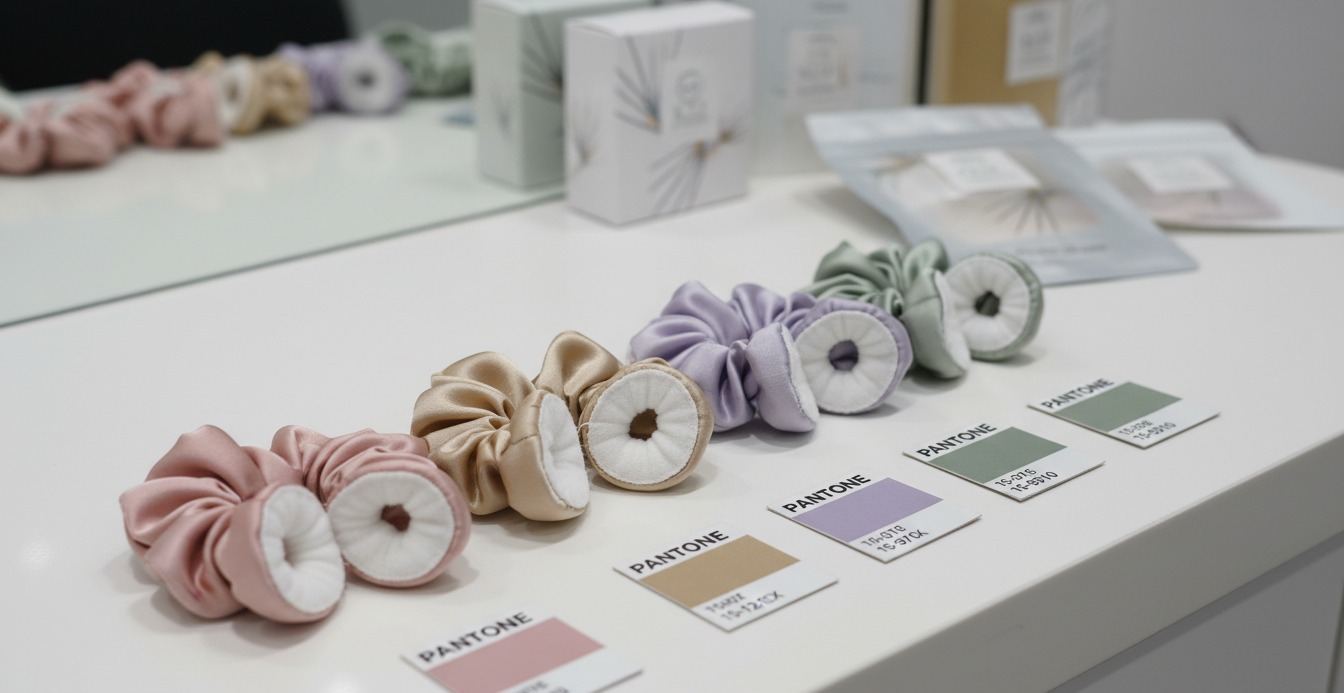
Color is where many OEM relationships break down. A salon distributor submits a swatch, receives a sample that looks close enough on screen, approves the production run, and then faces a container of scrunchies in a shade that is visibly off-brand. The solution is a disciplined color management process ndash and it starts with understanding what Delta E actually means for your program.
Delta E (dE) is the numerical measurement of color difference between a reference standard and a sample. The human eye generally cannot perceive color differences below a Delta E of 1.0. For professional textile matching, a ΔE below 1.5 is considered imperceptible, ΔE 1.5–3.0 is noticeable under close inspection, and ΔE above 3.0 is visibly different. For salon branding purposes, specify Delta E≤ 1.5 for primary brand colors and≤ 2.5 for seasonal or fashion-forward shades where slight variation is acceptable.
The Pantone Matching System (PMS) provides the universal reference language for communicating color intent. When you submit a PMS number to a manufacturer, that reference defines the target color. Achieving the match requires iterative sampling: dye a lab dip (a small fabric sample), measure with a spectrophotometer against the Pantone standard, adjust dye formula, repeat. Expect 2–4 sampling rounds for new colors, each requiring 5–7 days. Building this sampling timeline into your procurement calendar is critical ndash rushing color matching is how you end up with unusable inventory.
The most reliable approach is requesting pre-production swatches with physical spectrophotometer readings, not digital approximations. Ask your supplier for a Delta E report alongside each swatch ndash any manufacturer serious about color accuracy will have this equipment. If they cannot provide ΔE measurements, that is a signal to find a different supplier. At Wonderful Textile, every custom color order includes a spectrophotometer report with the production sample.
For salon distributors, the practical color strategy is to build a core palette and a seasonal palette. Core colors ndash blacks, navies, champagnes, and blush pinks ndash should match Pantone references with dE≤ 1.5 and be kept in stock as ready-program colors with 300-piece MOQ. Seasonal collections ndash deep burgundies for fall, soft lavenders for spring ndash run on longer timelines with 500-piece MOQ and should be specified 90+ days before the season begins. This tiered approach keeps inventory manageable while giving salon clients the variety they need to merchandise effectively.
OEM Program Structures: Finding the Right Fit for Your Salon Distribution Model
OEM programs for silk scrunchies are not one-size-fits-all. The structure that works for a single-salon private label program is materially different from what a 50-state distributor needs. Understanding the three dominant program models ndash and knowing which matches your scale ndash is foundational to profitable sourcing.
Model 1: Ready-Made with Logo Overlay is the fastest path to market. The manufacturer holds stock in common colors (black, ivory, blush, navy, champagne), and branding is added through hang tags, care labels, or outer packaging. MOQs typically start at 50–100 pieces per color, and the program is operational within 3–4 weeks of order confirmation. The trade-off is limited customization ndash you are working within the manufacturer’s existing construction and color range. This model works best for salon distributors testing a scrunchie line before committing to full custom production.
Model 2: Custom Production Run is where you specify everything: silk grade, elastic construction, dimensions, color (with Pantone matching), and packaging. MOQs for this model typically start at 300–500 pieces per color per style. The lead time for a full custom run ndash from sample approval to production completion ndash is 30–45 days for the silk goods, plus 14–21 days for custom packaging. The advantage is complete control over the finished product and significantly better unit economics at scale.
Model 3: Full Private Label Program is the most comprehensive option, designed for established salon brands with defined retail presence. This model includes custom fabric development, custom elastic specification, Pantone-matched dyeing, private label packaging, and sometimes custom box design with brand photography. MOQs for full private label programs typically start at 1,000 units, with pricing that rewards volume commitment. This model is the right choice when scrunchies are a planned SKU with 2–3 year inventory horizons.
OEM Program Comparison
| Program Model | MOQ | Lead Time | Customization | Unit Cost |
|---|---|---|---|---|
| Ready-made + Logo | 50–100 pcs/color | 3–4 weeks | Hang tag / packaging only | DollarDollar |
| Custom Production | 300–500 pcs/color | 6–10 weeks | Full spec control | DollarDollarDollar |
| Full Private Label | 1,000+ units | 10–14 weeks | Complete customization | DollarDollarDollarDollar |
Private Label Packaging: The Details That Make Salon Retail Work
Packaging is not a secondary consideration ndash for salon retail, packaging is part of the product experience. Clients pick up a silk scrunchy in its packaging, feel the weight of the bag, read the tag, and form a brand impression before they even unfold it. In our 12 years supplying salon and hospitality partners globally, the quality of packaging consistently correlates with retail sell-through rates.
Hang tags remain the most cost-effective branding tool for scrunchie programs. Standard hang tags with a hole punch and cotton string cost USD 0.08–0.25 per unit at 1,000 quantities, depending on paper weight and print complexity. For salon programs, include three key elements: the salon or brand name, a one-line product benefit (“100% Mulberry Silk ndash Hair-Friendly Elastic”), and care instructions. Overbranding a hang tag diminishes the premium feel. Less, executed well, is more.
Cotton dust bags are the mid-tier packaging choice ndash a simple fabric pouch that protects the scrunchy in transit and becomes a reusable storage accessory for the client. Custom-printed cotton pouches range from USD 0.35–0.80 per unit at 1,000 quantities, depending on print method and bag size. A branded dust bag is one of those details that clients photograph and share, which has genuine value for organic social reach.
Frosted sealable pouches ndash typically made from polyethylene with a soft-touch finish ndash offer a more contemporary retail aesthetic. They are waterproof, resealable, and present well on display counters. Pricing runs USD 0.25–0.60 per unit at volume. The practical advantage of frosted pouches is that they function as both shipping packaging and retail display packaging, eliminating a separate repack step.
Custom boxes are the premium packaging tier and the right choice for gifting programs, luxury salon lines, or hotel amenity kits. A folded carton with brand photography, embossing, and a magnetic closure creates an unboxing moment that clients remember. Custom box MOQs typically start at 500–1,000 units, with tooling costs of USD 300–800 depending on box complexity. Unit costs for premium boxes range from USD 1.00–3.50 per unit depending on materials, but the retail presentation justifies this at USD 15–30 scrunchie price points.
Woven labels and tagless care labels are often overlooked but matter for brand credibility. A woven label with the salon or brand name sewn into the scrunchy seam signals professional-grade quality. Woven label setup runs USD 150–400 per design, with per-unit costs of USD 0.05–0.15 depending on label size and fiber content.
Certifications That Unlock International Salon Markets
If you are distributing silk scrunchies internationally, certifications are not optional ndash they are the entry ticket to regulated markets. I have seen beautifully sourced scrunchies rejected at customs because the documentation was incomplete, and the cost of that rejection (storage fees, re-documentation, delayed retail launches) far exceeds the cost of getting certifications right from the start.
OEKO-TEX Standard 100 is the baseline certification for textile products sold in EU and North American markets. It tests for harmful substances across the entire finished product ndash including the elastic, dyes, threads, and any metallic components. OEKO-TEX certification is valid for 12 months and must be renewed annually, with the testing cost running USD 800–2,500 depending on the certification body and product complexity. For salon distributors, this certification is non-negotiable for any product touching client hair.
GOTS (Global Organic Textile Standard) certification is relevant if you are marketing silk scrunchies as organic or natural. GOTS certified silk must come from verified organic mulberry farms, and the manufacturing process must meet environmental and social criteria. The premium for GOTS-certified silk is typically 15–25 percent above conventional mulberry silk, and the certification process takes 3–6 months. Only pursue this if your salon clients specifically seek organic products.
REACH compliance is the EU regulation governing chemical substances in products. If you are selling into European markets, your silk scrunchies must comply with REACH restrictions on specific dye chemicals, finishing agents, and elastic compounds. Your manufacturer should have a REACH compliance declaration ndash if they cannot provide one, the risk of customs rejection is real. North American markets have analogous regulations (CPSIA in the US).
Landed Cost Arithmetic: What Your PandL Actually Looks Like
Unit price is only part of the landed cost equation. For OEM silk scrunchie programs, the fully loaded cost to get product on your warehouse shelf includes multiple line items that surprise first-time buyers. Understanding landed cost structure before you negotiate is the difference between a margin that looks good on the quote and a margin that holds in your PandL.
FOB unit price covers the manufacturing cost: silk fabric, elastic, assembly, and basic packaging. At 1,000 units in 22mm silk with standard packaging, expect FOB pricing of USD 2.80–4.50 per unit depending on elastic construction, color count, and packaging tier. It is typically 55–70 percent of your total landed cost.
Sample and tooling costs are often invisible until they appear on an invoice. Custom color development (Pantone matching), elastic specification samples, and packaging prototypes collectively run USD 400–2,500 depending on program complexity. These costs are amortized across the first order, so factor them into your per-unit cost for orders under 2,000 units.
Freight and shipping from China to major ports runs USD 0.60–1.80 per kilogram for sea freight, with scrunchies typically packing at 30–50 grams per unit. At 1,000 units, total shipping weight is 30–50 kg, adding USD 18–90 to the total invoice. Air freight, when needed for urgent reorders, runs 5–8times sea rates and should be reserved for fill-in orders only.
Customs duties vary by destination country. US imports of silk hair accessories typically face a duty rate of 6.6–8.9 percent under HTS code 9619.00.40. EU destinations face similar textile category rates. Including duties in your landed cost calculation early prevents margin surprises at customs clearance.
Last-mile delivery from the arrival port to your warehouse adds USD 0.15–0.50 per unit depending on location, carrier, and shipment volume. At scale, LTL (less-than-truckload) contracts negotiated annually deliver significant per-unit savings over spot rates. The total landed cost at 1,000 units with standard packaging typically lands at USD 3.20–5.50 per unit depending on destination.
How to Qualify a Silk Scrunchie Supplier Without Getting Burned
I have watched too many salon distributors enter OEM partnerships poorly prepared and exit with inventory they cannot sell and relationships they cannot repair. Supplier qualification is not a formality ndash it is the risk management step that determines whether your first order lands as a product you are proud of or a lesson you paid for.
Start with a sample order before a production order. Any serious manufacturer will produce a pre-production sample for your review. Examine the silk handfeel, test the elastic tension (it should expand to 2.5times its relaxed diameter without deforming), wash the sample three times and check for fraying, and inspect color consistency against your reference swatch. If the sample disappoints you, the container will be worse. Silk processing variables compound across bulk runs; what you see in 10 pieces, you will see in 10,000.
Request factory audit reports. Third-party inspection agencies (SGS, Bureau Veritas, Intertek) conduct social compliance and quality audits for USD 200–500 per day. An audit report tells you whether the factory has functioning quality control systems, adequate equipment, and trained personnel. A factory that refuses an audit is a factory that has something to hide. In 12 years of silk sourcing, I have never found an exception to this rule.
Verify their OEKO-TEX certification scope. Request a copy of the certificate and confirm the manufacturing facility is listed on the certificate. OEKO-TEX certificates are facility-specific, not company-wide. If the certificate does not list the specific address where your scrunchies will be produced, the certification is worthless for your purposes.
Negotiate payment terms that protect both parties. Standard practice for first orders is 30percent deposit, 70percent balance before shipment. Be wary of suppliers who demand 100percent prepayment. Established manufacturers with track records accept progressive payment structures because they are confident in their delivery. For long-term partnerships, aim to negotiate net-30 or net-45 terms on the balance after establishing trust.
Agree on a written quality specification before tooling. The specification should include silk grade and momme weight, elastic type and width, dimensions (diameter when flat and relaxed), Pantone color references with Delta E tolerance, packaging specifications, and defect tolerance rate. A written spec is your primary legal protection if a shipment arrives non-conforming.
Frequently Asked Questions
What is hair-friendly elastic in silk scrunchies?
Hair-friendly elastic is a specialized inner band designed to hold silk scrunchies securely without pulling, tugging, or breaking hair strands. Unlike standard elastic that creates friction and damage, quality hair-friendly elastic reduces grip by up to 40 percent, preserving hair integrity throughout the day.
Why is Pantone color matching important for salon-brand silk scrunchies?
Pantone color matching ensures brand consistency across all scrunchie shades, allowing salon distributors to maintain visual identity whether they stock neutrals, fashion-forward hues, or seasonal collections. The standard Delta E tolerance is below 1.5 for perfect replication.
What is the minimum order quantity for silk scrunchie OEM programs?
Most OEM programs start at 300–500 pieces per color per style. For full private label packaging customization, MOQs typically begin at 500–1,000 units. Seasonal or limited-collection runs often start at 150–200 pieces per color with longer lead times.
How does silk grade affect scrunchie quality and pricing?
Silk is graded by momme (mm) weight: 19mm is standard for scrunchies, 22mm offers a denser luxurious handfeel, and 30mm is premium for luxury lines. Higher momme silk resists pilling longer, maintains color vibrancy through 50+ washes, and commands 20–40 percent higher wholesale margins.
What packaging options are available for private label salon scrunchies?
Private label options include hang tags with salon branding, custom logo labels, printed cotton dust bags, frosted sealable pouches, and full custom box design. Materials range from recycled cardboard to velvet pouches. Lead times for custom packaging average 14–21 days beyond production.
What certifications do silk scrunchies need for international salon distribution?
Key certifications include OEKO-TEX Standard 100 for chemical safety, GOTS for organic silk, and ISO 9001 for quality management. EU and North American markets require REACH compliance for dye chemicals.
How do I calculate landed costs for bulk silk scrunchie orders?
Landed cost equals unit price plus packaging cost plus shipping plus customs duties plus last-mile delivery. At 1,000 units with standard packaging, expect FOB prices of USD 2.80–4.50 per unit depending on silk grade, with shipping adding 8–15 percent depending on destination and incoterm.
What is the typical production lead time for silk scrunchie OEM orders?
Standard production takes 20–35 days from sample approval. Add 7–10 days for custom Pantone dyeing, 14–21 days for custom packaging, and 5–10 days for shipping. Planning 60–75 days total from order confirmation to door delivery is recommended for international orders.
About the Author
Echo Xu is the International Business Director at Wonderful Silk, based in Shengzhou, Zhejiang mdash the heart of China&’s mulberry silk industry. With 12 years of experience in silk trade and B2B procurement, she has managed supply partnerships with hospitality chains, retail brands, and distributors across 30+ countries.
Explore our product range: Silk Scrunchies and Hair Accessories | www.cnwonderfultextile.com
Copyright 2026 Wonderful Textile. All rights reserved.
Post time: Jun-01-2026