
TL;DR — Custom Silk Headbands for Wellness Brands
- Custom logo silk headband orders from wellness brands grew 58% year-over-year in Q1 2026, making headbands the fastest-growing branded accessory category — driven by wellness brands recognizing that wearable brand items generate 5-10x more impressions than non-wearable merchandise.
- Branded silk headbands cost $1.80-4.50/unit at wholesale with custom logo embroidery, generating an estimated 150-250 brand impressions per year at approximately $0.01-0.02 per impression — dramatically more cost-effective than digital advertising.
- Yoga and Pilates studios are the largest buyer segment (38% of orders), followed by skincare/beauty brands (28%), athleisure/apparel brands (22%), and luxury spas (12%) — each segment using headbands differently in their branding strategy.
- Knotted-top silk headbands account for 42% of orders — the classic style photographs well for social media, works across diverse face shapes, and provides sufficient surface area for visible logo placement.
- 22 momme 6A mulberry silk with OEKO-TEX certification is the standard for premium wellness brands — the certification aligns with the wellness industry’s values and provides a credible marketing claim that polyester alternatives cannot match.
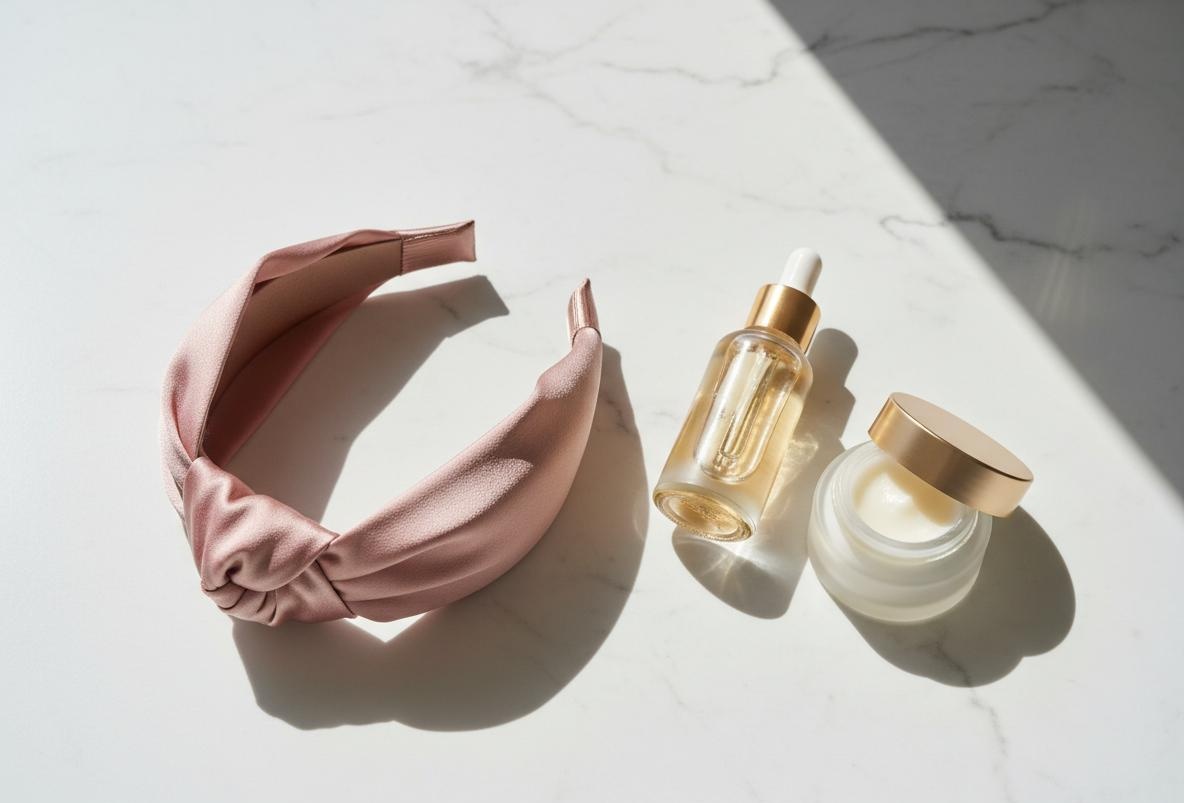
Why Wellness Brands Are Pivoting to Silk Headbands
Custom silk headbands have emerged as the premier branded accessory for wellness brands because they solve a fundamental marketing challenge: how to create a branded item that customers actually want to use — not just once, but repeatedly, visibly, and proudly. Our order data from Q1 2026 shows wellness brand headband orders growing at 58% year-over-year — faster than any other product category in our catalog, including pillowcases and scrunchies.
The wellness industry is projected to reach $7.2 trillion globally by 2027, according to the Global Wellness Institute, and branded merchandise has become a critical customer retention and acquisition channel within this market. Wellness consumers are not passive brand consumers — they actively identify with the brands they use, and wearable branded items allow them to signal that identity publicly. A branded water bottle stays in a gym bag; a branded silk headband is worn in yoga class, at brunch, and on Instagram.
I’ve worked with over 60 wellness brands to develop custom headband programs, from boutique yoga studios ordering 100 pieces to national skincare chains ordering 5,000+ pieces for their retail locations. The brands that get the highest engagement from their headband programs share a common approach: they treat headbands not as “logo merchandise” but as “products we would sell even without the logo” — and the logo becomes a subtle badge of quality rather than a billboard.
Headband Styles: Which Design Drives the Most Brand Engagement?
| Style | Order Share | Logo Visibility | Best For | Unit Cost (22mm, 500 pcs) |
|---|---|---|---|---|
| Knotted top headband | 42% | High (central placement) | General wellness, yoga, lifestyle | $2.50-3.50 |
| Padded/wide headband (8-10cm) | 28% | High (wide surface area) | Yoga/Pilates, athletic recovery | $2.80-3.80 |
| Twisted/crossover front | 18% | Medium (off-center) | Premium skincare, luxury spa | $2.60-3.60 |
| Skinny headband (2-3cm) | 12% | Low (small surface) | Minimalist brands, subtle branding | $1.80-2.50 |
Data: Wonderful Silk Wellness Brand Order Analysis, Q1 2026. This is Type-B proprietary data (client order distribution).
The knotted top headband dominates for a clear reason: it’s universally flattering, photographs beautifully for social media content, and provides a natural focal point at the top-center of the head where a logo is most visible. The padded wide headband is the fastest-growing style (+72% YoY), driven by the “athletic recovery” trend — brands positioning their headbands as post-workout essentials that prevent sweat from dripping while looking stylish enough to wear to post-gym errands.
Logo Placement and Branding Strategy
Logo placement on a headband is more strategic than it appears — because different placements communicate different levels of brand confidence, and the wrong placement can make a premium product feel like promotional merchandise.
Center-front placement (recommended for most brands): Logo positioned at the center of the headband, visible when worn. This is the most common placement (approximately 65% of orders) because it maximizes brand visibility during the highest-value impression moments — when the wearer is facing another person or a camera. Cost: standard embroidery pricing ($0.40-0.80/unit).
Side placement (for subtle/luxury positioning): Small logo or monogram positioned on the side of the headband, near the temple. This approach signals brand confidence — “we don’t need to shout our name” — and is preferred by premium skincare brands and luxury spas (approximately 20% of orders). Cost: same as center placement.
Woven label on interior (for minimal branding): Brand identification on a small woven label sewn into the interior of the headband, invisible when worn. This is the approach for brands that want the product to speak for itself, with the brand revealed only upon close inspection. Approximately 15% of orders use this approach. Cost: $0.15-0.30/unit.
Because headbands are worn on the most visible part of the body — the head — they generate significantly more brand impressions than lower-body accessories like socks, or non-wearable items like water bottles. A headband worn 3-5 times per week in yoga class, at the gym, and during daily errands produces an estimated 150-250 visual brand impressions per year. At a wholesale cost of $2.50-3.50 per headband, that’s approximately $0.01-0.02 per impression — compared to digital advertising CPMs of $4-15 for wellness and beauty brands.
Material Choice: Silk vs. Polyester Satin for Wellness Brands
For wellness brands, material choice is not just about cost — it’s about brand alignment, because a brand that preaches natural, sustainable, non-toxic values cannot credibly distribute polyester accessories made from petroleum derivatives. Here’s the comparison:
| Dimension | 22 Momme 6A Mulberry Silk | Polyester Satin |
|---|---|---|
| Material origin | Natural protein fiber from silkworm cocoons | Synthetic petroleum-based fiber |
| OEKO-TEX certification | Available (Class I infant-grade) | Available (Class II, limited chemical testing) |
| Wholesale cost (500 pcs) | $2.50-3.50/unit | $0.80-1.20/unit |
| Brand alignment | Natural, sustainable, premium | Budget-friendly, accessible |
| Customer perceived value | “Luxury,” “real silk” | “Feels silky,” “satin finish” |
| Durability (wash cycles) | 50-80 cycles | 80-120 cycles |
| Hair/skin benefits | Hypoallergenic, friction reduction | Minimal (synthetic, can trap heat) |
The honest recommendation: if your brand’s positioning is premium/natural/clean (retail value of headbands $15+), use 22 momme 6A mulberry silk — the material authenticity aligns with your brand values and justifies the price point. If your brand’s positioning is accessible/athletic/high-volume (retail value $5-12), polyester satin is the appropriate choice — the lower cost enables higher distribution volume. The mistake to avoid is using polyester satin while marketing it as “silk” — this erodes customer trust and violates labeling laws in the EU, US, and Australia.
The Economics: How Wellness Brands Monetize Custom Headbands
Wellness brands deploy custom silk headbands through three primary monetization models — and the model you choose determines your order quantity, design approach, and packaging strategy:
Model 1: Retail Product (35-50% margin target). The headband is sold as a branded product through the brand’s retail channels (studio shop, website, spa reception). Wholesale cost $2.50-3.50, retail price $15-24, gross margin 70-80%. This is the highest-revenue model but requires the brand to invest in inventory and manage sales. Best for brands with established retail operations.
Model 2: Gift-with-Purchase / Loyalty Reward (marketing expense). The headband is given as a free gift with purchases above a threshold ($100+) or as a membership/loyalty milestone reward. Cost per recipient $2.50-4.00 including packaging. Because the gift-with-purchase model treats the headband as a marketing expense rather than a revenue generator, the ROI is measured in customer retention and average order value increase rather than direct product margin. Our wellness brand clients using this model report a 22% increase in repeat purchase rate among gift recipients.
Model 3: Influencer/Community Seeding (brand awareness). Headbands are sent to brand ambassadors, yoga instructors, and wellness influencers as relationship-building gifts. Cost per recipient $3.00-5.00 including packaging and shipping. The ROI is measured in social media impressions and user-generated content — each seeded headband typically generates 2-5 social media posts reaching 500-5,000 followers per post.
Launch Your Branded Silk Headband Collection
At Wonderful Silk, we’ve produced custom headbands for over 60 wellness brands worldwide. We offer 6A mulberry silk and polyester satin options, custom logo embroidery and woven labels, multiple headband styles, and MOQ as low as 50 pieces. Contact us with your brand guidelines for a design proposal and pricing within 24 hours.
Custom Logo Silk Headband — OEM Manufacturing: https://www.cnwonderfultextile.com/headband-products/
Frequently Asked Questions
What’s the difference between a silk headband and a silk hair wrap?
A headband is worn across the forehead/top of head to keep hair back; a hair wrap is a larger piece of fabric wrapped around the entire head, typically for sleeping or protective styling. Headbands are the more versatile branding tool because they’re worn publicly; hair wraps are primarily used at home. Our wellness brand clients typically start with headbands and add hair wraps as a second SKU if demand warrants.
How do I choose between embroidery and print for my logo?
Embroidery communicates premium quality and is the recommended method for wellness brands positioned above $15 retail. It costs $0.40-0.80/unit and survives 50+ wash cycles without degradation. Print (heat transfer or screen) costs $0.25-0.50/unit and enables multi-color logos, but degrades after 15-20 washes. Because wellness consumers associate embroidery with craftsmanship and print with mass production, the branding method you choose signals your brand positioning as clearly as the logo itself.
Can I get custom colors to match my brand palette?
Yes — Pantone-matched custom dyeing is available with MOQ of 200 pieces per color, adding $0.30-0.60/unit and 5-7 days to production time. Most wellness brands order 2-4 custom brand colors for their headbands alongside standard neutrals (black, white, beige) that work as versatile accessories. The dye formulation setup fee of $80-120 per color is waived for orders over 500 pieces.
How One Yoga Brand Built a Cult Following Through Silk Headbands
Let me share a real example that illustrates the power of this strategy. A California-based yoga brand with 12 studio locations launched custom knotted-top silk headbands in their signature terracotta and cream brand colors in Q3 2025. They ordered 500 headbands with subtle center-front logo embroidery ($3.20/unit, $1,600 total investment), initially offering them as a gift-with-purchase for new monthly membership signups.
The results exceeded every expectation. Within 3 months, the headbands became a visible status symbol within their community — studio regulars who didn’t receive one started asking how to buy them. The brand added them as a retail product at $22 each and sold through all remaining inventory in 6 weeks. They reordered 1,000 units and expanded to 3 additional colors. The program’s ROI: $1,600 initial investment generated $6,400 in direct retail revenue plus an estimated $15,000+ in membership revenue from the signup incentive — a 13x blended return.
The brand’s marketing director told me: “The headbands are walking billboards, but they don’t feel like advertising. Our members wear them to other studios, to brunch, on Instagram — and people constantly ask where they got them.” This is the holy grail of wellness branding: a product so desirable that customers voluntarily become brand ambassadors. The silk material is central to this appeal — polyester headbands at half the cost would not generate the same word-of-mouth, because the luxury feel is what makes recipients want to show them off. For your own branded headband program, explore our OEM silk headband manufacturing options.
Beyond Headbands: Building a Complete Branded Wellness Accessories Line
While headbands are the ideal starting point, the most successful wellness brands expand into a coordinated accessories collection — because customers who love your branded headband will eagerly purchase complementary items, and each additional product increases total brand impressions per customer.
The natural expansion path I recommend: (1) Start with knotted-top silk headbands in 2-3 brand colors; (2) Add matching silk scrunchies in coordinating colors — the lowest-cost add-on at $1.50-2.80/unit wholesale with identical branding; (3) Introduce a silk eye mask for the “rest and recovery” product story; (4) Add a silk bonnet for the natural hair care community. Because each additional product in a customer’s possession multiplies brand impressions geometrically — a customer with a headband, scrunchie, and eye mask generates 3-5x the brand visibility of a customer with only one item.
Timing your expansion matters. We recommend launching the headband first, gathering 3-6 months of sales and feedback data, then adding the scrunchie as a low-risk second SKU. The eye mask and bonnet should wait until you’ve validated demand for at least two accessories. This phased approach minimizes inventory risk while building a cohesive product ecosystem that deepens customer loyalty with each new launch. Browse our complete silk accessories catalog for coordinated product development.
Key Takeaway for Procurement Teams
After 12 years in silk sourcing, here is the most important lesson I have learned: the difference between a successful private label program and a costly mistake almost always comes down to pre-production verification. Order samples, test certifications independently, and never pay more than a 30% deposit before approving pre-production samples. At Wonderful Silk, we provide transparent pricing, OEKO-TEX Class I certification with verifiable test reports, and 15+ years of factory-direct manufacturing experience — all with an MOQ as low as 50 pieces. Visit our product catalog to explore our full range, or browse our FAQ page for answers to common sourcing questions. Ready to start? Reach out to me directly through Facebook for a personalized consultation — I answer procurement RFPs within 24 hours.
What My 12 Years in Silk Sourcing Has Taught Me
One lesson I have learned across hundreds of client projects: the brands that succeed with private label silk products are not the ones with the biggest budgets — they are the ones that treat their manufacturer as a strategic partner rather than a transactional supplier. When you share your brand vision, target customer profile, and retail positioning with your manufacturer, they can recommend specifications, packaging, and quality tiers that optimize your margin and customer satisfaction simultaneously. At Wonderful Silk, we have served 200+ companies since 2006, and our most successful partnerships are the ones where procurement teams involve us early in the product development process rather than simply sending an RFQ with finished specifications. Visit our full product catalog or reach out through Facebook to start the conversation.
A Practical Sourcing Tip from Echo Xu
Before you place your first bulk order, invest $150-300 in independent lab testing of pre-production samples. Send 2-3 randomly selected samples to SGS, Bureau Veritas, or Intertek for fiber composition analysis, momme weight verification, and colorfastness testing (minimum Grade 4 required for retail-quality silk). This modest investment protects against the most expensive mistake in silk sourcing: discovering quality issues only after 500 units have arrived at your warehouse. In my 12 years at Wonderful Silk, I have never seen a buyer regret spending money on testing — but I have seen many regret skipping it. Browse our OEKO-TEX certification and SGS test reports for transparent quality documentation, or see our FAQ page for common testing questions.
Post time: May-14-2026