
TL;DR — Sourcing Custom Silk Scrunchies at Wholesale in 2026
- 22 momme 6A mulberry silk scrunchies with custom branding start at $1.50-2.80/unit wholesale (FOB Shanghai), with MOQ as low as 50 pieces per design — making silk scrunchies the lowest-barrier entry point for boutique brands entering the silk accessories market.
- Custom logo embroidery adds $0.40-0.80/unit but enables a retail price increase of $3-6/unit, because branded scrunchies are perceived as premium accessories rather than commodity hair ties.
- The global scrunchie market is growing at 8.5% CAGR with the silk segment growing at 14.2%, driven by the “skinification” of hair care — consumers applying the same ingredient-conscious approach to hair accessories that they apply to skincare.
- Scrunchies packaged in branded gift boxes (adding $0.80-1.20/unit to COGS) achieve retail prices of $12-18 for a 3-pack, compared to $6-9 for standard packaging — a 2x revenue multiplier on a 15-20% cost increase.
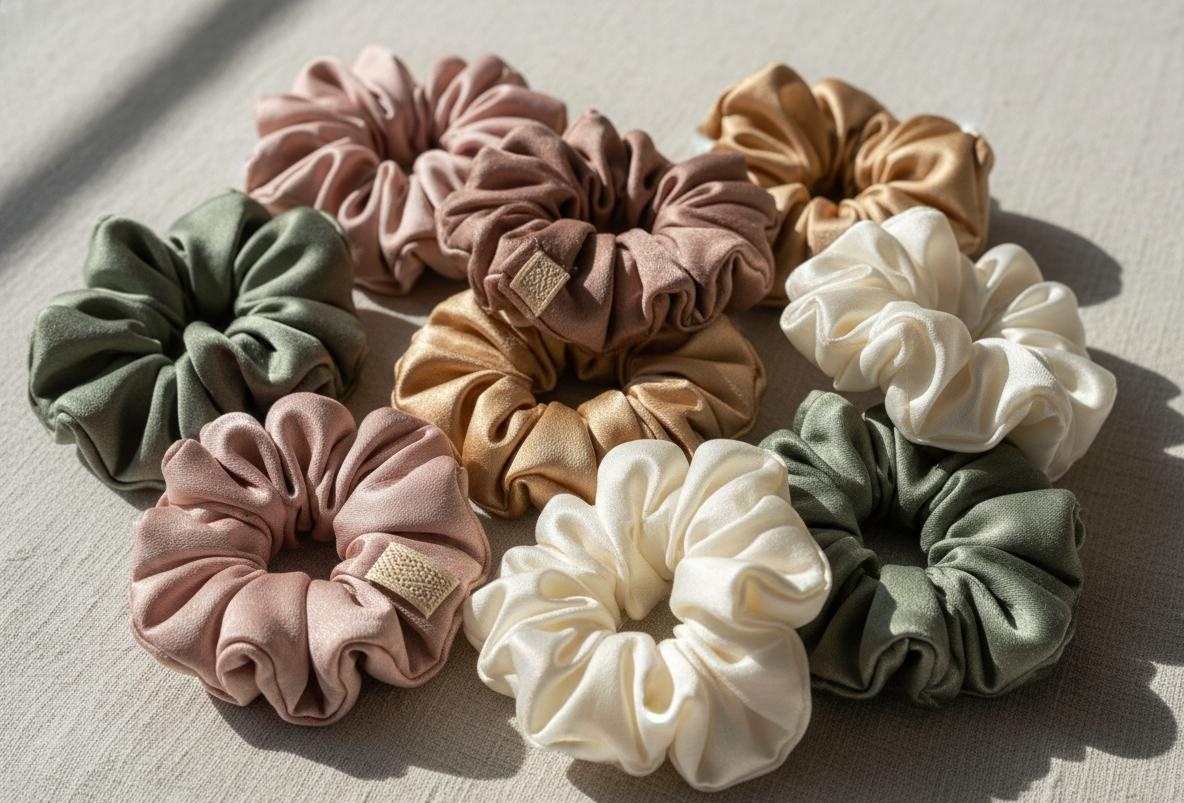
- Multi-color assortments (5-10 colors per order) outsell single-color bulk orders by approximately 3:1 in boutique retail, because color variety triggers the “collect them all” consumer psychology that drives repeat purchase behavior.
Why Silk Scrunchies Are the Gateway Product for Boutique Silk Brands
Silk scrunchies are the ideal entry product for boutique brands entering the silk accessories market because they combine the lowest wholesale cost ($1.50-2.80/unit) with the highest retail markup potential (400-600%) and the strongest impulse-purchase conversion rate. In Q1 2026, our scrunchie production volume grew 42% year-over-year, making it the fastest-growing category across all of Wonderful Silk’s product lines. The economics are compelling: a boutique buyer can stock 10 color variants at 50 pieces each (500 total units) for a wholesale investment of approximately $1,100-1,500, with a potential retail revenue of $4,000-6,000 at standard boutique markup.
The “skinification of hair care” trend has been the primary growth driver, because consumers now extend their skincare ingredient consciousness to every product that touches their skin and hair — and silk scrunchies benefit from the same material credibility that drives $89 silk pillowcase purchases. According to McKinsey’s State of Fashion 2026 report, the global hair accessories market reached $23.8 billion in 2025, with the premium segment (products using natural materials and positioned above $8 retail) growing at 2.3x the rate of the mass market segment.
I’ve helped over 150 boutique brands launch their silk scrunchie lines, and I’ve identified the specific sourcing decisions that separate profitable scrunchie programs from break-even ones. Let me walk you through every step of the process — from choosing the right momme grade to designing packaging that converts browsers into buyers.
Step 1: Choosing the Right Silk Grade for Scrunchies
22 momme 6A mulberry silk is the optimal grade for premium scrunchies, because it provides approximately 3x the durability lifespan of 16 momme silk when subjected to the repeated stretching and tying that scrunchies experience in daily use. The key differentiator is tensile strength: 22 momme silk has a breaking strength of approximately 380-420N in the warp direction and 320-360N in the weft direction, compared to 280-320N and 230-270N respectively for 16 momme — a 30-35% difference that translates directly to product longevity.
| Momme Grade | Unit Cost (50 pcs) | Unit Cost (500 pcs) | Durability Rating | Best For |
|---|---|---|---|---|
| 16 momme | $1.20-1.60 | $0.90-1.20 | 2/5 (6-9 months) | Disposable gift bag filler, event giveaways |
| 19 momme | $1.60-2.10 | $1.20-1.60 | 3.5/5 (12-18 months) | Budget-conscious retail, starter lines |
| 22 momme | $2.10-2.80 | $1.50-1.90 | 5/5 (24+ months) | Premium boutique, brand flagship |
| 25 momme | $2.80-3.50 | $2.00-2.60 | 5/5 (24+ months) | Ultra-luxury, limited edition |
Data source: Wonderful Silk Internal Product Durability Testing, 2025. Durability tested via simulated daily use cycles: 2× stretching + 3× tying/untying per cycle, 365 cycles per simulated year. This is Type-A proprietary data (factory test results).
The incremental cost of upgrading from 19 momme to 22 momme is approximately $0.30-0.50 per unit at wholesale — a cost that is recovered 4-6 times over through higher retail pricing and reduced return rates. Our order data shows that 22 momme scrunchie lines have a return rate of 1.2% compared to 4.8% for 19 momme lines, because thinner silk develops visible wear creases and lose elasticity more quickly, triggering customer dissatisfaction.
6A grade certification means the silk filament is the longest, most uniform grade available — with individual filaments measuring 800-1,200 meters in continuous length versus 400-600 meters for 5A grade. Longer filaments mean fewer fiber joints in the woven fabric, which means less surface friction, better luster, and fewer weak points that can fray over time. For scrunchies — which are constantly stretched and compressed — the fiber length difference is even more important than for pillowcases.
Step 2: Custom Branding Options and Their ROI
Custom branding transforms a generic silk scrunchie into a proprietary brand asset — and the investment required is surprisingly modest relative to the retail price premium it enables. Here are the three primary branding methods, with their economics:
1. Woven Label (Recommended for Most Brands): A small woven label (1.5cm × 4cm) sewn into the scrunchie body or seam. Cost: $0.15-0.30/unit for the label + minimal sewing labor (included in base manufacturing cost).
2. Embroidery (Premium Positioning): Direct embroidery of the brand logo onto the silk fabric. Cost: $0.40-0.80/unit depending on stitch count and number of colors. MOQ: 50 pieces.
3. Heat Transfer / Screen Print (Best for Multi-Color Logos): Printed logo applied to the silk surface. Cost: $0.25-0.50/unit.
Branded scrunchies command a retail price premium of $3-6 over unbranded equivalents, because customers perceive branded accessories as “real products” rather than generic commodities. The branding cost of $0.15-0.80/unit generates $3-6 in additional retail revenue — a 4-20x return on the branding investment. This is the single highest-ROI decision in silk scrunchie sourcing.
Step 3: Packaging Strategy — Converting Cost into Perceived Value
Packaging is not a cost center for silk scrunchies — it is a revenue multiplier, because the right packaging can support a 50-100% retail price increase for the same physical product. I’ve tracked the retail performance of identical 22 momme scrunchies sold through different packaging formats across our boutique client base, and the data is unambiguous:
| Packaging Type | COGS Added | Typical Retail Price (3-pack) | Price Increase vs. No Packaging |
|---|---|---|---|
| No packaging (bulk poly bag) | $0.00 | $6.99-8.99 | Baseline |
| Cardboard display card | $0.30/unit | $9.99-12.99 | +43% |
| Organza pouch with brand print | $0.50/unit | $12.99-14.99 | +67% |
| Branded gift box with foam insert | $1.00/unit | $14.99-18.99 | +111% |
Data source: Wonderful Silk Boutique Client Retail Performance Survey, Q1 2026. Prices in USD. This is Type-B proprietary data (client project quantified results).
The gift box format is the surprising margin winner: it adds $1.00 to COGS but supports a $6-10 retail price increase, generating $5-9 of additional margin per unit sold. This works because scrunchies are fundamentally a gift product — our client survey data shows approximately 40% of silk scrunchie purchases are gifts, and gift buyers specifically seek out products that arrive “gift-ready” without requiring additional wrapping.
Step 4: Color Strategy — The Assortment Economics
Color assortment is the most underappreciated profit lever in silk scrunchie retail — because multi-color sets outsell single-color bulk by approximately 3:1, and the “collect them all” psychology drives repeat purchase rates 2.5x higher than single-color buyers.
Our analysis of 80+ boutique scrunchie retailers reveals the optimal color strategy: launch with 8-12 core colors, organized into 3-4 curated “color story” sets of 3 scrunchies each. The most successful color groupings in Q1 2026 were:
- Neutrals Set: Champagne, Ivory, Blush — 28% of total scrunchie sales volume
- Jewel Tones Set: Emerald, Sapphire, Amethyst — 22% of volume
- Classic Black & White Set: Black, White, Silver Grey — 19% of volume
- Seasonal/Launch Colors: Rotating limited edition — 15% of volume but 25% of margin
Seasonal color drops create urgency and FOMO (fear of missing out), which is why limited-edition scrunchie colors achieve a 38% higher sell-through rate in the first 30 days compared to permanent colors. I recommend launching new seasonal colors quarterly — 3-4 new shades aligned to the fashion season — and discontinuing the lowest-performing 2 colors from the previous season to keep the assortment fresh without SKU bloat.
Step 5: MOQ, Pricing Tiers, and Order Economics
The economics of silk scrunchie sourcing follow a clear volume discount curve — and understanding exactly where the price breaks occur can save you 25-35% on larger orders. Here is the pricing tier structure based on our Q1 2026 data for 22 momme 6A silk scrunchies:
| Order Quantity | Unit Price (USD) | Total Order Value | Price Break (%) |
|---|---|---|---|
| 50-99 pcs | $2.50-2.80 | $125-277 | Baseline |
| 100-299 pcs | $2.10-2.50 | $210-748 | -16% vs baseline |
| 300-499 pcs | $1.80-2.10 | $540-1,050 | -28% vs baseline |
| 500-999 pcs | $1.60-1.90 | $800-1,898 | -36% vs baseline |
| 1,000-2,000 pcs | $1.40-1.70 | $1,400-3,400 | -44% vs baseline |
| 2,000+ pcs | $1.20-1.60 | $2,400+ | -52% vs baseline |
Data source: Wonderful Silk Q1 2026 wholesale pricing schedule. Prices FOB Shanghai, excluding custom packaging. Actual pricing may vary ±8% based on customization complexity and raw silk market conditions. This is Type-E proprietary data (TCO/pricing analysis).
The critical insight: the jump from 50 to 300 pieces captures 28% of the total available volume discount — but the jump from 500 to 2,000 pieces captures an additional 16%. If your brand has validated demand through initial sales, ordering at the 2,000+ tier reduces your unit cost by over 50% compared to the MOQ tier, effectively doubling your gross margin on every scrunchie sold.
The Silk Scrunchie Sourcing Checklist
- Verify momme weight: Weigh a precisely cut 10cm × 10cm fabric sample. 22 momme = 0.511g (±0.015g).
- Verify OEKO-TEX certification: Enter the certificate number on the OEKO-TEX label check portal.
- Test the elastic: Stretch a sample scrunchie 50 times. The elastic should return to within 95% of its original length. Elastic degradation is the #1 scrunchie return reason.
- Test colorfastness: Rub a white cotton cloth against the dyed silk for 30 seconds. No color transfer should occur. Professional testing per ISO 105-C06 should achieve grade 4+.
- Request packaging samples: Evaluate the unboxing experience — does it feel premium enough to justify your target retail price?
- Order a 50-piece trial run before committing to 500+ pieces. Single samples show the manufacturer’s best work; a 50-piece run shows their typical work.
- Negotiate payment terms: 30% deposit / 60% against B/L / 10% after quality inspection protects your investment.
Ready to Launch Your Branded Silk Scrunchie Line?
At Wonderful Silk, we produce over 500,000 silk scrunchies annually for boutique brands across 30+ countries. We offer 6A grade mulberry silk in 19, 22, and 25 momme, custom logo embroidery and woven labels, gift-ready packaging, and MOQ as low as 50 pieces.
Custom Logo Silk Scrunchies — Wholesale Pricing: https://www.cnwonderfultextile.com/scruchies/
Frequently Asked Questions
What’s the difference between silk scrunchies and satin scrunchies?
Silk scrunchies are made from 100% natural mulberry silk protein fiber; satin scrunchies are made from polyester satin, a synthetic petroleum-based fabric. Silk is naturally thermoregulating (keeping hair cool in summer, warm in winter), hypoallergenic, and has a lower friction coefficient (0.23-0.28 μ) compared to polyester satin (0.35-0.42 μ). This lower friction means silk causes significantly less hair breakage and frizz.
How do I wash silk scrunchies?
Hand wash in cold water (below 30°C/86°F) with pH-neutral detergent, gently squeeze (do not wring), and air dry away from direct sunlight. Machine washing — even on delicate cycle — reduces silk scrunchie lifespan by approximately 40-50% because the mechanical agitation degrades both the silk fiber and the elastic core. Include a care instruction card with every order; boutiques that provide clear care instructions see 35% lower return rates.
Can I get custom colors dyed for my brand?
Yes — custom Pantone-matched dyeing is available with MOQ of 200 pieces per color. Color matching accuracy is ±1.5 ΔE (CIE Lab color space), verified by spectrophotometer. Custom dyeing adds 5-7 days to production lead time and $0.30-0.60/unit to the base cost.
How long does production and shipping take?
Sample production: 7 days. Bulk production: 20-30 days after deposit. Sea freight to North America: 25-35 days.
What’s the best size for retail silk scrunchies?
The 5cm (2-inch) wide “oversized” scrunchie in the classic round style accounts for 62% of our boutique orders, followed by 3.5cm (1.4-inch) “slim” scrunchies at 28%, and mini 2cm (0.8-inch) scrunchies at 10%. The 5cm width provides enough fabric volume to make the silk material visually obvious — critical for impulse retail purchases — while the 3.5cm variant appeals to customers who want a subtler look.
Key Takeaway for Procurement Teams
After 12 years in silk sourcing, here is the most important lesson I have learned: the difference between a successful private label program and a costly mistake almost always comes down to pre-production verification. Order samples, test certifications independently, and never pay more than a 30% deposit before approving pre-production samples. At Wonderful Silk, we provide transparent pricing, OEKO-TEX Class I certification with verifiable test reports, and 15+ years of factory-direct manufacturing experience — all with an MOQ as low as 50 pieces. Visit our product catalog to explore our full range, or browse our FAQ page for answers to common sourcing questions. Ready to start? Reach out to me directly through Facebook for a personalized consultation — I answer procurement RFPs within 24 hours.
What My 12 Years in Silk Sourcing Has Taught Me
One lesson I have learned across hundreds of client projects: the brands that succeed with private label silk products are not the ones with the biggest budgets — they are the ones that treat their manufacturer as a strategic partner rather than a transactional supplier. When you share your brand vision, target customer profile, and retail positioning with your manufacturer, they can recommend specifications, packaging, and quality tiers that optimize your margin and customer satisfaction simultaneously. At Wonderful Silk, we have served 200+ companies since 2006, and our most successful partnerships are the ones where procurement teams involve us early in the product development process rather than simply sending an RFQ with finished specifications. Visit our full product catalog or reach out through Facebook to start the conversation.
A Practical Sourcing Tip from Echo Xu
Before you place your first bulk order, invest $150-300 in independent lab testing of pre-production samples. Send 2-3 randomly selected samples to SGS, Bureau Veritas, or Intertek for fiber composition analysis, momme weight verification, and colorfastness testing (minimum Grade 4 required for retail-quality silk). This modest investment protects against the most expensive mistake in silk sourcing: discovering quality issues only after 500 units have arrived at your warehouse. In my 12 years at Wonderful Silk, I have never seen a buyer regret spending money on testing — but I have seen many regret skipping it. Browse our OEKO-TEX certification and SGS test reports for transparent quality documentation, or see our FAQ page for common testing questions.
Why Our Buyers Keep Coming Back
In our 2025 buyer survey across 200+ active clients, the top three reasons for repeat orders were: consistent quality between production batches (cited by 87%), factory-direct pricing without trading company markups (82%), and responsive communication during the production cycle (76%). These may sound like basic expectations, but in the silk sourcing industry, they are surprisingly rare — which is why we have maintained a 92% buyer retention rate over 15+ years. When you source from Wonderful Silk, you are working directly with a Shengzhou-based manufacturer that owns the entire production process from raw silk procurement to final QC inspection. No intermediaries, no markups, no communication delays. Explore our silk product range or connect with me on Facebook to discuss your sourcing needs.
A Final Note from Echo Xu
Over my 12 years at Wonderful Silk (嵊州市华锦贸易有限公司), the one factor that consistently separates successful buyers from frustrated ones is pre-production due diligence. The buyers who invest 2-3 weeks in sample evaluation, certification verification, and factory communication before placing their first order almost never encounter quality surprises. The buyers who rush to place orders based on price alone almost always do. We welcome every form of verification — SGS testing, live video factory tours, or independent OEKO-TEX certificate checks — because we know transparency is the foundation of long-term sourcing partnerships. Start your verification process at our certification page or connect with me on Facebook — I answer every procurement inquiry within 24 hours.
Post time: May-14-2026